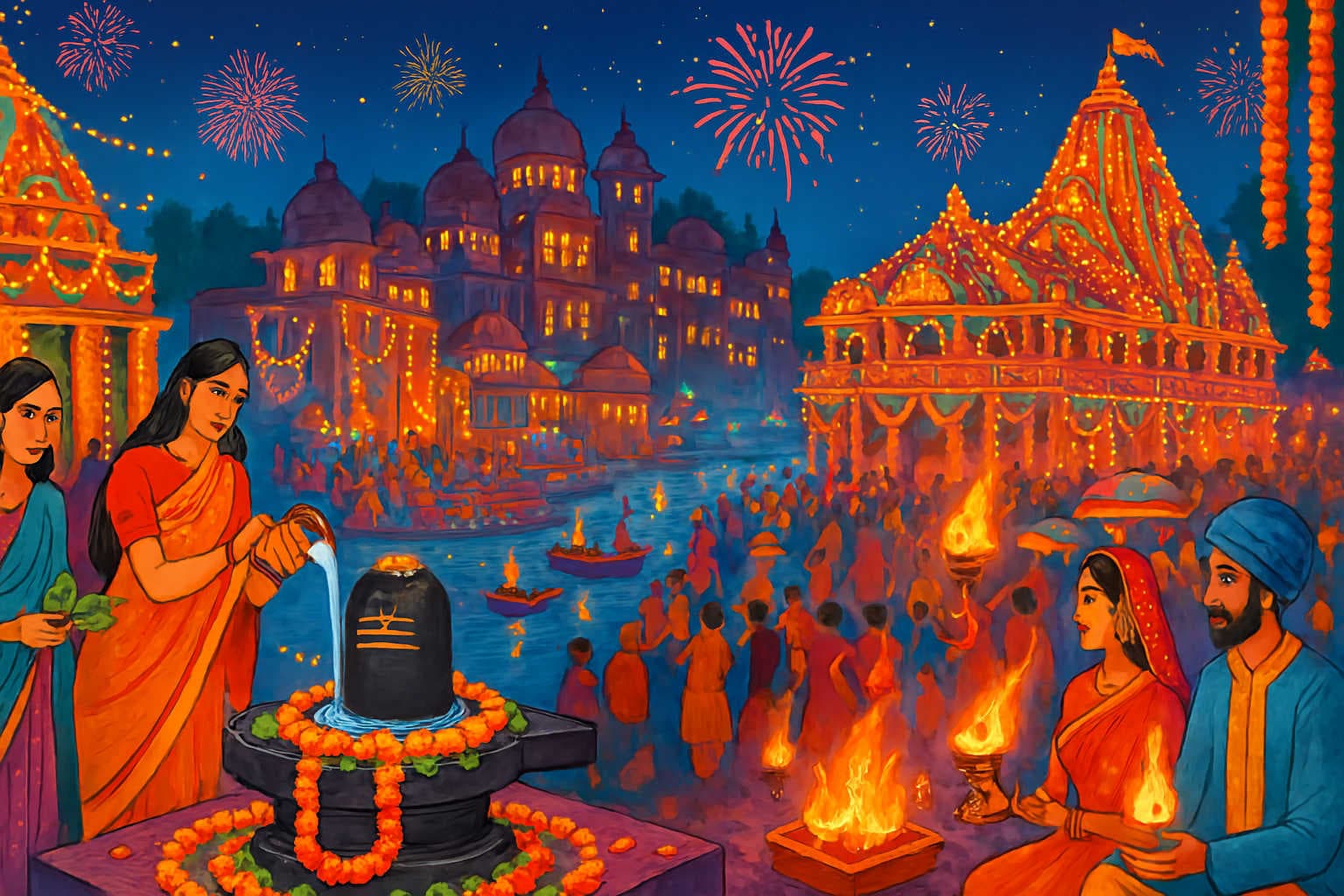
Celebration of Mahashivratri in Different States
Mahashivratri, meaning “The Great Night of Shiva,” is one of the most important Hindu festivals dedicated to Lord Shiva. Observed on the 14th night of the dark fortnight in the month of Phalguna (February–March), it is a time of fasting, night-long vigils, chanting, and deep devotion. While the essence of Mahashivratri is the same across India—honoring Lord Shiva—the way it is celebrated differs from state to state, highlighting the cultural richness of the country.
Let’s take a journey across India to see how Mahashivratri comes alive in different regions.
1. Varanasi, Uttar Pradesh – The City of Shiva
Varanasi, regarded as the spiritual capital of India, celebrates Mahashivratri with unmatched grandeur.
-
Devotees throng the Kashi Vishwanath Temple, one of the most sacred shrines of Shiva.
-
Ganga ghats are lit with diyas, and people observe fasting and night-long chanting of “Har Har Mahadev.”
-
A grand procession of Lord Shiva and Goddess Parvati is carried through the streets, drawing thousands of devotees.
Varanasi’s Mahashivratri is a mix of ritual purity and cultural festivity, making it an unforgettable experience.
2. Ujjain, Madhya Pradesh – Mahakaleshwar’s Sacred Night
The Mahakaleshwar Temple, one of the twelve Jyotirlingas, is the focal point of Mahashivratri in Ujjain.
-
The temple is decorated with flowers and lights, and the atmosphere reverberates with Shiva chants and bhajans.
-
The famous Bhasma Aarti, performed with sacred ash, holds special significance on this night.
-
Thousands of devotees participate in night-long worship, with rituals continuing until dawn.
In Ujjain, Mahashivratri is seen as a time to seek liberation and blessings from the powerful Mahakaleshwar Jyotirlinga.
3. Somnath, Gujarat – Shiva’s Coastal Abode
The Somnath Temple, another Jyotirlinga located on the coast of Gujarat, celebrates Mahashivratri with grandeur.
-
Devotees observe fasts and perform abhishekam with milk, honey, and ghee throughout the night.
-
Cultural programs, devotional music, and fairs take place near the temple.
-
Pilgrims from across India visit Somnath during this period, turning it into a hub of faith and festivity.
Here, the festival reflects Shiva’s role as protector of dharma and the cosmic order.
4. Jammu & Kashmir – Herath Shivratri
In Kashmir, Mahashivratri is known as Herath, celebrated with unique traditions.
-
Kashmiri Pandits prepare a special dish called watak pooja thali, which includes fish, walnuts, and rice.
-
The day involves family rituals, worship at home, and distribution of walnuts as prasad.
-
Unlike other regions, Herath is often celebrated a day earlier, reflecting ancient lunar calculations.
For Kashmiri Hindus, Shivratri is not just about temple worship but also about family unity and cultural continuity.
5. Tamil Nadu – Shivaratri at Chidambaram and Thanjavur
In South India, Mahashivratri takes on a spiritual and musical tone.
-
At the Chidambaram Nataraja Temple, the cosmic dance of Shiva is celebrated with devotional music and dance performances.
-
Temples remain open all night for darshan, and devotees chant “Om Namah Shivaya” continuously.
-
Fasts and abhishekam with sacred bilva leaves form the central part of the rituals.
In Tamil Nadu, Mahashivratri highlights Shiva’s aspect as Nataraja, the cosmic dancer, and the festival becomes an artistic as well as spiritual experience.
6. Karnataka – Night-long Bhajans and Devotion
In Karnataka, especially in Murudeshwar and other Shiva temples, the festival is marked with grandeur.
-
Temples organize night-long bhajan sessions, discourses, and abhishekam rituals.
-
Devotees stay awake all night, singing devotional songs and narrating stories of Shiva.
-
Fairs and processions are also held in smaller towns and villages.
Here, Mahashivratri is seen as a night of communal devotion and spiritual awakening.
7. Andhra Pradesh & Telangana – Lingodbhava Rituals
In this region, Mahashivratri is observed with the sacred Lingodbhava puja, symbolizing Shiva’s infinite form.
-
Temples like Srisailam Mallikarjuna Temple see lakhs of devotees.
-
Night-long rituals include special decorations of the Shiva Lingam with flowers and lamps.
-
Fasting, abhishekam, and recitation of Shiva Purana form the core of the worship.
The festival here emphasizes Shiva as the eternal light and cosmic energy.
Spiritual Meaning of Mahashivratri
Across states, the essence of Mahashivratri remains the same:
-
Overcoming darkness and ignorance through devotion.
-
Fasting and meditation to purify the mind and body.
-
Night-long vigil representing spiritual awakening.
-
Celebrating the cosmic marriage of Shiva and Parvati, symbolizing the union of consciousness and energy.
Conclusion
The celebration of Mahashivratri across different states of India beautifully reflects the diversity of Hindu traditions while uniting devotees in their love for Lord Shiva. From the grand processions of Varanasi to the serene vigils in Tamil Nadu, from Kashmiri Herath rituals to the musical bhajans of Karnataka, each region adds its own flavor to the universal message of Mahashivratri—the victory of light over darkness, devotion over ego, and truth over ignorance.
This diversity in unity is what makes Mahashivratri one of the most cherished and widely celebrated festivals of India.