Bhai Dooj vs Raksha Bandhan – What’s the Difference?
In India, the bond between brothers and sisters is celebrated with great enthusiasm through many festivals. Among them, Raksha Bandhan and Bhai Dooj stand out as two of the most prominent occasions. At first glance, they may seem similar—both honor the sibling relationship, involve rituals, and include exchange of gifts. However, they are celebrated in different ways, at different times of the year, and with slightly different cultural and spiritual meanings.
In this article, we’ll explore the similarities and differences between Bhai Dooj and Raksha Bandhan, helping you understand why both are equally cherished in Indian families.
Raksha Bandhan – A Bond of Protection
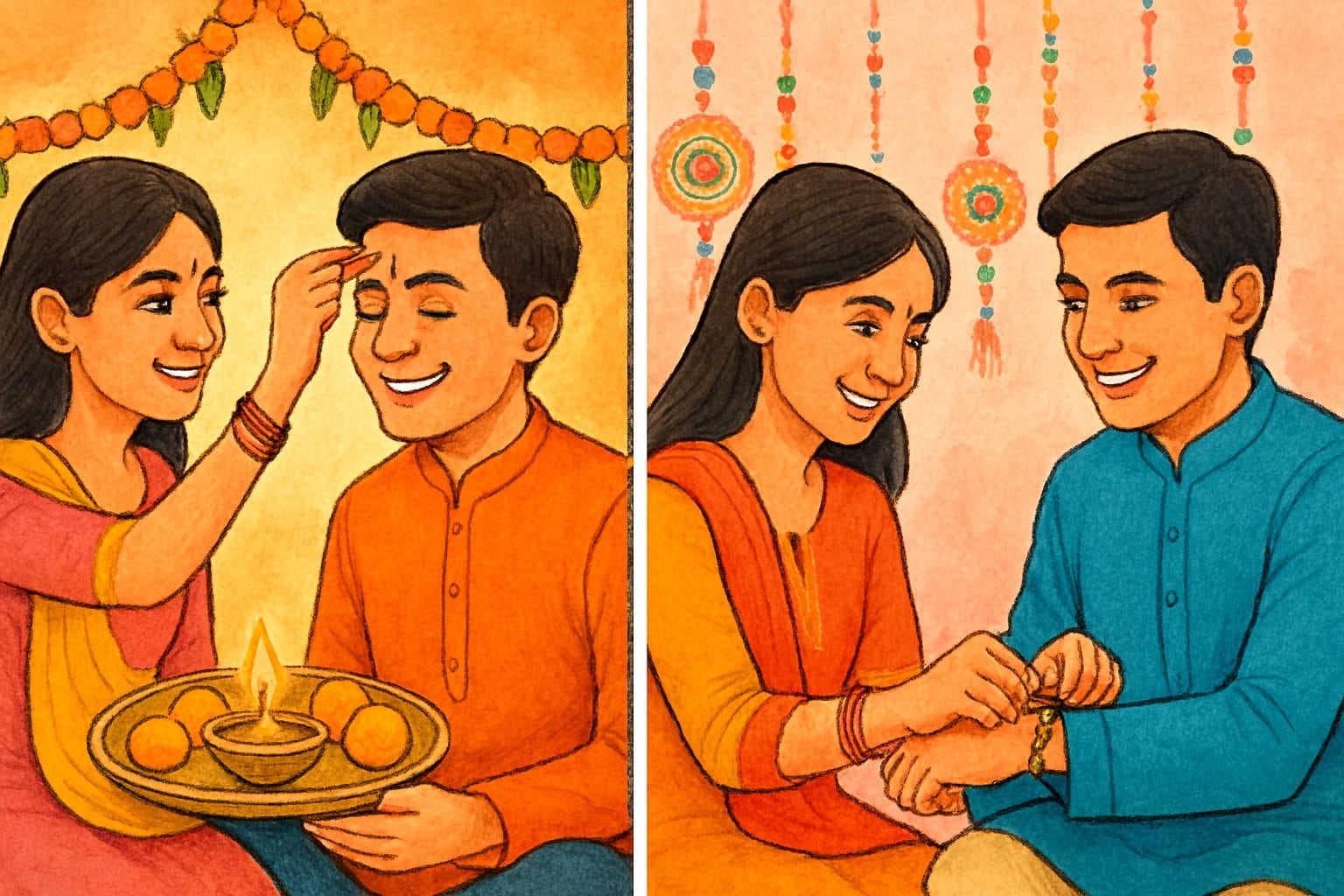
Raksha Bandhan, popularly called Rakhi, is celebrated on the full moon day of Shravan month (July–August). On this day, sisters tie a decorative thread, known as a rakhi, around their brothers’ wrists. This thread symbolizes her love, prayers, and wishes for his well-being. In return, the brother promises to protect her throughout life and often gives her gifts.
Mythological Roots of Raksha Bandhan
Several stories highlight the origins of this festival:
-
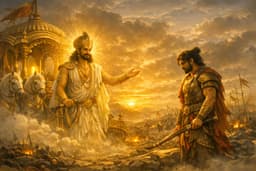
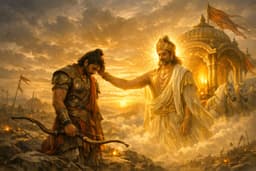
Draupadi and Krishna – When Krishna injured his finger, Draupadi tore her sari and tied it to his wound. Krishna, touched by her act, promised to protect her forever.
-
Rani Karnavati and Emperor Humayun – According to folklore, Queen Karnavati of Mewar sent a rakhi to Emperor Humayun seeking protection, which he honored.
Thus, Raksha Bandhan emphasizes the brother’s duty to protect his sister, while also celebrating their bond of affection.
Bhai Dooj – A Ritual of Blessings
Bhai Dooj is observed on the second day after Diwali (Shukla Paksha of Kartik month, October–November). Unlike Raksha Bandhan, here the ritual centers around a sister applying a tilak (vermilion mark) on her brother’s forehead, performing aarti, and praying for his long and prosperous life. The brother, in turn, showers his sister with gifts and blessings.
Legend Behind Bhai Dooj
The most popular story is about Yamraj (the god of death) and his sister Yamuna. According to the tale, Yamuna invited her brother to her home and performed aarti for his well-being. In return, Yamraj granted her a boon that any brother who visits his sister on this day will live a long, healthy life. Hence, the festival came to be known as Bhai Dooj.
This festival, therefore, highlights the sister’s prayers and blessings for her brother’s longevity and happiness.
Key Differences Between Bhai Dooj and Raksha Bandhan
Although both festivals celebrate sibling love, the rituals and symbolism differ:
| Aspect | Raksha Bandhan | Bhai Dooj |
|---|---|---|
| Date of Celebration | Full moon of Shravan month (July–August) | Second day after Diwali (Kartik Shukla Dwitiya, Oct–Nov) |
| Main Ritual | Sister ties a rakhi on brother’s wrist | Sister applies tilak on brother’s forehead and performs aarti |
| Symbolism | Brother’s promise to protect sister | Sister’s prayers for brother’s long life and prosperity |
| Mythological Reference | Draupadi-Krishna, Karnavati-Humayun | Yamraj and Yamuna |
| Season | Monsoon | Post-Diwali autumn |
| Exchange of Gifts | Brother gives gifts after receiving rakhi | Brother gives gifts after the tilak ceremony |
Similarities Between the Two Festivals
Despite differences, Raksha Bandhan and Bhai Dooj share some common aspects:
-
Both celebrate the sacred bond between brothers and sisters.
-
Both include rituals where the sister expresses love, care, and prayers.
-
Both involve gift exchanges and family gatherings.
-
Both strengthen family unity and remind siblings of their duties towards one another.
Cultural Variations Across India
-
In Maharashtra and Goa, Bhai Dooj is known as Bhau Beej. Sisters invite their brothers for a meal, symbolizing hospitality and love.
-
In West Bengal, it is called Bhai Phonta. Elaborate rituals are performed, and sisters fast until the tilak ceremony.
-
Raksha Bandhan, on the other hand, is widely celebrated across North India, but in some states, even sisters tie rakhis to cousins, friends, and soldiers as a gesture of love and protection.
Why Both Festivals Are Important
Together, Raksha Bandhan and Bhai Dooj provide two different perspectives on sibling relationships:
-
Raksha Bandhan highlights the protective role of the brother.
-
Bhai Dooj emphasizes the blessings and prayers of the sister.
In this way, they complement each other—one showing strength and protection, the other showing care and prayers. Both festivals remind us that the sibling bond is built on mutual love, duty, and lifelong support.
Conclusion
While Raksha Bandhan and Bhai Dooj may seem similar at first, each carries its own unique rituals, legends, and emotional expressions. Raksha Bandhan is about the rakhi and the brother’s vow of protection, whereas Bhai Dooj is about the tilak and the sister’s blessings for her brother’s well-being.
Together, they create a complete circle of love and duty between siblings. In celebrating both, Indian families reaffirm the strength of family ties, ensuring that love and protection flow both ways.
So, whether it is tying a rakhi in August or applying tilak after Diwali, both festivals continue to nurture one of the most beautiful relationships in the world—the bond between brothers and sisters.