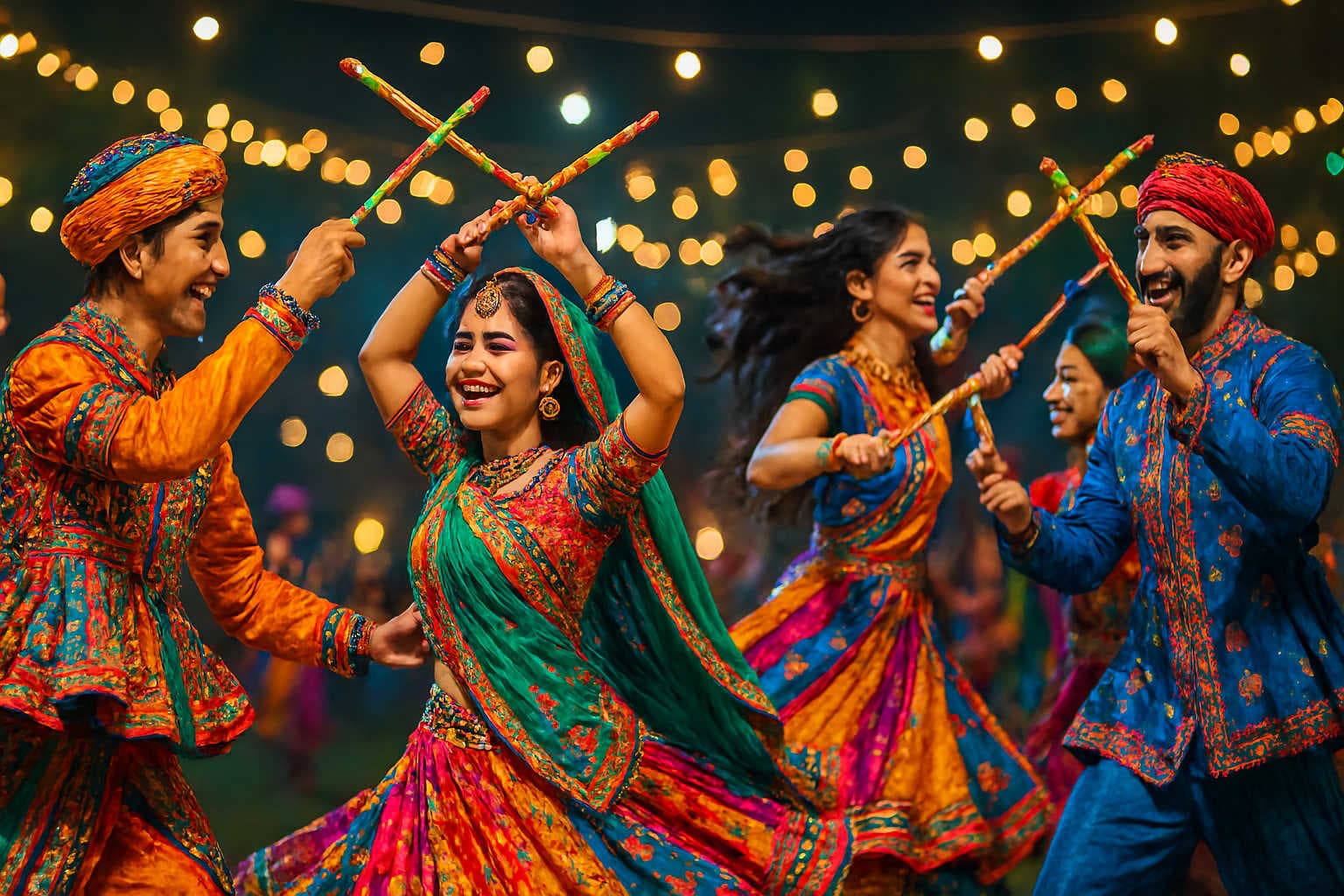
Garba and Dandiya – Dance of Devotion in Navratri
Navratri, the nine-night festival dedicated to Goddess Durga, is not only a time of prayer and rituals but also a celebration of culture, music, and dance. Among its most colorful and energetic traditions are Garba and Dandiya Raas, folk dances from Gujarat that have now gained immense popularity across India and the world.
These dances are more than just joyful expressions—they are acts of devotion, bringing communities together in honor of the Divine Mother.
Origins of Garba and Dandiya
Garba derives its name from the Sanskrit word Garbha (womb) and Deep (lamp). Traditionally, it is performed around a clay pot with a lit lamp inside, symbolizing the source of life and the divine energy of the Goddess.
Dandiya Raas, on the other hand, is believed to represent the mock fight between Goddess Durga and the demon Mahishasura, using decorated sticks to symbolize the Goddess’s weapons.
Historically, these dances were part of temple rituals in Gujarat, but over time, they evolved into vibrant community celebrations.
Garba – The Dance of the Womb
In its purest form, Garba is a circular dance performed around the garbha deep, representing the eternal cycle of life—birth, preservation, and death—under the watch of the Goddess.
-
Movements are rhythmic and graceful, involving claps, twirls, and steps in sync with devotional songs.
-
Attire is a feast for the eyes: women wear chaniya choli adorned with mirrors and embroidery, while men wear kediyu and pyjama or dhotis.
-
Music is typically performed live, with traditional instruments like the dhol, harmonium, and cymbals, accompanied by folk singing in Gujarati.
Garba is performed before the aarti during Navratri, as a way to prepare the mind and body for worship.
Dandiya Raas – The Dance of Sticks
Dandiya is more energetic and structured, performed after the Garba session.
-
The sticks, called dandiyas, are brightly decorated with ribbons or mirrors.
-
Dancers form two circles, moving in opposite directions, tapping sticks in rhythm with a partner before moving to the next.
-
The tempo increases as the night progresses, creating a sense of joyous fervor.
In traditional lore, the Dandiya Raas symbolizes the battle between good and evil, with the clashing of sticks representing the destruction of negative forces.
Spiritual Significance
Though now celebrated with grandeur, Garba and Dandiya remain rooted in devotion:
-
Circular movements represent the cyclical nature of the universe, with the Goddess at the center as the source of creation.
-
Rhythmic dancing creates a meditative state, allowing participants to connect spiritually while celebrating.
-
Community gathering fosters unity, breaking down social barriers in shared worship.
In essence, these dances blend physical activity, cultural identity, and spiritual devotion.
Modern Garba and Dandiya Nights
While village Garba retains its simplicity, urban and international versions have become massive events with:
-
Live bands and DJs mixing traditional folk tunes with Bollywood beats.
-
Light shows, decorated stages, and themed dress codes.
-
Dance competitions attracting participants of all ages.
Cities like Ahmedabad, Vadodara, and Surat are famous for hosting grand Garba nights that last till dawn, drawing thousands of dancers. Similarly, in the US, UK, and Canada, Indian communities organize Garba and Dandiya events, keeping the tradition alive overseas.
Etiquette and Rules for Participation
Even though it’s festive, Garba and Dandiya have certain traditions to maintain their sanctity:
-
Always dance in a clockwise direction around the central lamp or image of the Goddess.
-
Wear traditional attire to respect the cultural roots of the dance.
-
Maintain the rhythm and avoid pushing or crowding other dancers.
-
Use decorated sticks, and never strike too hard.
Benefits Beyond Celebration
Participating in Garba and Dandiya offers more than spiritual joy:
-
Physical exercise – The energetic steps and twirls are a full-body workout.
-
Stress relief – The music and movement act as a natural mood booster.
-
Cultural preservation – Keeping alive a centuries-old tradition in modern times.
-
Social bonding – Strengthening community ties through shared celebration.
Conclusion
Garba and Dandiya are not merely dances—they are a fusion of devotion and joy, where each step, clap, and twirl honors the Goddess and celebrates life itself. Whether performed in a small village courtyard or under dazzling city lights, the spirit remains the same: gratitude, unity, and the triumph of good over evil.
As the beats of the dhol fill the air this Navratri, remember that when you join the circle, you are part of a tradition that has spun for generations—one that will keep dancing forward for many more.