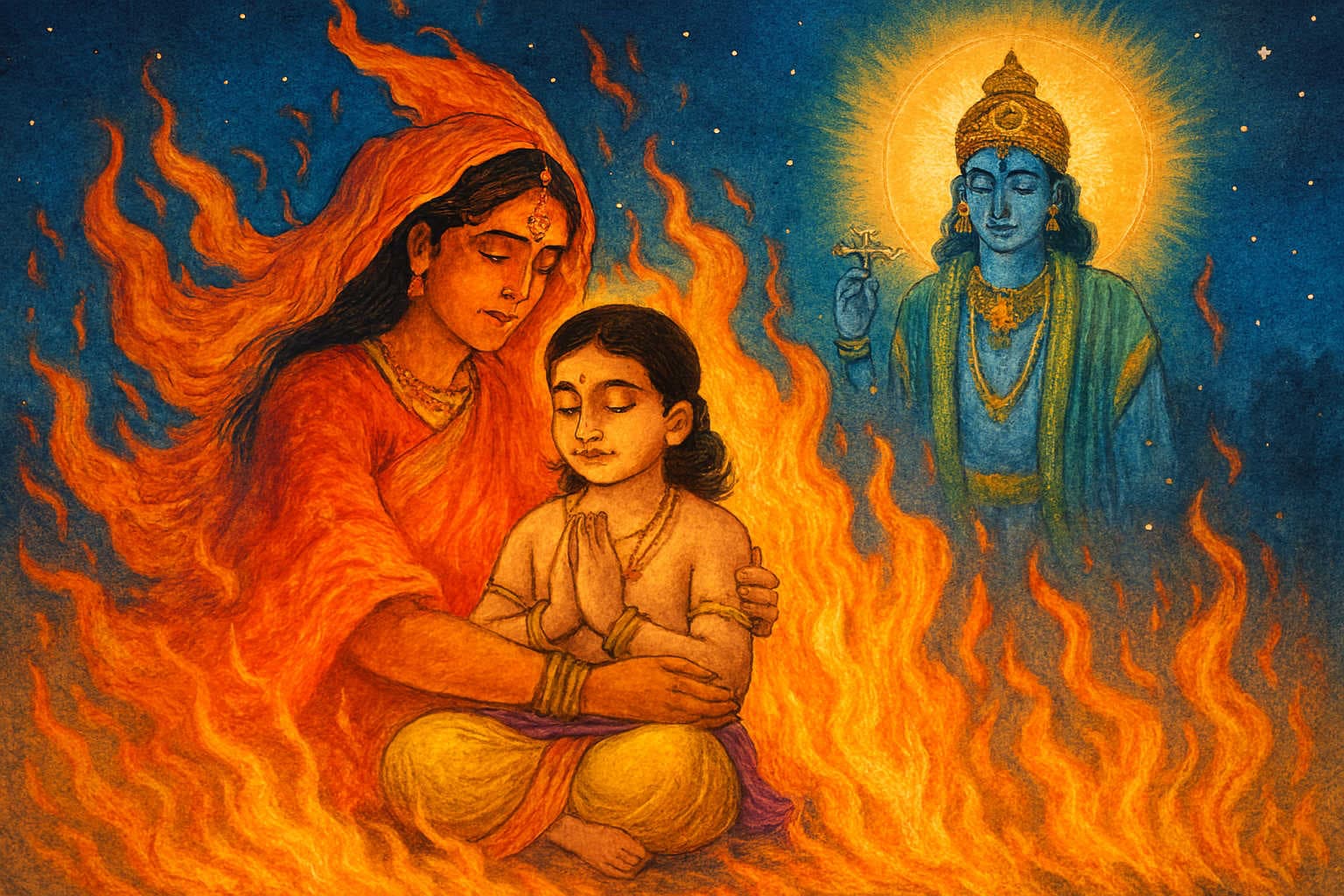
Why We Burn Holika on Holi Eve – Story of Prahlad
Holi, the festival of colors, is one of the most vibrant and joyous celebrations in India. But before the colored powders fly and water balloons burst, the night before Holi holds a solemn and deeply symbolic ritual—Holika Dahan. On this night, large bonfires are lit in streets and courtyards across the country, symbolizing the victory of good over evil.
The origin of this tradition lies in the ancient story of Prahlad and Holika, a tale of faith, devotion, and divine justice.
The Story Behind Holika Dahan
The Tyrant King Hiranyakashipu
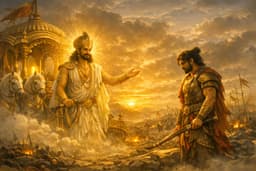
Long ago, in a time described in Hindu scriptures, there lived a powerful demon king named Hiranyakashipu. Through intense penance, he received a boon from Lord Brahma that made him nearly invincible—no man or beast, no weapon, no day or night, inside or outside, could kill him.
With this arrogance, Hiranyakashipu declared himself to be God and demanded that everyone in his kingdom worship him. Anyone who dared to pray to other deities faced severe punishment.
Prahlad – The Devoted Son
Ironically, the king’s own son, Prahlad, was a devoted follower of Lord Vishnu. From a young age, Prahlad would chant Vishnu’s name and spend his time in worship.
This enraged Hiranyakashipu, who saw his son’s devotion to Vishnu as a personal insult. He tried many times to convince Prahlad to abandon his faith, but Prahlad refused, saying:
“Lord Vishnu is the protector of the universe. I can never forsake Him.”
Holika’s Deadly Plan
Hiranyakashipu’s sister, Holika, possessed a magical shawl that made her immune to fire. Seeing no other way to break Prahlad’s devotion, the king devised a cruel plan—Holika would sit in a blazing fire with Prahlad on her lap, using her fire-proof garment to survive while the boy burned.
Confident in their victory, they lit the pyre. Holika sat in the flames with Prahlad, who prayed calmly to Vishnu.
Divine Intervention
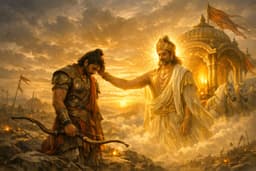
But the plan did not go as expected. By the grace of Lord Vishnu, the magical shawl flew off Holika and wrapped around Prahlad instead. Holika, unprotected, was consumed by the flames, while Prahlad emerged unharmed.
Holika’s death symbolized the destruction of arrogance and evil, while Prahlad’s survival proved the power of unwavering devotion and righteousness.
Holika Dahan – The Symbolism
The burning of Holika is not just a retelling of an old myth—it carries deep spiritual meaning:
-
Victory of good over evil – Evil may seem powerful, but truth and righteousness ultimately prevail.
-
Faith over fear – Prahlad’s unshakable belief in Vishnu protected him against impossible odds.
-
Karma’s justice – Holika misused her gift, and it became the cause of her downfall.
Holika Dahan Rituals Across India
On the eve of Holi, communities gather to recreate the symbolic burning of Holika:
-
Collecting the Wood – Days before the festival, people gather wood, dried leaves, and combustible materials to build a large pyre.
-
Creating the Effigy – An effigy of Holika, sometimes along with a child figure representing Prahlad, is placed atop the pyre.
-
The Lighting Ceremony – At sunset, after performing prayers, the pyre is set alight amidst chanting, singing, and dancing.
-
Parikrama (Circumambulation) – Devotees walk around the fire, seeking blessings for protection from evil and misfortune.
-
Ash as a Blessing – Some take a small portion of the cooled ash home, believing it brings good luck.
Regional Variations
While Holika Dahan is celebrated across India, each region adds its own unique flavor:
-
Punjab – Known as Holika Dehan, the ritual is often followed by dancing the Gidda and Bhangra.
-
Uttar Pradesh & Bihar – People sing folk songs narrating the story of Prahlad and Holika.
-
Odisha & Bengal – Holika Dahan coincides with Dol Jatra, dedicated to Lord Krishna.
-
Maharashtra – People call the next day Rang Panchami and focus more on the colors after the burning of Holika.
The Connection to Holi Colors
Holika’s story sets the stage for the joyful festival of colors the next day. The burning of the pyre symbolizes the destruction of negativity, clearing the way for a fresh start filled with joy, unity, and celebration.
In a spiritual sense, just as the fire purifies and protects Prahlad, the colors of Holi wash away divisions, bringing communities together.
Lessons from the Legend
The story of Prahlad and Holika is more than a festival origin—it’s a reminder for everyday life:
-
Stand firm in your beliefs – Even in the face of pressure, truth and faith give strength.
-
Power must be used wisely – Misusing gifts or power leads to self-destruction.
-
Evil is temporary – The flame of righteousness will always burn brighter than the darkness of wrongdoing.
Conclusion – A Fire That Inspires
Every year, when the bonfires of Holika Dahan light up the night sky, they remind us of an eternal truth—devotion, courage, and righteousness are indestructible.
The ashes of Holika’s pyre are not just remnants of a ritual; they are symbols of hope, renewal, and the eternal triumph of good over evil. And as the flames die down, they make way for the most colorful day of the year—Holi, where the spirit of joy reigns supreme.