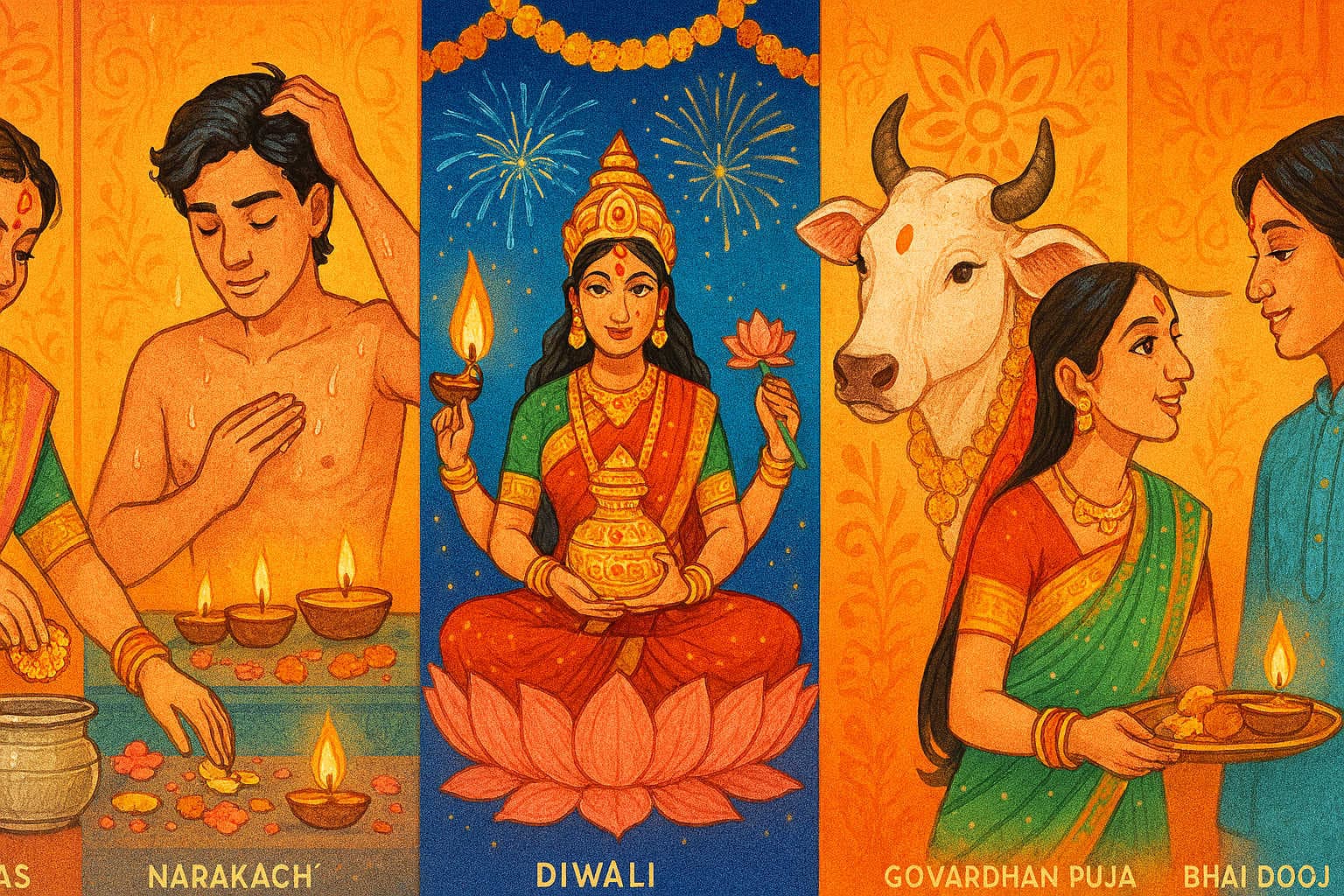
Why Diwali Lasts for 5 Days – Meaning of Each Day
Diwali, the Festival of Lights, is not just a single-day celebration—it unfolds over five consecutive days, each with its own unique customs, stories, and significance. While most people associate Diwali with the night of Lakshmi Puja and fireworks, the festival’s rich traditions span nearly a week, weaving together mythology, seasonal rituals, and cultural practices that have evolved over centuries.
Here’s a closer look at each of the five days of Diwali, their meaning, and the traditions observed.
Day 1 – Dhanteras: The Day of Wealth and Prosperity
The festival begins with Dhanteras, also called Dhanatrayodashi. The word "Dhan" means wealth, and "Teras" refers to the 13th lunar day of Krishna Paksha (dark fortnight) in the month of Kartik.
Significance
-
According to legend, on this day, the physician of the gods, Dhanvantari, emerged from the ocean during the Samudra Manthan carrying a pot of nectar, symbolizing health and longevity.
-
In another belief, purchasing gold, silver, or new utensils brings good fortune and wealth into the home.
Traditions
-
People clean and decorate their homes.
-
Diyas are lit at the entrance to ward off evil and invite prosperity.
-
Markets are crowded as families buy jewelry, metalware, or even new business tools.
Day 2 – Naraka Chaturdashi: Victory Over Darkness
The second day is known by different names across India—Naraka Chaturdashi, Kali Chaudas, or Chhoti Diwali.
Significance
-
It commemorates Lord Krishna’s victory over the demon Narakasura, who had imprisoned thousands of women. By defeating Narakasura, Krishna liberated them, symbolizing the triumph of light over deep darkness.
Traditions
-
People wake up before sunrise for a ritual oil bath, considered purifying and energizing.
-
Homes are decorated with rangoli, and the first set of diyas are lit in the evening.
-
In some regions, special sweets are prepared, and crackers are burst to celebrate the demon’s defeat.
Day 3 – Diwali: The Main Festival Night
The third day is the grand night of Diwali, also known as Lakshmi Puja. It falls on the Amavasya (new moon), the darkest night of the month—making the glow of diyas even more magical.
Significance
-
Marks the return of Lord Rama to Ayodhya after defeating Ravana, welcomed with rows of oil lamps.
-
Dedicated to Goddess Lakshmi, who is believed to visit homes that are clean, well-lit, and filled with positive energy.
Traditions
-
People wear new clothes and exchange sweets and gifts.
-
Lakshmi Puja is performed with offerings of flowers, sweets, and coins.
-
Rows of diyas are placed around the home, and fireworks light up the sky.
Day 4 – Govardhan Puja: Gratitude to Nature
The fourth day varies by region. In North India, it is Govardhan Puja; in Gujarat, it marks the start of the New Year according to the Vikram Samvat calendar.
Significance
-
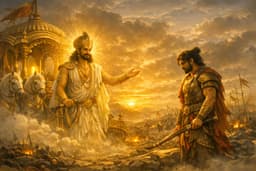
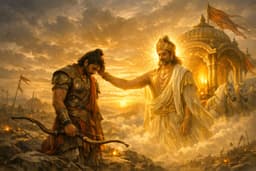
Celebrates the story from the Bhagavata Purana, where Lord Krishna lifted the Govardhan Hill to protect villagers from torrential rains sent by Indra, the rain god.
-
Symbolizes protection, humility, and gratitude toward nature’s bounty.
Traditions
-
In many households, small hill-like mounds made of cow dung or food are decorated to represent Govardhan.
-
Devotees prepare Annakut—a large variety of vegetarian dishes—to offer in temples.
-
Farmers and rural communities worship their cattle, recognizing them as essential to livelihood.
Day 5 – Bhai Dooj: Celebrating the Sibling Bond
The festival concludes with Bhai Dooj (also called Bhau Beej, Bhai Phota, or Bhai Tika in different regions).
Significance
-
Rooted in the story of Yamraj, the god of death, visiting his sister Yamuna. She welcomed him with aarti, tilak, and sweets, and he blessed her with long life and protection.
Traditions
-
Sisters pray for the well-being of their brothers and apply a ceremonial tilak on their foreheads.
-
Brothers give gifts to sisters as a token of love and appreciation.
-
Families gather for meals, making it a day of warmth and bonding.
Why the 5-Day Format Matters
Diwali’s five-day span is not just about extending the festivities—it reflects a cycle of cleansing, worship, gratitude, and relationships:
-
Cleansing and preparation (Dhanteras)
-
Spiritual and physical purification (Naraka Chaturdashi)
-
Welcoming divine blessings (Diwali Night)
-
Giving thanks to nature and community (Govardhan Puja)
-
Celebrating family bonds (Bhai Dooj)
This sequence reflects the essence of Hindu philosophy: harmony between spirituality, nature, and human relationships.
Regional Variations
While the essence is similar, different parts of India interpret and celebrate these five days uniquely:
-
Maharashtra: The sequence begins with Vasu Baras (cow worship) and ends with Tulsi Vivah.
-
West Bengal: Diwali coincides with Kali Puja rather than Govardhan Puja.
-
South India: Naraka Chaturdashi takes precedence over the Diwali Amavasya night.
Conclusion – A Festival of Many Layers
Diwali’s five days form a journey—from preparing the home and self, to honoring divine forces, to giving thanks for nature’s gifts, and finally celebrating human bonds. It’s a reminder that light takes many forms—prosperity, purity, protection, gratitude, and love—and each is essential for a truly illuminated life.
As diyas burn brightly across these five days, they do more than light up the night—they illuminate the human spirit.