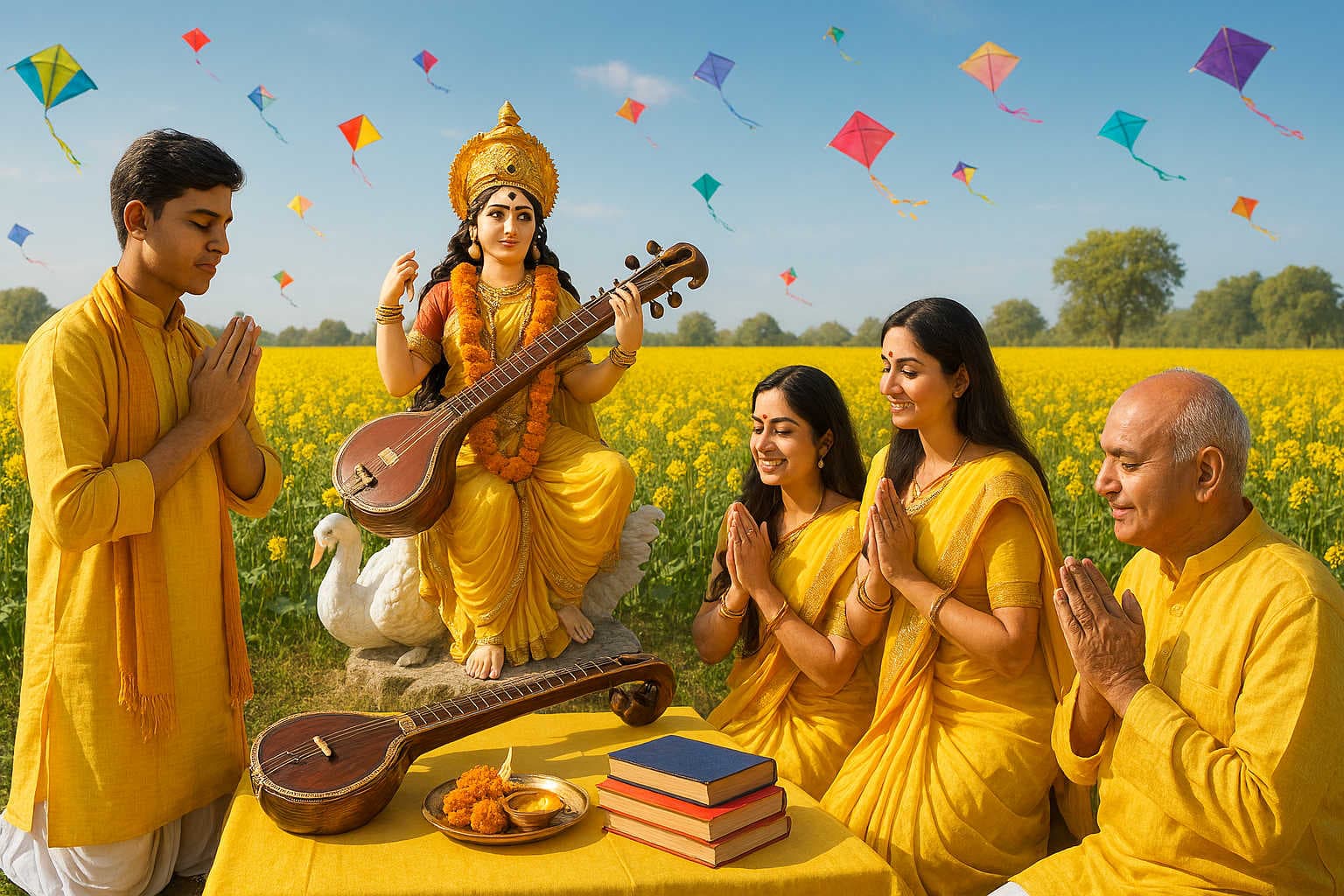
Basant Panchami – The Festival of Goddess Saraswati
When winter’s chill begins to fade and the first signs of spring paint the land in hues of gold and green, India celebrates Basant Panchami, a festival dedicated to Goddess Saraswati, the embodiment of wisdom, learning, and the arts. Falling on the fifth day (Panchami) of the bright fortnight of the month of Magha (January–February), Basant Panchami signals the seasonal shift toward warmth, blooming fields, and renewed energy.
This day holds deep cultural, spiritual, and seasonal significance, blending devotion with vibrant celebrations across the country.
🌼 The Goddess of Knowledge and the Essence of the Day
Goddess Saraswati, often depicted dressed in pure white, seated on a lotus or swan, holding a veena and scriptures, symbolizes the highest pursuit of human intellect—knowledge and wisdom. She is revered by students, artists, scholars, and seekers.
Basant Panchami is believed to be her birthday, and devotees honor her by performing Saraswati Puja, placing books, musical instruments, and tools of learning before her idol or image, and refraining from using them for the day as a sign of respect.
🪔 Rituals and Traditions
While customs vary by region, the spirit of devotion and joy is universal. Key rituals include:
-
Saraswati Puja – Idols or images of the goddess are decorated with yellow flowers, and offerings of fruits, sweets, and turmeric are made. Books and musical instruments are placed before her to be blessed.
-
Yellow as the Color of the Day – Yellow symbolizes energy, wisdom, and prosperity. Devotees dress in yellow attire, prepare yellow dishes like khichdi, kesari halwa, and boondi laddoo, and decorate homes with yellow flowers.
-
Flying Kites – In parts of North India, especially Punjab and Haryana, the sky fills with colorful kites, a joyful symbol of freedom and celebration of spring’s arrival.
-
Offering Mustard Flowers – In rural regions, mustard fields in full bloom are offered to the goddess, and their golden color becomes a central motif of the festival.
🌿 Regional Celebrations
-
West Bengal, Bihar & Odisha – Known as Saraswati Puja, it is celebrated in educational institutions with grandeur. Students organize cultural programs and decorate classrooms.
-
Punjab & Haryana – Farmers celebrate the onset of the sowing season and participate in kite flying competitions.
-
Rajasthan – Temples and homes are adorned with yellow flowers, and special halwa made from gram flour is prepared.
-
Uttar Pradesh – Devotees bathe in holy rivers like the Ganga and Yamuna before performing the puja.
-
Southern India – Though celebrated less prominently, it is still observed in some communities as a day of honoring learning and art.
📖 Mythological Significance
There are several legends associated with Basant Panchami:
-
Creation and Speech – According to one story, Brahma created the world but found it silent. He created Goddess Saraswati, who blessed humans with speech and knowledge, bringing life and communication to the world.
-
The Harvest Festival – In agrarian traditions, Basant Panchami marks the readiness of mustard crops, symbolizing abundance and fertility.
-
Kaamdev’s Worship – In some traditions, the day is associated with worshiping Kaamdev, the god of love, heralding the romantic energy of spring.
🧘 Spiritual Meaning
Basant Panchami goes beyond ritual—it is a celebration of clarity of mind and renewal of spirit. The yellow color represents light, learning, and life-giving energy, while Saraswati’s white attire symbolizes purity and detachment, reminding devotees to balance worldly pursuits with spiritual wisdom.
It also serves as a reminder that education is sacred, and the tools of learning—whether books, music, or skills—are blessings that deserve respect.
🍽️ Festive Foods
Food plays a delightful role in the celebrations. Common dishes include:
-
Kesari Halwa – Semolina pudding flavored with saffron and cardamom
-
Khichdi – Lentils and rice cooked together, often with turmeric for the signature yellow color
-
Sweet Boondi – Tiny fried gram flour balls soaked in sugar syrup
-
Pulao – Fragrant rice cooked with vegetables and turmeric
In rural areas, freshly harvested grains are used to prepare these offerings, symbolizing prosperity.
🌸 Basant Panchami and Spring’s Arrival
This festival is deeply linked to Ritu Parivartan—the change of seasons. The warmth of spring encourages new growth in nature, much like Saraswati’s blessings spark fresh growth in the human mind and heart. In many ways, Basant Panchami is nature’s way of reminding us that after every winter, there is a spring waiting to bloom.
🗺️ How to Experience Basant Panchami
If you wish to truly experience the festival:
-
Wear yellow attire and participate in Saraswati Puja at a local temple or school.
-
Visit mustard fields to enjoy the season’s beauty.
-
Try flying kites in open fields or terraces.
-
Prepare a yellow-themed festive meal at home.
-
Read or listen to stories of Goddess Saraswati and her significance in Indian culture.
✨ Why Basant Panchami is Special
Basant Panchami is more than a festival—it is a cultural and spiritual bridge between winter and spring, ignorance and knowledge, dormancy and creativity. It invites us to awaken our minds, embrace learning, and celebrate the beauty of life with joy and devotion.
In honoring Goddess Saraswati, we also honor the eternal truth that knowledge is the greatest wealth, one that grows the more we share it. As the mustard fields sway in the spring breeze and kites dance in the sky, Basant Panchami reminds us that wisdom and happiness are meant to soar.