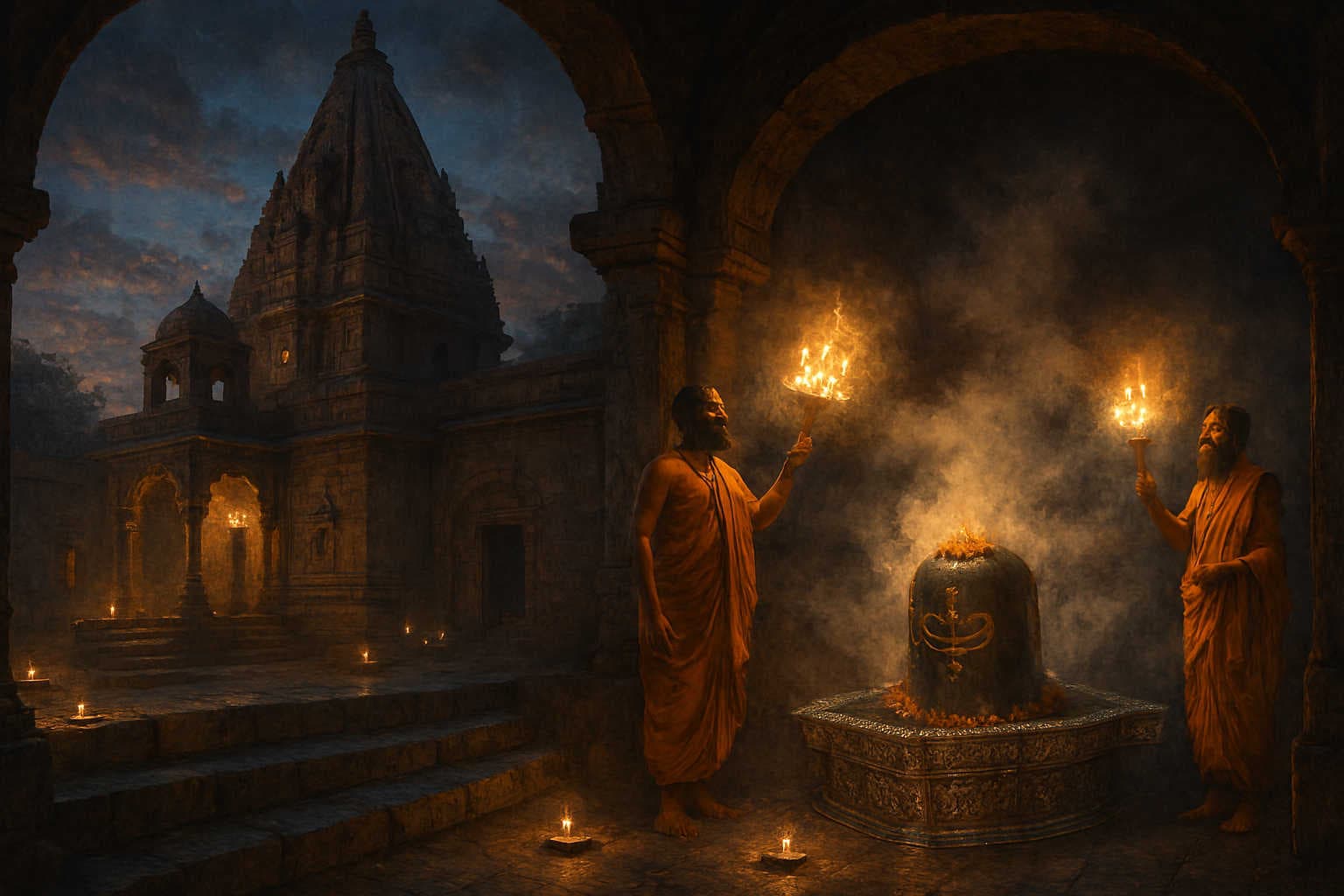
Mahakaleshwar – The Only South-Facing Jyotirlinga
Among the twelve Jyotirlingas scattered across India, each a powerful manifestation of Lord Shiva, the Mahakaleshwar temple in Ujjain, Madhya Pradesh, holds a unique place. It is the only Jyotirlinga that faces south, a direction traditionally associated with death and Yama (the god of death)—yet here, it symbolizes victory over death and the timeless power of Mahakal, the Lord of Time.
Nestled beside the Rudra Sagar Lake, the Mahakaleshwar temple isn’t just a place of worship—it is a portal to divine timelessness, where spiritual seekers feel the gravity of life, death, and the eternal presence of Shiva.
🌌 Mahakal – The Lord Beyond Time
The name Mahakaleshwar itself reveals the essence of this Jyotirlinga. “Mahakal” translates to the great destroyer of time. Shiva, in this form, transcends time, creation, and destruction. He is the supreme force that liberates souls from the cycle of birth and death.
According to Hindu mythology, the city of Ujjain was once ruled by a virtuous king named Chandrasena. A young boy named Shrikhar, inspired by the king’s devotion, began meditating on Shiva. When Ujjain was attacked by demons, Lord Shiva appeared as Mahakal, destroyed the invaders, and decided to stay in the city in the form of a Jyotirlinga.
What sets this lingam apart is its Dakshinamukhi (south-facing) position—rare and powerful. South is associated with death in Hindu belief, and Mahakaleshwar, facing that very direction, is believed to guard devotees from untimely death and grant moksha.
🛕 A Temple Steeped in Antiquity
The Mahakaleshwar temple complex reflects a blend of Bhumija, Chalukya, and Maratha architecture. With towering spires, intricate stone carvings, and the sacred Garbhagriha (inner sanctum) underground, the entire space radiates ancient sanctity.
The original structure is believed to be over a thousand years old, though it has been rebuilt and renovated several times, especially during the Maratha period under Rani Ahilyabai Holkar.
Inside the temple, the Shiva lingam sits lower than the ground level, representing humility and grounding energy. The sanctum is filled with the sound of conch shells, bells, and Vedic mantras, as pilgrims offer milk, flowers, and sacred ash to the lord.
🔥 The Bhasma Aarti – A Ritual Like No Other
What truly distinguishes Mahakaleshwar is the world-famous Bhasma Aarti—a sacred ritual performed at 4 a.m. every morning, where the Shiva lingam is worshipped with ashes from a funeral pyre.
This stark, mystical ceremony symbolizes the impermanence of life, the burning away of ego, and the journey toward the eternal. Only at Mahakaleshwar is such an offering accepted by the deity.
Devotees gather in the temple before dawn, clothed in silence and reverence, to witness the spectacle of priests adorned in dhotis, chanting ancient hymns while smearing ash over the lingam. It’s not just a ritual—it’s an awakening.
🧘♂️ Spiritual Significance and Pilgrimage
Ujjain, where the temple stands, is itself one of the seven Moksha-puris—sacred cities that can grant liberation. The Shipra River, which flows nearby, is believed to be infused with spiritual energy, especially during the Kumbh Mela, which Ujjain hosts every twelve years.
Pilgrims often combine their Mahakaleshwar visit with darshan at other important temples like:
-
Kal Bhairav Temple – another fierce form of Shiva.
-
Harsiddhi Temple – a Shakti Peeth.
-
Mangalnath Temple – considered the birthplace of Mars.
The entire city breathes devotion. Walking through its ghats and alleys is like traveling back in time, where every chant and every step leads you closer to the cosmic consciousness.
🗓️ Festivals and Celebrations
The temple experiences a surge of devotees during:
-
Mahashivaratri – a day dedicated to Shiva, celebrated with great fervor and all-night vigils.
-
Nitya Yatra – a special pilgrimage circuit in Ujjain involving darshan at multiple temples, starting and ending at Mahakaleshwar.
-
Shravan Maas – the holy month dedicated to Shiva, with daily processions and bhajans.
-
Kartik Purnima – when the temple is lit with thousands of diyas.
Each festival reinforces the idea that Shiva is not just a god to be worshipped but a presence to be felt.
🧭 Practical Information for Visitors
-
Timings: 3:00 AM to 11:00 PM daily (Bhasma Aarti requires prior registration and strict dress code)
-
Best Time to Visit: Between October and March for pleasant weather and festive atmosphere
-
Dress Code: Traditional Indian attire preferred; men must wear dhotis for Bhasma Aarti
-
Location: Ujjain, Madhya Pradesh – well-connected by road, rail, and nearby Indore airport
🔱 Why Mahakaleshwar Matters Today
In an age driven by speed, distractions, and uncertainty, Mahakaleshwar reminds us of what is eternal, what is real, and what is beyond time. It is not just a temple but a mirror for the soul, showing us that death is not the end, but a return to the cosmic source.
The south-facing Shiva here doesn’t look into darkness—He faces it and transcends it. For those who seek strength, clarity, and spiritual transformation, Mahakaleshwar is a gateway to inner stillness and timeless wisdom.