Ravana’s End – The Triumph of Dharma
In the timeless epic of the Ramayana, one of the most powerful and climactic moments is the final battle between Lord Rama and Ravana. It is not just a fight between two warriors—it is a cosmic confrontation between dharma (righteousness) and adharma (unrighteousness). The death of Ravana marks not only the end of a tyrant’s reign, but also the victory of truth, humility, and duty over ego, pride, and desire.
Let us explore this defining moment and understand its deeper meaning in the spiritual and moral fabric of Indian tradition.
🔥 Ravana – The Scholar King Gone Astray
Ravana, the mighty king of Lanka, was no ordinary villain. He was a brilliant scholar, a powerful devotee of Lord Shiva, and a master of weapons, astrology, and the Vedas. His ten heads symbolized his vast knowledge and capabilities.
Yet, it was his ego and unchecked desires that led him to fall from grace. His decision to abduct Sita, Rama’s wife, was not born of love but of possessiveness and arrogance—the belief that he was above the laws of dharma.
This hubris set the stage for his confrontation with Lord Rama, the embodiment of virtue and restraint.
⚔️ The Final Battle Begins
The battle between Rama and Ravana took place in Lanka, amidst the ruins of a long and brutal war. Rama’s army, led by Hanuman, Sugriva, Jambavan, and the Vanaras, had breached Lanka’s defenses. Ravana had lost his most powerful generals, including Kumbhakarna and Meghnath (Indrajit).
Even then, Ravana stood defiant.
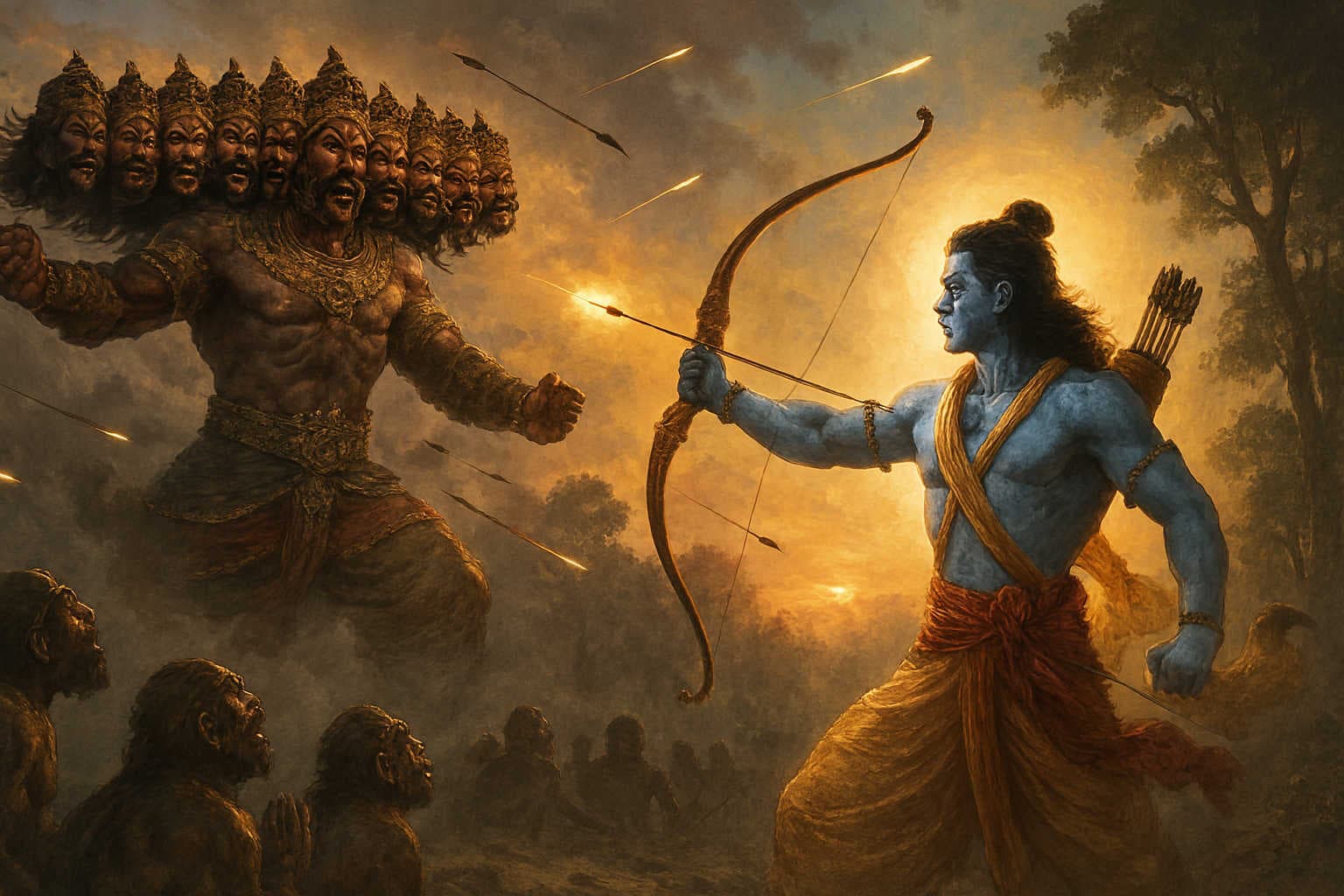
As the two armies prepared for the final clash, the world watched with bated breath. Rama, calm and radiant with divine energy, stood with his bow Kodanda. Ravana, fierce and fiery, towered with his ten heads and multiple weapons blazing.
🏹 A Battle of Arrows and Ideals
The duel between Rama and Ravana was more than just physical combat. It was a battle of ideals. Ravana launched powerful astras (celestial weapons), invoking dark energies, illusions, and chaos. Rama countered them with clarity, control, and divine force.
At times, Ravana multiplied himself through illusions, only to be pierced by Rama’s vision of truth. He hurled the Nagapasha (serpent noose), but Rama cut through it. His chariot shone with arrogance, while Rama’s shone with humility and divine grace.
Each arrow fired by Rama seemed not only to wound Ravana’s body but break down layers of his ego.
🧠 Symbolism of the Ten Heads
Ravana’s ten heads are rich in symbolism. They represent his ten qualities or desires—lust, anger, greed, attachment, pride, jealousy, selfishness, injustice, cruelty, and ego.
In Rama’s battle against Ravana, each head that was severed symbolized the destruction of a vice. Yet the heads kept returning—until the central core of ego was finally pierced by Rama’s ultimate arrow.
🕉️ The Brahmastra – The Final Arrow
As the battle neared its end, Rama invoked the Brahmastra, a divine weapon gifted by Lord Brahma. He prayed with full concentration and compassion—not out of hatred, but out of duty to uphold dharma.
With a deep breath, Rama released the arrow. It traveled with divine light, cutting through Ravana’s armor and illusions, striking him in the heart. Ravana let out a final roar—not of defeat, but of release.
The tyrant fell.
💫 Ravana’s Final Moments
In his final moments, Ravana was no longer a demon—but a fallen soul who recognized the truth. He acknowledged Rama’s divinity and greatness. Rama, ever noble, instructed Lakshman to learn from Ravana in his dying moments, respecting the wisdom that still remained in him.
Thus, even in death, Ravana was granted dignity and spiritual closure. This is the beauty of the Ramayana—not just in slaying evil, but in redeeming even the fallen with respect and grace.
🌱 The Triumph of Dharma
Ravana’s death was not a celebration of war, but a reaffirmation of dharma:
-
That power without virtue leads to destruction.
-
That ego, even when masked by brilliance, cannot withstand humility.
-
That righteousness, even when slow or tested, always prevails.
Lord Rama stood not just as a warrior, but as an eternal symbol of restraint, duty, and selfless leadership.
🌸 The Return of Sita
After Ravana’s fall, Sita was brought back with honor. But even then, Rama did not simply accept her. He ensured her purity was tested in the fire (Agni Pariksha), not out of mistrust, but to uphold her dignity in the eyes of the world. This remains a debated and complex part of the story, but also shows the weight of upholding dharma as king and husband.
🌅 The Legacy of Ravana’s End
Even today, Ravana’s effigy is burned across India during Dussehra, symbolizing the triumph of good over evil. But we are also reminded to respect his knowledge and to understand that no one is beyond redemption.
Rama teaches us not to hate evil blindly, but to defeat it with clarity, purpose, and compassion.
🪔 Final Thoughts
The death of Ravana is not just a tale of conquest—it is a spiritual lesson for all. It shows that no amount of brilliance or power can protect one from the consequences of ego. And it teaches us that the greatest warrior is one who is ruled by conscience, not anger.
Lord Rama’s victory was not about domination, but about restoring cosmic balance. And that is why, even after millennia, we remember this story not as a war saga, but as a guide to living a life of dharma.