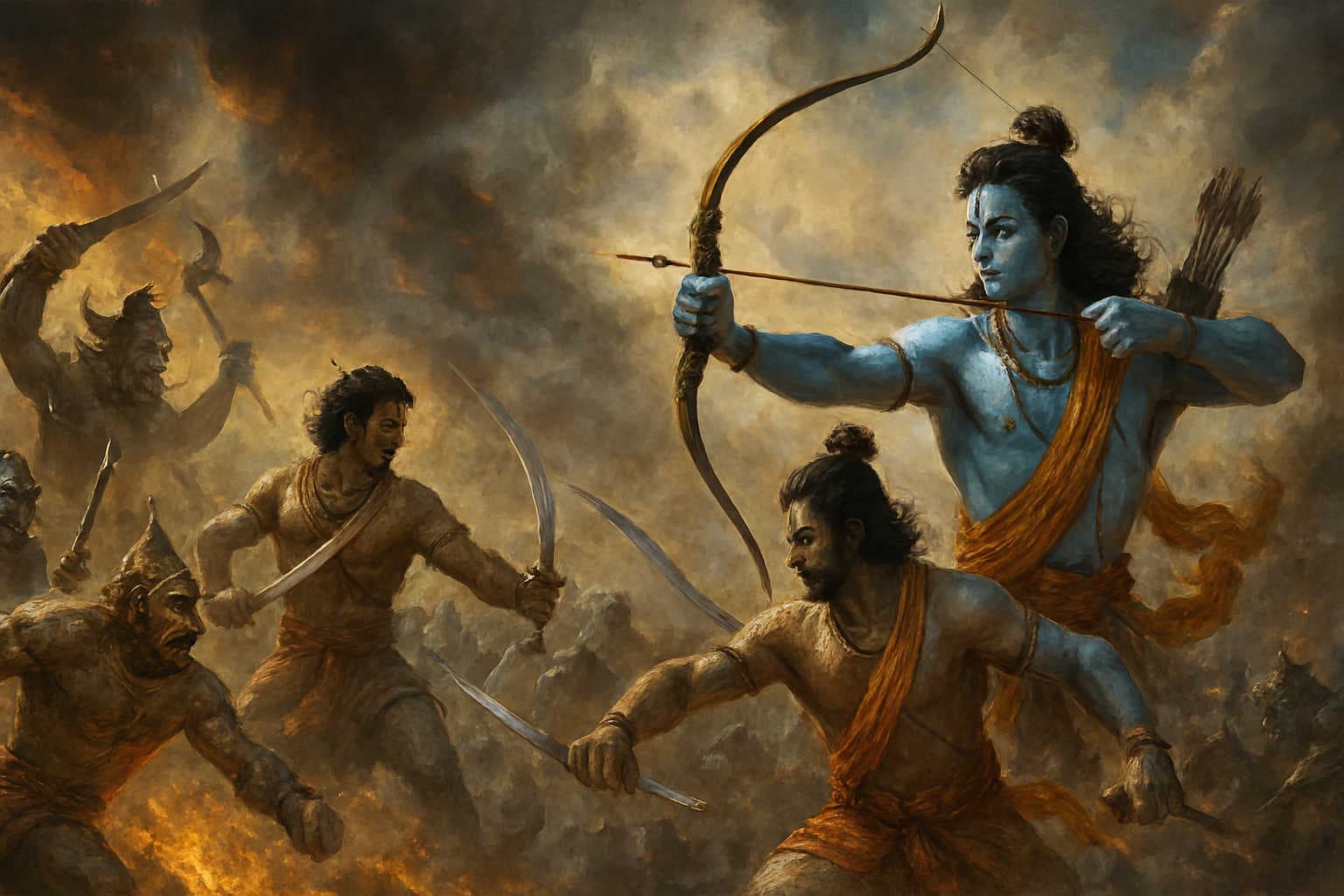
The War of Lanka – Vanar Sena vs Rakshasas
The War of Lanka stands as one of the most monumental and spiritually symbolic battles in Indian mythology. It was not just a physical confrontation but a divine clash between dharma and adharma, good and evil, light and darkness.
Fought between Lord Rama’s Vanar Sena (monkey army) and the Rakshasa army of Ravana, the battle encapsulates devotion, bravery, sacrifice, and divine intervention. It lasted for several days and involved numerous legendary warriors, celestial weapons, and heart-wrenching moments that defined the very soul of the Ramayana.
⚔️ The Stage is Set
After building Ram Setu and crossing into Lanka, Lord Rama, accompanied by Lakshman, Hanuman, Sugriva, and the massive Vanar Sena, set up camp outside the golden city of Lanka.
Ravana, having ignored all appeals to return Sita and uphold righteousness, prepared his army of powerful rakshasas, headed by warriors like Indrajit, Kumbhakarna, and Atikaya.
Both sides knew that this was a war of destiny—a decisive confrontation that would shape the future of the world.
🐒 The Vanar Sena: Army of Faith
The Vanar Sena was unlike any conventional army. Composed of monkeys and bears, led by the mighty Sugriva, Angad, Jambavan, and of course, the incomparable Hanuman, they were not trained soldiers—but they fought with devotion, courage, and loyalty.
Each vanara believed in the cause. For them, this was not just Rama’s fight—it was their dharma too. Their strength lay not only in physical power, but in selfless service and unwavering bhakti (devotion) to Lord Rama.
👹 Ravana’s Rakshasa Army: Power and Arrogance
Ravana’s forces were formidable. His warriors were trained in asura warfare, wielded dark magic, and possessed immense strength. He was joined by his sons Indrajit (Meghnad), who could become invisible, and his brother Kumbhakarna, a giant whose roar shook mountains.
But despite their power, the Rakshasas were consumed by arrogance and ego, led by a king whose pride blinded his wisdom.
🌪️ Day One – The Battle Begins
The war began with a thunderous roar. Monkeys clashed with demons. Trees and boulders were hurled like missiles. The skies darkened with dust and divine energy.
Angad, the son of Vali, led the first charge, challenging the mightiest of rakshasas. The Vanar Sena fought with raw strength, but what they lacked in weapons, they made up for in faith and tenacity.
🏹 Rama and Lakshman in Combat
Lord Rama used his divine bow and celestial arrows, invoking mantras to strike with precision. Every shot from Rama was charged with truth and righteousness.
Lakshman, too, fought valiantly. One of the most emotional moments came when Indrajit struck Lakshman with a powerful shakti weapon, rendering him unconscious.
🪔 The Sanjeevani Miracle
As hope faded, Hanuman rose again. He leapt across the skies to the Himalayas and brought back the entire Dronagiri mountain, which held the Sanjeevani herb to revive Lakshman.
This act of devotion became legendary—a symbol of how love, faith, and urgency can move mountains. Lakshman rose again, and so did the spirit of the Vanar Sena.
🐘 Kumbhakarna Enters the War
The arrival of Kumbhakarna, the giant brother of Ravana, shifted the tide. Towering like a mountain, he crushed vanaras with ease. His strength was unmatched.
Yet, Rama faced him head-on. With a rain of arrows, Rama brought down the colossal demon, showing again that even the greatest force of evil cannot stand before truth and divine will.
🌩️ The Fall of Indrajit
The elusive Indrajit was a fierce warrior. Using illusions and dark magic, he vanished from sight and launched deadly attacks.
But Lakshman, guided by Rama and aided by Vibhishan’s knowledge of Lanka, challenged and killed Indrajit after a brutal duel—proving that dharma guided by strategy and courage always prevails.
🔥 The Final Confrontation – Rama vs Ravana
At last, the moment arrived.
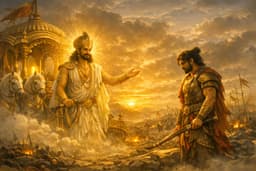
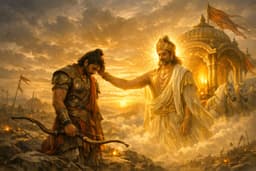
Rama and Ravana stood face-to-face. The air was still. The world watched.
Ravana, mounted on his chariot, unleashed his fury with astras (divine weapons). Rama countered with grace and power. The two clashed like thunder and lightning, gods and sages watching from the heavens.
Finally, Rama invoked the Brahmastra, the most sacred weapon, and aimed it at Ravana’s heart. With a flash of divine light, Ravana fell—ending the rule of adharma and arrogance.
🕊️ Aftermath and Legacy
The war ended with the reunion of Rama and Sita. But more importantly, it marked the victory of virtue, the importance of faith, and the power of service.
Rama crowned Vibhishan, Ravana’s righteous brother, as the new king of Lanka, signifying that dharma is not about destruction, but restoration of balance.
✨ Lessons from the War of Lanka
-
Faith beats fear: The Vanar Sena were not warriors, but their love for Rama gave them unmatched strength.
-
Power without humility leads to ruin: Ravana had it all, but his ego destroyed him.
-
Devotion inspires miracles: Hanuman’s Sanjeevani feat is proof of what love and urgency can achieve.
-
Dharma must be defended: Not just by gods, but by all who believe in it.
🪔 Conclusion
The War of Lanka was more than a battle—it was a cosmic drama, rich in meaning, emotion, and inspiration. It reminds us that every fight between right and wrong is a test of character, and that victory belongs to those who walk the path of dharma, not just those who carry weapons.
In every age, the war of Lanka plays out—in hearts, homes, and societies. And like Rama’s army, with truth, courage, and devotion, we too can emerge victorious.