Lakshman Rekha – The Protective Line
In the rich tapestry of the Ramayana, few symbols are as powerful and enduring as the Lakshman Rekha. Though not found in the original Valmiki Ramayana, this later addition has captured the imagination of millions across generations. It is more than just a line—it is a metaphor for boundaries, protection, trust, and the consequences of crossing limits.
Let us journey into this pivotal episode to understand its profound significance, both in the epic and in our lives today.
🌲 Life in the Forest
During their 14-year exile, Rama, Sita, and Lakshmana lived in a modest forest dwelling in Panchavati. Their days were spent in quietude, devotion, and simplicity, far from the luxuries of Ayodhya. But peace in exile was never meant to last.
Unbeknownst to them, Ravana, the ten-headed king of Lanka, had already set his sights on Sita. Enraged by the insult to his sister Surpanakha and enchanted by Sita’s beauty (as described by Surpanakha herself), Ravana plotted her abduction.
But Sita was never alone—Lakshmana, ever vigilant, remained close by, guarding her while Rama went into the forest.
🦌 The Golden Deer and Rama’s Absence
To lure Rama and Lakshmana away, Ravana employed the demon Maricha, who took the form of a golden deer—radiant, mesmerizing, and magical. Sita, enchanted by the beautiful creature, asked Rama to catch it for her.
Despite Lakshmana’s suspicion, Rama went after the deer, asking Lakshmana to stay behind and protect Sita. But when Rama fatally struck the deer and Maricha cried out in Rama’s voice, mimicking distress, Sita panicked. She feared the worst and insisted Lakshmana go help his brother.
✍️ Drawing the Line
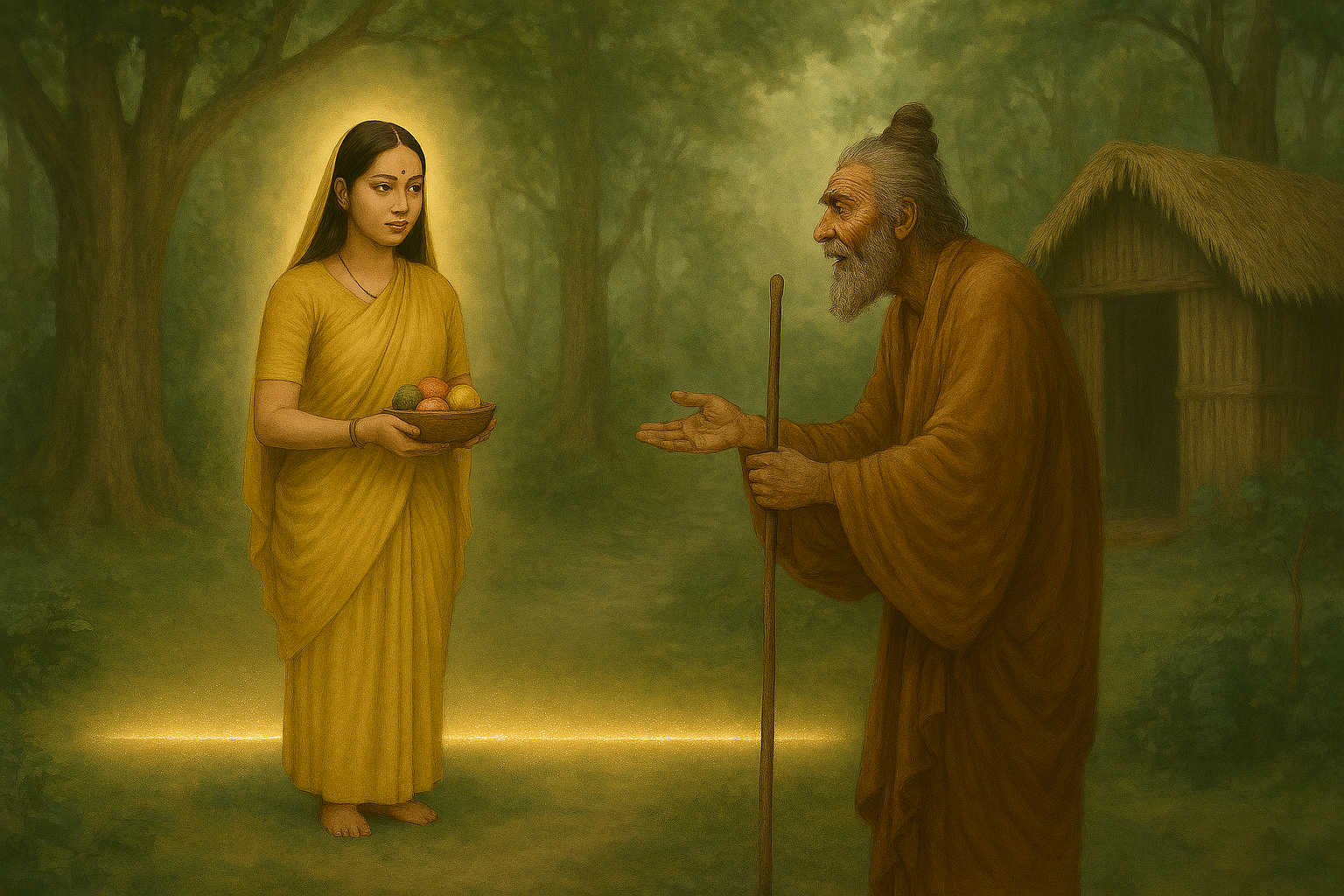
Lakshmana, torn between duty to Rama and Sita, reluctantly agreed to leave—but not before drawing a line around their cottage. This Lakshman Rekha, he warned, was a divine boundary of protection. No evil could cross it. But, crucially, Sita too was not to step outside of it.
This glowing line was a shield of love and dharma, forged not with weapons but with devotion and faith. It symbolized a sacred boundary—a line between safety and danger, obedience and disobedience, dharma and adharma.
Lakshmana disappeared into the forest, leaving Sita alone behind the divine barrier.
👹 Ravana’s Trickery and Sita’s Compassion
Ravana, disguised as a humble wandering sage (sadhu), approached the hut. He called out, asking for alms. As a queen raised in dharma, Sita had always been taught hospitality and charity—to never turn away a Brahmin or a guest in need.
But this time, to honor her values, she would have to cross a divine instruction.
Ravana, standing outside the line, demanded she come forward to give him food. Bound by her own moral compass, Sita stepped out of the Lakshman Rekha—and in that moment, Ravana seized her.
The protective line had been crossed, literally and symbolically.
🏹 A Turning Point in the Ramayana
Sita’s abduction marks a pivotal moment in the Ramayana. It is this act that triggers the formation of alliances, the building of the bridge to Lanka, the epic war, and ultimately Ravana’s downfall.
But it all began with the crossing of the Lakshman Rekha.
While Sita’s act may seem disobedient, it stemmed from compassion and dharma—principles that often conflict in complex moments. Should she have followed Lakshmana’s warning? Or was she right to uphold the tradition of feeding a sage?
This very tension is what makes the tale so powerful. It shows that even noble intentions can lead to grave consequences if wisdom and discernment are not applied.
🧠 Symbolism of the Lakshman Rekha
Over the centuries, the phrase “Lakshman Rekha” has come to represent any protective boundary, physical or moral, that one must not cross. It is a symbol of limits—limits set for safety, ethics, and balance.
-
In Relationships – The line reminds us to respect emotional and ethical boundaries.
-
In Governance – It stands for rules that protect fairness and justice.
-
In Personal Life – It’s a call to stay within the lines of right conduct, even when temptations or emotions call us out.
Yet, the tale also cautions us that blind adherence to any line, without understanding context, can be just as dangerous. Every boundary must be backed by wisdom, not fear.
🪔 Modern Lessons from the Ancient Line
-
Not all dangers wear evil faces – Ravana appeared as a sadhu, reminding us that appearances can be deceptive.
-
Boundaries matter – Be it personal, emotional, or spiritual, the lines we set protect not just ourselves but others too.
-
Trust and communication are essential – Had Sita trusted Lakshmana’s words over her fears, the abduction could have been prevented.
-
Values must be tempered with awareness – Dharma is important, but so is timing, wisdom, and the situation at hand.
🌺 Conclusion
The story of Lakshman Rekha is not about blaming Sita or glorifying rules. It is about the delicate balance between compassion and caution, faith and foresight.
That glowing line in the forest wasn't just a magical protection—it was a test of human behavior under pressure. And in crossing it, Sita reminded us all that even the most virtuous hearts must tread carefully in the face of deception.
In today’s world, the Lakshman Rekha still exists—in our decisions, relationships, and moral compasses. May we all learn to recognize it, respect it, and act with wisdom when we face our own Ravanas at the doorstep.