Surpanakha’s Insult and Revenge
The Ramayana is an epic of dharma, love, loyalty, and war — but at its core, it is also about choices and the chain of consequences that unfold from them. One of the most pivotal and often overlooked turning points in this grand narrative is the encounter with Surpanakha, the demoness sister of Ravana. Her insult and subsequent thirst for revenge became the spark that ignited the fire of war between Rama and Ravana — and ultimately changed the fate of both kingdoms.
🌿 The Encounter in the Forest
Surpanakha, a rakshasi (demoness), roamed the forests of Dandaka. With shape-shifting abilities and a fierce personality, she was bold, powerful, and unafraid. She had seen many mortals before, but the day she saw Rama, she was captivated.
Rama, in his exile, lived peacefully in the forest with Sita and Lakshmana. Surpanakha approached him, transformed herself into a beautiful woman, and boldly proposed marriage. She was drawn not only by Rama’s physical beauty but by an inexplicable magnetism that echoed divinity.
Rama, amused but kind, gently refused her proposal, explaining that he was already married to Sita. But Surpanakha would not give up so easily. When she turned to Lakshmana, he too playfully dismissed her, saying she should go back to Rama.
What began as flirtation quickly turned to fury.
🔥 The Insult
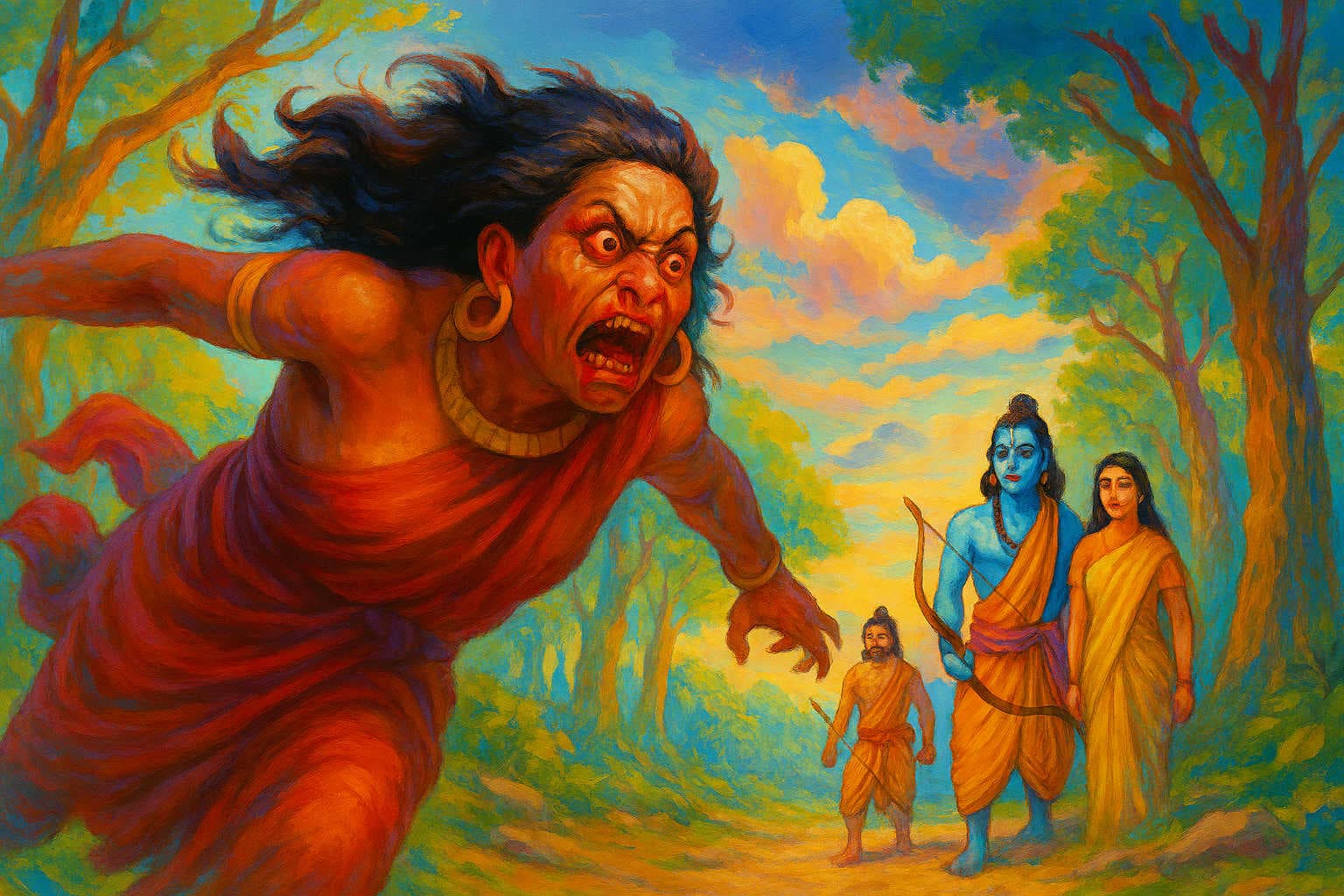
When Surpanakha realized that Sita was the obstacle between her and Rama, her jealousy turned into rage. She tried to attack Sita, intending to eliminate her rival. At that moment, Lakshmana stepped in to defend Sita and, in a swift act, cut off Surpanakha’s nose and ears, disfiguring her brutally.
For Surpanakha, this was not just a physical wound — it was a deep humiliation. A demoness of royal blood, the sister of mighty Ravana, had been publicly insulted and mutilated by forest dwellers — humans! Her pride was shattered. Bleeding and shrieking with humiliation, Surpanakha fled the forest, burning with a singular desire — revenge.
🩸 Revenge Begins
Humiliated and furious, Surpanakha ran straight to her brother Khara, a powerful rakshasa commander. She demanded that he avenge her by destroying Rama and his companions. Khara, along with Dushana and a large army of rakshasas, marched towards Rama’s hermitage.
But Rama, with his divine prowess, slew all the rakshasas, including Khara and Dushana. Surpanakha was now not just humiliated — she had suffered the loss of her brothers and kin. Her thirst for vengeance deepened.
She then turned to the one person who could truly match Rama — her elder brother, the ten-headed Ravana, king of Lanka.
🧠 The Manipulation of Ravana
Ravana was a mighty warrior, supremely proud of his strength, intellect, and lineage. At first, he dismissed Surpanakha’s cries as melodrama. But Surpanakha, cunning and vengeful, knew how to reach him.
She didn’t just speak of her insult — she spoke of Sita’s beauty.
Surpanakha described Sita as the most beautiful woman she had ever seen, declaring that she was worthy of Ravana himself — not Rama. She planted a seed of lust and pride in Ravana’s mind. She spoke not just as a victim but as a strategist.
Her words ignited Ravana’s desire and ego. Ravana, who saw himself as the master of all realms, could not tolerate a rival — a mere human — possessing something he believed he deserved. This manipulation marked the beginning of a cosmic conflict.
👑 The Abduction of Sita
Enraged and enchanted, Ravana devised a plan. With the help of Maricha, who took the form of a golden deer, Ravana lured Rama and Lakshmana away from their hut. With both brothers temporarily distracted, Ravana seized the moment and abducted Sita, taking her to Lanka.
This act of kidnapping — driven by lust, pride, and vengeance — set into motion the great war of Lanka, the alliance between Rama and Hanuman, and ultimately Ravana’s own downfall.
But the first domino to fall — the first crack in the seemingly steady ground — was Surpanakha’s insult.
📜 Symbolism and Reflections
Surpanakha’s story often gets reduced to a vengeful villainess with a bruised ego. But when looked at closely, her tale reveals many important themes:
-
Desire unchecked leads to destruction – Her initial infatuation, if left alone, might have passed. But when combined with ego and anger, it spiraled into chaos.
-
Words have power – Her description of Sita changed the course of the epic. What we say, and how we say it, can spark wars or create peace.
-
Revenge breeds ruin – Her need for revenge didn’t heal her pain. It led to the death of her brothers, the destruction of Lanka, and the defeat of her own family.
-
The smallest moment can change history – A few moments in the forest triggered a war involving gods, demons, and kings.
🪔 Conclusion
The episode of Surpanakha’s insult and revenge is a reminder that in every epic tale, even seemingly minor characters hold the power to shift destinies. Her actions may have stemmed from personal insult, but they exposed human vulnerabilities — pride, lust, vengeance, and manipulation.
Her story is not just a tale of punishment but a warning: that ego, when wounded, can become more dangerous than any weapon.
In remembering Surpanakha, we are reminded not only of the war between good and evil but also of the war within — the inner battles we fight between hurt and healing, between desire and dharma.