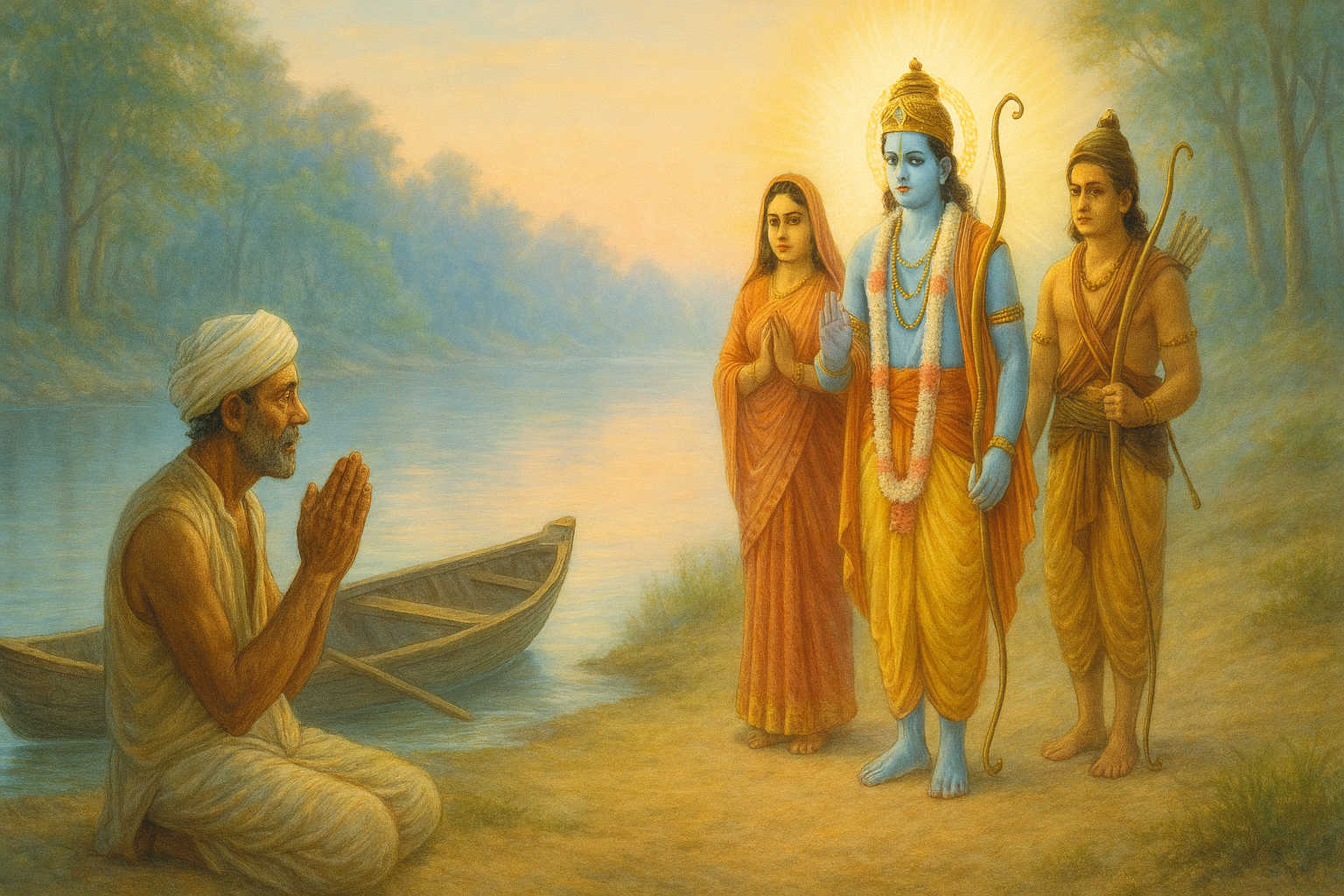
Kewat's Devotion and the Boat Ride
The Ramayana is filled with profound spiritual symbolism, dramatic episodes, and moments of deep human emotion. Among its many beloved stories, one humble incident stands out for its sheer simplicity and spiritual depth — the encounter between Lord Rama and Kewat, the boatman. This short but touching episode reveals the power of pure devotion, the humility of the heart, and the grace of the Divine.
🛶 The Setting – A Sacred Crossing
After being exiled from Ayodhya, Rama, along with Sita and Lakshmana, travels into the forest. As they reach the banks of the Ganga River, they need help crossing to the other side to continue their journey into the deeper forests.
There, they encounter Kewat, a simple boatman of a low caste, who lives by ferrying people across the river. But Kewat is no ordinary man — he is a soul burning with devotion (bhakti) for Lord Rama.
🙏 Kewat’s Devotion and a Surprising Request
Upon seeing Lord Rama, Kewat is overcome with emotion. He recognizes Rama not as a prince or a banished nobleman, but as the Supreme Being in human form. With folded hands and tears in his eyes, Kewat bows before Rama.
When Rama requests a boat ride across the river, Kewat politely refuses — but not out of arrogance or ignorance. His reasoning is simple, heartfelt, and deeply spiritual:
“O Lord, I have heard from the sages that even a single touch of your lotus feet has the power to transform stone into life. I am just a poor man — if your feet touch my boat, it too may turn into something divine and leave me without a livelihood. Please let me wash your feet before you step in.”
Kewat’s words refer to the legend of Ahalya, the woman who was turned into stone and later liberated by Rama’s touch. His request is not based on fear, but on a deep understanding of Rama’s divinity and his humble reliance on his means of earning.
🚿 Washing the Lord’s Feet
Rama, touched by the sincerity of Kewat’s devotion, agrees. Kewat brings water, washes the Lord’s feet with reverence, and drinks that sacred water, considering it the highest blessing of his life.
This act is profoundly symbolic. In that moment, the Lord of the Universe allows a humble boatman to serve Him, illustrating that true devotion transcends caste, class, and position. Rama embraces the humility and love in Kewat’s heart, accepting his service with grace and affection.
🚣♂️ The Boat Ride
After the ritual, Kewat helps Rama, Sita, and Lakshmana onto the boat and begins rowing them across the river. But for Kewat, this is not merely a ferry ride — it is a spiritual journey. As he rows, he gazes lovingly at Rama, his heart overflowing with bliss. Each stroke of the oar is an offering of love, each breath a prayer.
By the time they reach the other side, Kewat is transformed. He asks for one final boon: “Just as I have helped you cross this river, may you one day help me cross the ocean of life — samsara.”
Rama, smiling with divine love, promises him liberation.
🌸 The Essence of Bhakti
Kewat’s story is more than just a tale from scripture. It is a spiritual metaphor. The river represents worldly life, filled with challenges and distractions. The boat represents spiritual practice, and the boatman — our inner devotion and surrender.
Kewat teaches us:
-
True devotion is selfless – He asked for nothing but to serve.
-
Simplicity is strength – His understanding of Rama’s divinity came not from scholarly knowledge, but pure love.
-
Service is worship – Washing the Lord’s feet and rowing the boat became sacred acts of devotion.
-
God accepts love, not status – Rama never saw Kewat’s caste or occupation — He saw only his heart.
🕊️ A Divine Relationship
Rama’s interaction with Kewat is also a lesson in divine reciprocity. While Kewat helped Rama physically cross the river, Rama promised him spiritual liberation — helping him cross the deeper ocean of worldly existence.
This mutual exchange of love and service between God and devotee is the essence of bhakti yoga — a path where the devotee offers love and receives divine grace in return.
📿 Legacy and Relevance
In many parts of India, especially in folk traditions and bhajans (devotional songs), Kewat is remembered as an ideal devotee. His story continues to inspire millions who believe that even the simplest soul, with love and humility, can reach God.
For today’s spiritual seeker, Kewat's devotion is a powerful reminder that you don’t need temples or rituals to connect with the Divine. A humble heart, sincere love, and the desire to serve are enough to attract divine grace.
🌅 Conclusion
Kewat’s devotion and the boat ride is a story of deep humility, unconditional love, and the power of simple faith. In a world often obsessed with external appearances, Kewat reminds us that God dwells in the heart of the pure and the loving.
His story flows like the gentle river he once rowed upon — steady, clear, and filled with devotion. May we all, like Kewat, live with a heart open to serve, a mind ready to surrender, and a spirit longing to row the Lord to the other shore — and in doing so, be carried to our own spiritual freedom.