Ram’s Exile – Kaikeyi’s Boons
The Ramayana is filled with moments of high drama, emotion, and profound moral lessons, but few are as pivotal and heart-wrenching as the episode of Rama’s exile, caused by Queen Kaikeyi’s demand for two boons. This singular event not only changed the course of the story but also set in motion the divine journey of Lord Rama, marking one of the most significant spiritual tales in Indian tradition.
👑 The Palace of Ayodhya
The kingdom of Ayodhya was thriving under the rule of King Dasharatha. A just and noble king, Dasharatha had long awaited the day when he would crown his eldest and most beloved son, Rama, as the heir to the throne. Rama was admired by all—wise, courageous, and virtuous.
Preparations for his coronation were underway. The entire city rejoiced at the news. But within the palace walls, a storm was brewing—one that would shake the very foundation of the royal family.
🧿 Kaikeyi and the Influence of Manthara
Queen Kaikeyi, the youngest and most beautiful of Dasharatha’s three queens, initially shared in the joy. She loved Rama like her own son and had no objection to his coronation. However, her maid, Manthara, poisoned her mind with manipulation and fear.
Manthara, consumed by jealousy and political cunning, reminded Kaikeyi of the ancient boons granted by Dasharatha during a past battle, when she had saved his life. Manthara sowed the seed of insecurity, suggesting that once Rama became king, Kaikeyi’s own son, Bharata, would be sidelined and stripped of influence.
Overcome by a mix of fear, ego, and confusion, Kaikeyi fell into Manthara’s trap. What followed was one of the most tragic decisions in epic literature.
💬 The Demand for Two Boons
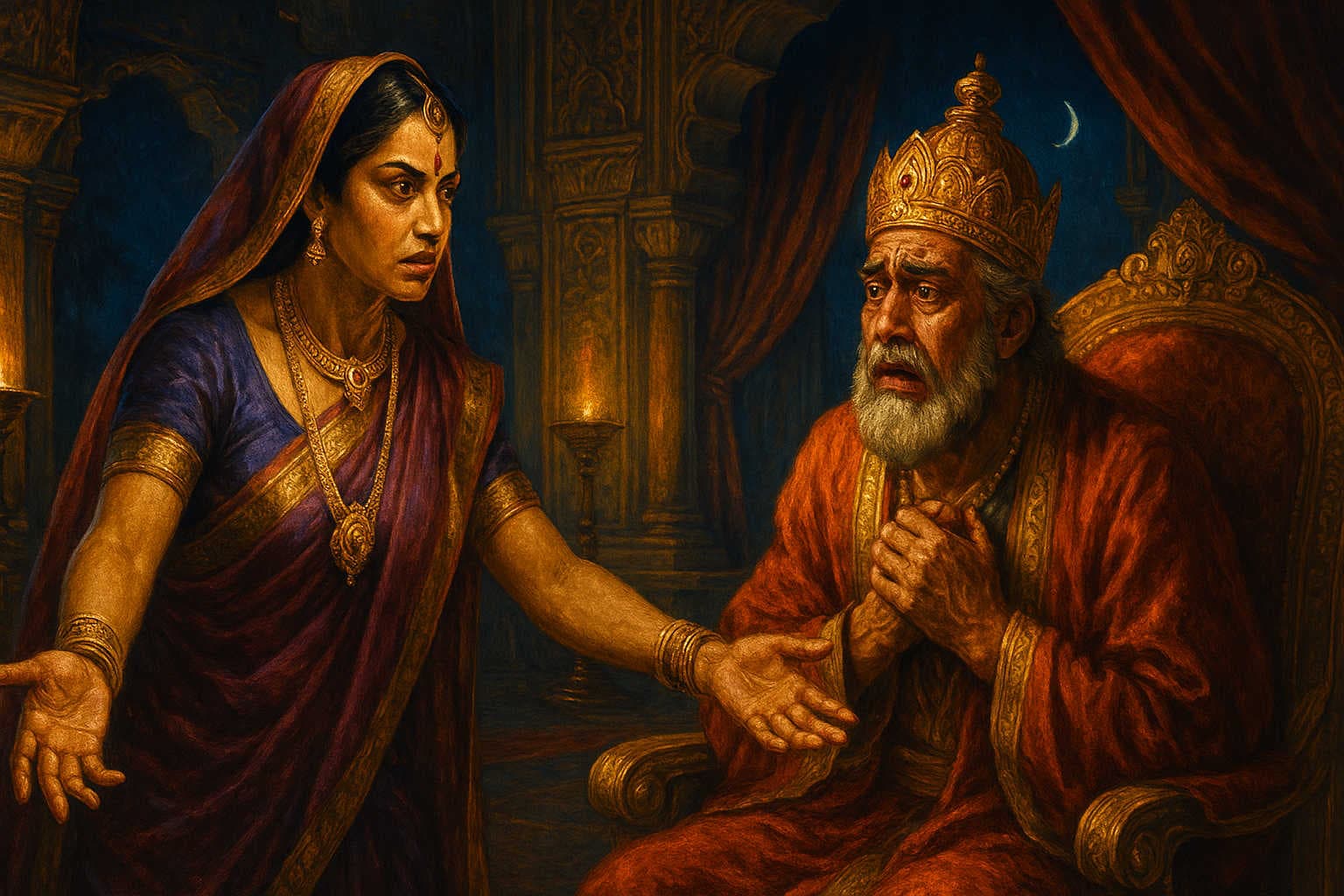
On the eve of Rama’s coronation, Kaikeyi entered Dasharatha’s private chambers. Reminding him of the two boons he had once promised her, she made her demands:
-
Rama must be exiled to the forest for 14 years.
-
Her son Bharata must be crowned as king in his place.
Dasharatha was devastated. He had never imagined Kaikeyi would ask for something so cruel. His love for Rama was immeasurable, and the thought of banishing him was unbearable. Yet, bound by honor and his promise, he had no choice.
His sorrow was so deep that it led to his eventual death, broken-hearted and guilt-ridden.
🙏 Rama’s Graceful Acceptance
When Rama learned of Kaikeyi’s demand, he accepted it without hesitation. He viewed the exile not as a punishment, but as a duty to uphold his father’s honor and the sanctity of promises.
Rama’s reaction stands as a beacon of ideal conduct and dharma. He consoled his grieving father, comforted his mother Kausalya, and gently explained to his wife Sita and brother Lakshmana that he must go.
Sita, refusing to stay behind, insisted on accompanying him. Lakshmana too pledged to follow his brother into the forest. Thus began their 14-year exile, filled with trials, divine encounters, and the eventual war against evil.
🌀 Kaikeyi’s Inner Turmoil
Though Kaikeyi got what she demanded, her heart soon realized the weight of her actions. Bharata, upon learning of the events, condemned her and refused the throne. He mourned the exile of Rama and set out to bring him back.
Kaikeyi, once proud and defiant, was now left ashamed and broken, realizing that she had lost the love and respect of everyone, especially her son. Her actions, driven by fear and manipulation, led to years of personal suffering and regret.
🪔 Symbolism and Moral Lessons
The episode of Kaikeyi’s boons is layered with spiritual and moral insights:
-
Temptation and Manipulation: Even the virtuous can fall when guided by ego and fear.
-
Power of Promises: Dasharatha’s adherence to his word, though painful, upholds the sacred nature of truth and dharma.
-
Rama’s Dharma: His willingness to sacrifice personal happiness for the sake of righteousness makes him the epitome of Maryada Purushottam—the ideal man.
-
Redemption: Kaikeyi’s later remorse shows that realization and repentance are always possible, even after grave errors.
🌄 The Beginning of a Divine Journey
Though this episode is filled with sorrow, it also marks the beginning of Rama’s mission on Earth. His exile allowed him to interact with sages, slay demons like Tataka, form alliances with Hanuman and Sugriva, and eventually confront the evil Ravana.
The pain caused by Kaikeyi’s boons became the soil from which Rama’s divine purpose bloomed. It reminds us that even painful events have a higher cosmic purpose, often beyond our understanding.
📖 Conclusion
The story of Ram’s exile due to Kaikeyi’s boons is a central and emotionally powerful episode in the Ramayana. It teaches us about the fragility of human emotions, the power of influence, and the strength required to uphold righteousness in the face of injustice.
In Rama’s calm acceptance, we see the essence of true dharma. In Dasharatha’s pain, we witness the cost of honor. In Kaikeyi’s downfall, we understand the danger of ego. And in the unfolding journey that follows, we see the divine hand at work, shaping destiny through the actions of mortals.
This tale continues to inspire millions across generations, reminding us that even in exile, one can walk the path of truth.