Bharat’s Devotion – The Sandals on the Throne
In the rich tapestry of the Ramayana, one of the most touching and profound stories is that of Bharat, the younger brother of Lord Rama. Often overshadowed by the grandeur of Rama’s exile and triumph, Bharat’s chapter is one of quiet sacrifice, unwavering dharma, and pure devotion. The symbolic act of placing Rama’s wooden sandals (padukas) on the throne of Ayodhya is a timeless example of humility, love, and righteous leadership.
👑 The Moment of Crisis
The story begins with a storm of emotion and injustice. When Kaikeyi, the queen and Bharat’s mother, demanded that her son be crowned king and Rama exiled to the forest for 14 years, Ayodhya was thrown into sorrow. Rama, ever obedient, accepted his exile without protest. Dasharatha, the king, died from the grief of parting with his beloved son.
Bharat was away when these events unfolded. Upon returning and learning the truth, he was devastated. Though the throne had been promised to him, Bharat rejected it completely, declaring he had no desire to benefit from injustice. His loyalty lay not with his own gain but with the values of dharma and brotherhood.
🛕 Journey to Chitrakoot
Determined to right the wrong, Bharat set out with a full entourage to the forest where Rama had taken refuge. His mission was simple: to bring Rama back and crown him king, as was rightfully due.
The meeting at Chitrakoot between the brothers is one of the most emotionally charged moments in Indian literature. Rama, steadfast in his vow, refused to return until the 14 years of exile were over. Bharat, equally firm in his devotion, refused to accept the throne.
It was at this moment that a sacred compromise was born.
👣 The Sandals on the Throne
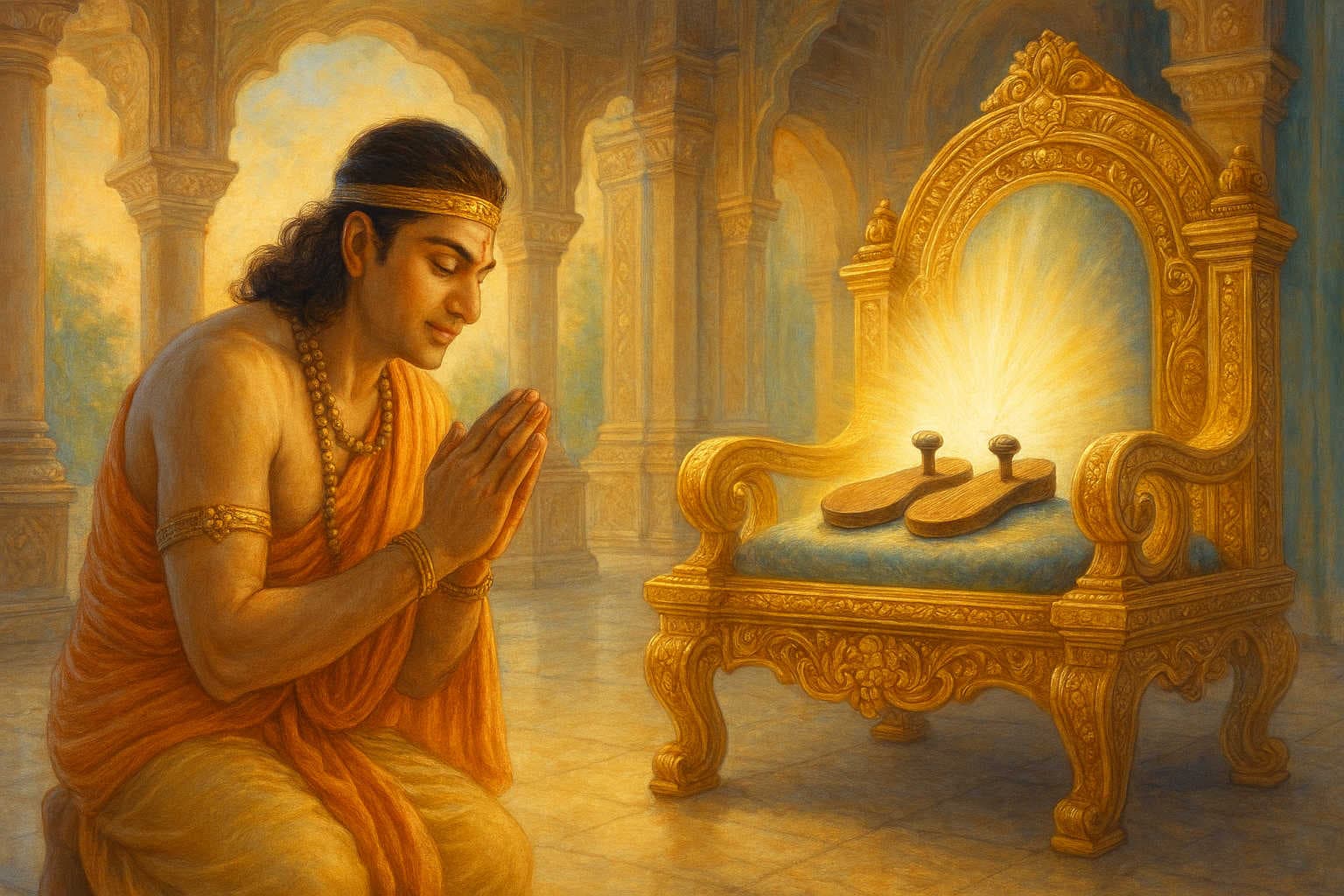
Unable to convince Rama to return, Bharat asked for something sacred to symbolize Rama’s kingship in his absence. Rama gave him his wooden sandals (padukas)—not just objects, but symbols of divine authority, righteousness, and the soul of the kingdom.
Bharat returned to Ayodhya and placed the sandals on the royal throne, declaring that Rama was the true king, and he would only serve as a caretaker or regent until his brother’s return.
He moved to Nandigram, outside Ayodhya, wore the robes of an ascetic, and lived a life of simplicity and discipline. For 14 years, Bharat ruled not as a king, but as a servant of Rama, beginning each day with worship of the sandals and governing in Rama’s name.
💡 The Power of Devotion and Dharma
This act is more than a touching story—it is a spiritual lesson.
-
Humility Over Power: Bharat’s rejection of the throne teaches us that true greatness lies in humility, not position.
-
Selfless Devotion: His love for Rama was not based on personal benefit, but on selfless surrender to righteousness.
-
Rule Without Ego: Bharat ruled a kingdom without ever considering it his own—a rare example of ego-less leadership.
The wooden sandals on the throne became a metaphor for spiritual authority and the presence of divine consciousness even in physical absence.
🙏 Bharat – A Forgotten Hero?
In many retellings of the Ramayana, Bharat’s role is often under-emphasized. Yet, among all the characters, his act is perhaps the most self-sacrificing. He could have easily taken the throne, justified by his mother’s manipulation and the political vacuum. Instead, he chose to wait, to suffer, and to serve.
While Rama is rightly worshipped for his divine qualities, Bharat is an embodiment of the ideal devotee—one who places duty over desire, and love over ambition.
🪔 Lessons for Today
In a world obsessed with power, recognition, and self-interest, Bharat’s story reminds us of the timeless values of:
-
Integrity
-
Family loyalty
-
Respect for rightful order
-
Spiritual humility
It also shows that you don’t have to wear a crown to lead. Leadership can come through quiet strength, moral clarity, and deep devotion.
📖 Symbolism of the Sandals
The image of Rama’s sandals on the throne has become iconic in Indian art and philosophy. It is not just about a political statement—it’s about presence in absence, faith in unseen goodness, and the triumph of dharma over personal gain.
Even today, replicas of these padukas are kept in temples and homes, representing the spiritual authority of Rama and the unwavering devotion of Bharat.
✨ Conclusion
Bharat’s devotion in the Ramayana is not just a tale of brotherhood, but a spiritual beacon. His story, centered around a pair of wooden sandals, teaches us that the greatest acts are not always the most visible, and the highest dharma lies in surrender, not control.
When Lord Rama finally returned after 14 years, Bharat joyfully handed back the throne, his heart fulfilled, his vow completed. He had never ruled; he had only served.
Let us all strive to embody a fragment of Bharat’s devotion in our own lives—living not for the crown, but for the cause of righteousness and love.