Ishavasya Upanishad – Whole World Is God
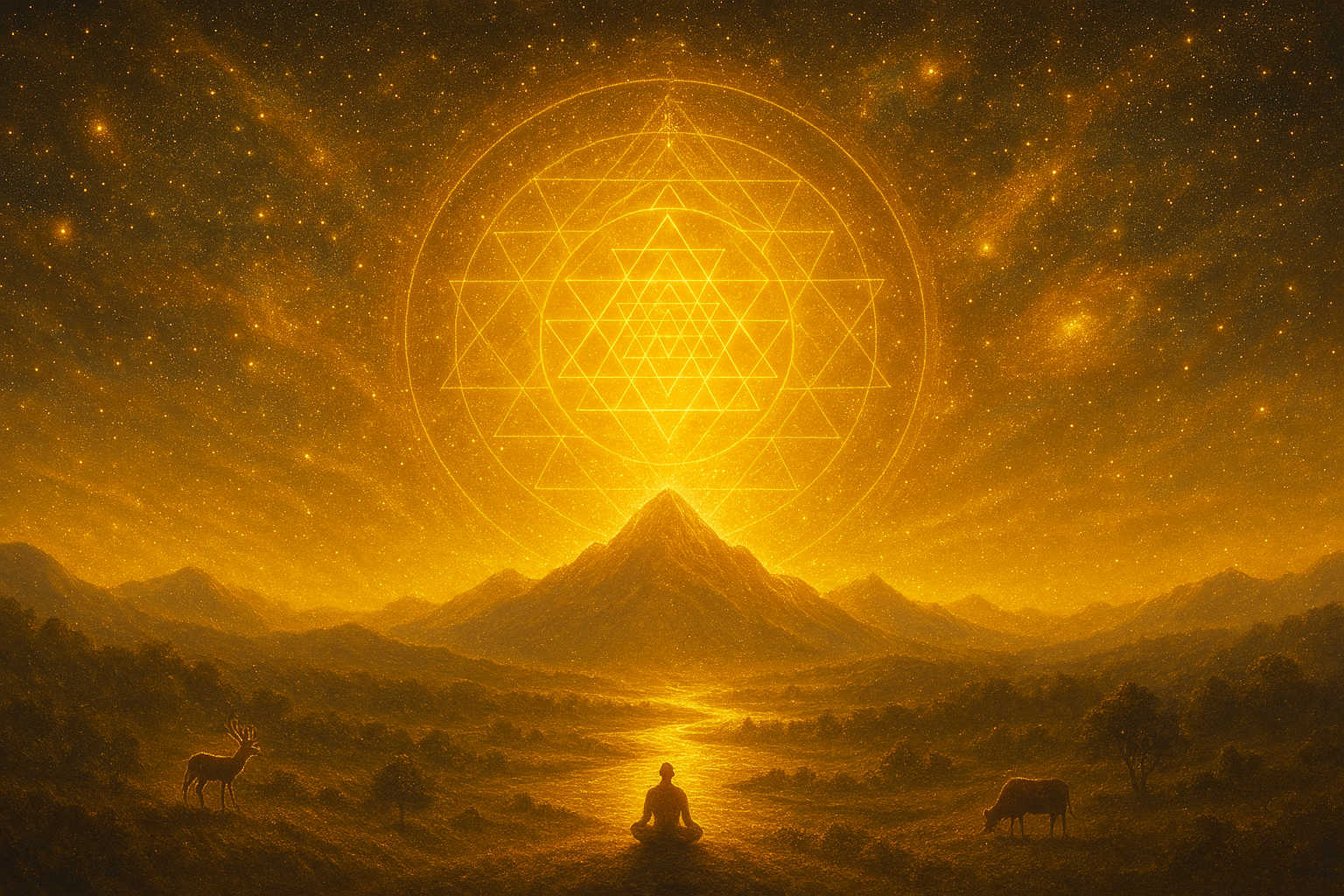
The Ishavasya Upanishad is one of the shortest yet most profound spiritual texts in the Vedic tradition. Found at the beginning of the Shukla Yajur Veda, it offers a complete vision of life in just 18 mantras. Its central teaching is simple yet revolutionary: “Isha vāsyam idam sarvam” – The entire universe is pervaded by the Divine. This single declaration forms the foundation of a spiritual worldview where God is not separate from creation but immanent within every particle of existence.
The Upanishad inspires human beings to shift their perspective—from seeing the world as fragmented and material to experiencing it as sacred and divinely interconnected. According to its philosophy, the Divine is not limited to temples or rituals alone; instead, everything we touch, see, and experience is an expression of that one cosmic reality.
1. The Essence of “Isha Vasyam”
The first mantra states:
“Isha vāsyam idam sarvam yat kiñca jagatyāṁ jagat.”
Meaning: The whole universe, moving and unmoving, is enveloped by the Lord.
This mantra invites seekers to perceive divinity everywhere. It dissolves the boundaries between sacred and secular and teaches that the world itself is a manifestation of God. When everything is divine, how can we exploit, hate, or harm anything? The mantra leads to a life of respect, responsibility, and harmony.
2. Renunciation Through Right Understanding
The Upanishad does not advocate running away from the world. Instead, it teaches inner renunciation while living fully.
It says:
“Tena tyaktena bhunjithaḥ” – Enjoy life through renunciation.
Here, renunciation means giving up the sense of possessiveness, ego, and greed. One may use worldly objects, but always with the awareness that they belong to the Divine, not to the individual. Thus, one can live a joyful, meaningful life without attachment.
3. Karma and Knowledge – Harmony, Not Conflict
Unlike later philosophies that often divide karma (action) and jnana (knowledge) into separate paths, the Ishavasya Upanishad shows they can coexist.
It teaches:
-
Perform duties selflessly.
-
Keep your mind anchored in the awareness of God.
This is the essence of Karma Yoga, where actions do not bind the soul because they are performed without ego. Knowledge purifies intention; action becomes a tool for spiritual evolution.
4. The Nature of the Divine
The Upanishad describes the Divine as:
-
Within everything, yet beyond everything
-
Moving faster than the mind, yet unmoving
-
Far away, yet extremely near
These paradoxical statements reveal that the Divine is not limited by space, time, or form. It can be experienced both externally (as creation) and internally (as consciousness).
5. Ignorance and Knowledge – A Subtle Balance
A powerful teaching found here states that both:
-
Avidya (ignorance)
-
Vidya (knowledge)
can bind a person if misunderstood.
Avidya represents worldly pursuits, while Vidya represents spiritual understanding. The Upanishad teaches that both must be balanced. Only worldly interest leads to material bondage; only spiritual interest can become escapism. True wisdom lies in walking the middle path—fulfilling material duties while maintaining spiritual awareness.
6. The Witnessing Self
Another essential teaching is recognizing the Self (Atman) as untouched by worldly actions.
The Upanishad says:
-
The Self is pure,
-
Unmoving,
-
Unchanging,
-
Beyond good and evil,
-
Beyond birth and death.
By identifying with this inner Self rather than the temporary external world, one experiences freedom and inner peace.
7. Seeing God in All – The Path to Fearlessness
The Upanishad states that one who sees the same Divine presence in all beings becomes free from hatred, jealousy, fear, and sorrow. When separateness dissolves, conflict dissolves. When unity is understood, compassion naturally arises.
This is one of the earliest and most powerful statements of universal brotherhood and spiritual equality found in world scriptures.
8. Life as Worship
The Ishavasya Upanishad does not ask you to escape life; it asks you to transform your vision.
Everything becomes sacred—
-
Every action becomes an offering.
-
Every person becomes divine.
-
Every moment becomes an opportunity to experience God.
Life becomes a continuous meditation, naturally leading one toward liberation.
9. The Final Message – Freedom Through Awareness
The closing mantras speak of the journey of the soul after death and the prayer of the seeker:
“Lead me from darkness to light, from the unreal to the real.”
Ultimately, the Upanishad teaches that realizing the presence of God everywhere leads to moksha, freedom from fear, ignorance, and sorrow.
Conclusion
The Ishavasya Upanishad offers a timeless message: the entire universe is a divine expression, and recognizing this truth is the essence of spirituality. It encourages humanity to live with awareness, humility, detachment, and love. When we understand that God resides in all beings and all things, every action becomes righteous, and every moment becomes sacred. Through this vision, the world transforms—not because the world changes, but because our perception changes.