Nasadiya Sukta – Vedic Philosophy of Creation
The Nasadiya Sukta, found in the Rig Veda (10.129), is one of the most intriguing and philosophical hymns ever composed in human history. It approaches the mystery of creation not with dogmatic certainty but with deep inquiry, humility, and wonder. Unlike many ancient cosmologies that claim absolute answers, the Nasadiya Sukta stands out by acknowledging the profound mystery of existence. It explores the origins of the universe with a blend of poetry and metaphysics, asking questions that continue to fascinate scientists, philosophers, and spiritual seekers even today.
The hymn opens with a powerful statement: “Then, there was neither existence nor non-existence.” This paradox challenges the very foundation of logical thinking. How can something be neither existent nor non-existent? The Rishis hint that before creation, the universe could not be described through ordinary categories. Time, space, and causation—the tools by which we understand reality—had not yet come into being. What existed was an undifferentiated potential, a state beyond duality, beyond thought.
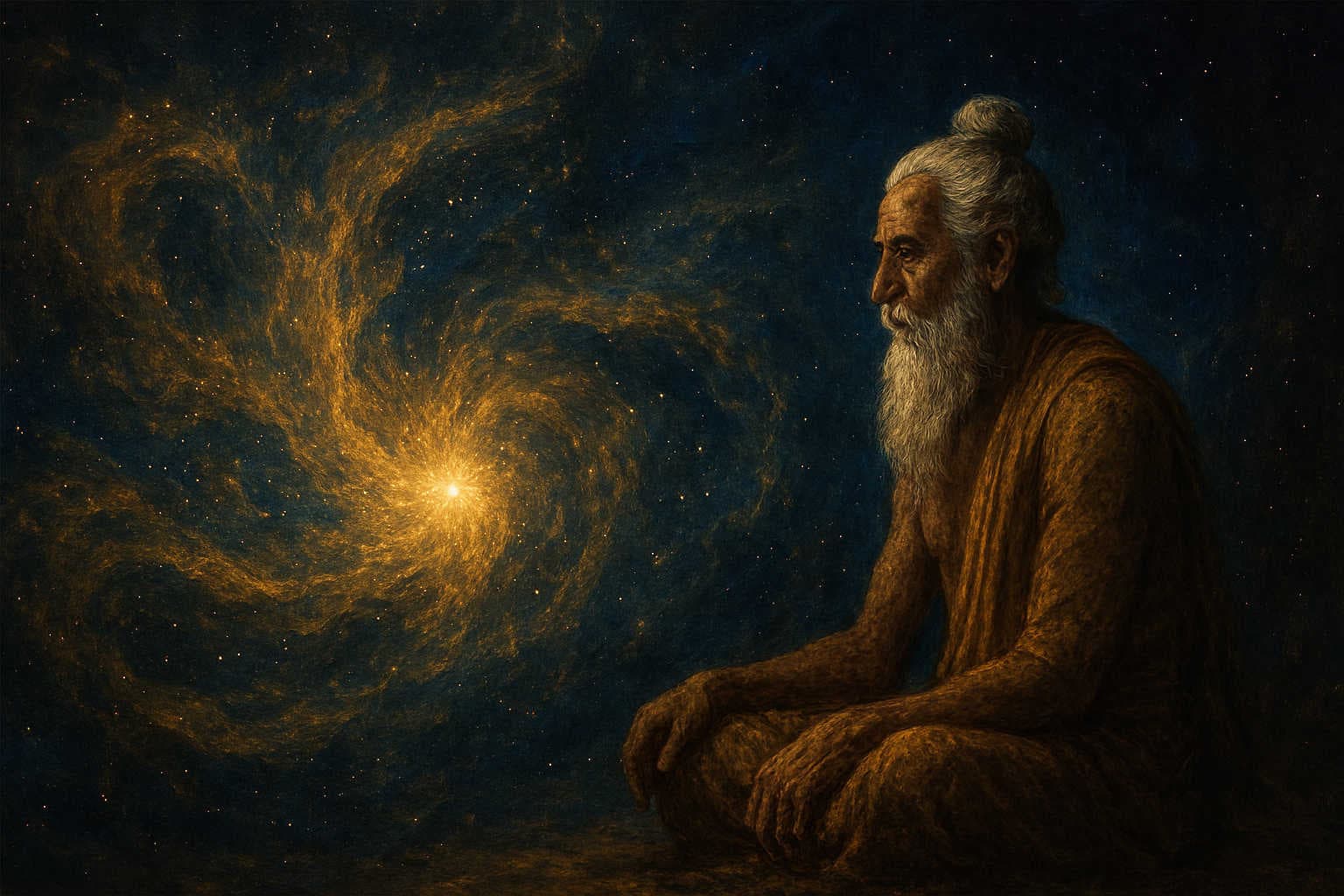
The Nasadiya Sukta goes on to describe an era when there was no sky, no atmosphere, no life, and no distinction of “above” or “below.” Yet, something stirred—unspecified, subtle, perhaps a primordial desire or heat (tapas) that became the seed of creation. This “desire,” which the hymn calls the “first seed of mind,” is not the emotional desire of humans but a cosmic impulse, the first hint of differentiation within the absolute. It reflects a deep insight: creation begins not with material forms but with consciousness.
One of the most striking ideas in the Sukta is the origin of creation from One, which was enveloped in darkness. This One was neither awake nor asleep, neither dead nor alive, but self-contained. The hymn says it “breathed without breath,” indicating a subtle, self-sustaining presence. This aligns with later Vedic and Upanishadic teachings that speak of Brahman—the infinite, uncaused reality from which everything arises.
The Rishis then explore how the universe emerged from this undifferentiated source. Was creation a deliberate act, or did the cosmos evolve naturally, like a seed sprouting into a tree? Was it driven by inner laws or some divine agency? The hymn does not give definitive answers. Instead, it embraces uncertainty and encourages inquiry. This makes the Nasadiya Sukta remarkably modern in its thought. Many scholars even compare its tone to scientific cosmology, which also begins with mystery—what happened before the Big Bang? What caused the first fluctuation?
Another profound element of the hymn is its reflection on the limits of knowledge. It asks: “Who truly knows? Who can declare how creation happened?” Even the gods, the hymn says, came into being after creation, so they cannot know the origin. This radical statement breaks from the common tendency to attribute creation to divine beings. It suggests that the ultimate truth lies beyond all beings, beyond all conceptual frameworks, beyond even divine comprehension.
The final verse delivers the most astonishing insight: “Perhaps the One who looks over creation knows—or perhaps even He does not.” This humble acceptance of the unknown is one of the rarest moments in ancient literature. The sages acknowledge that the mystery of existence might be deeper than any intellect, even cosmic intellect, can fully grasp. This is not atheism but a profound respect for the vastness of reality. It reveals a maturity of thought that encourages seekers to explore, question, and evolve without the arrogance of absolute certainty.
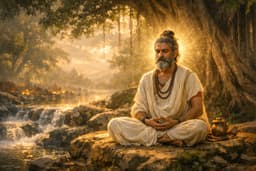
Spiritually, the Nasadiya Sukta invites contemplation. It encourages us to sit with the mystery rather than force answers. When we meditate, we often touch a space of silence that feels ancient, unbounded, and beyond identity. This experience mirrors the primordial stillness described in the hymn. By reflecting on the verses, one begins to appreciate that existence is not a fixed phenomenon but an ongoing process of unfolding.
In modern times, the Sukta holds unparalleled relevance. It resonates with scientific theories such as the quantum vacuum, singularity, and cosmic expansion. Yet, it goes beyond physics by addressing the philosophical and existential dimensions of creation. It reminds us that science and spirituality are not opposing fields but complementary ways of exploring reality.
The Nasadiya Sukta also teaches humility. It reminds humanity that despite technological advancements and growing knowledge, the deepest questions remain open. Where did we come from? Why is there something rather than nothing? What existed before time began? These questions continue to inspire exploration across disciplines, echoing the same curiosity that the Vedic sages expressed thousands of years ago.
Ultimately, the hymn is not just about cosmology—it is about the human quest for understanding. It encourages us to look inward and outward with wonder, recognizing that the mystery of creation is not a puzzle to solve but a doorway to spiritual awakening. In acknowledging the unknown, we step closer to the truth.
Thus, the Nasadiya Sukta stands as a timeless testament to the depth of Vedic wisdom. It invites us to reflect, inquire, and marvel at the universe with humility, reminding us that creation is both a cosmic mystery and a profound spiritual journey.