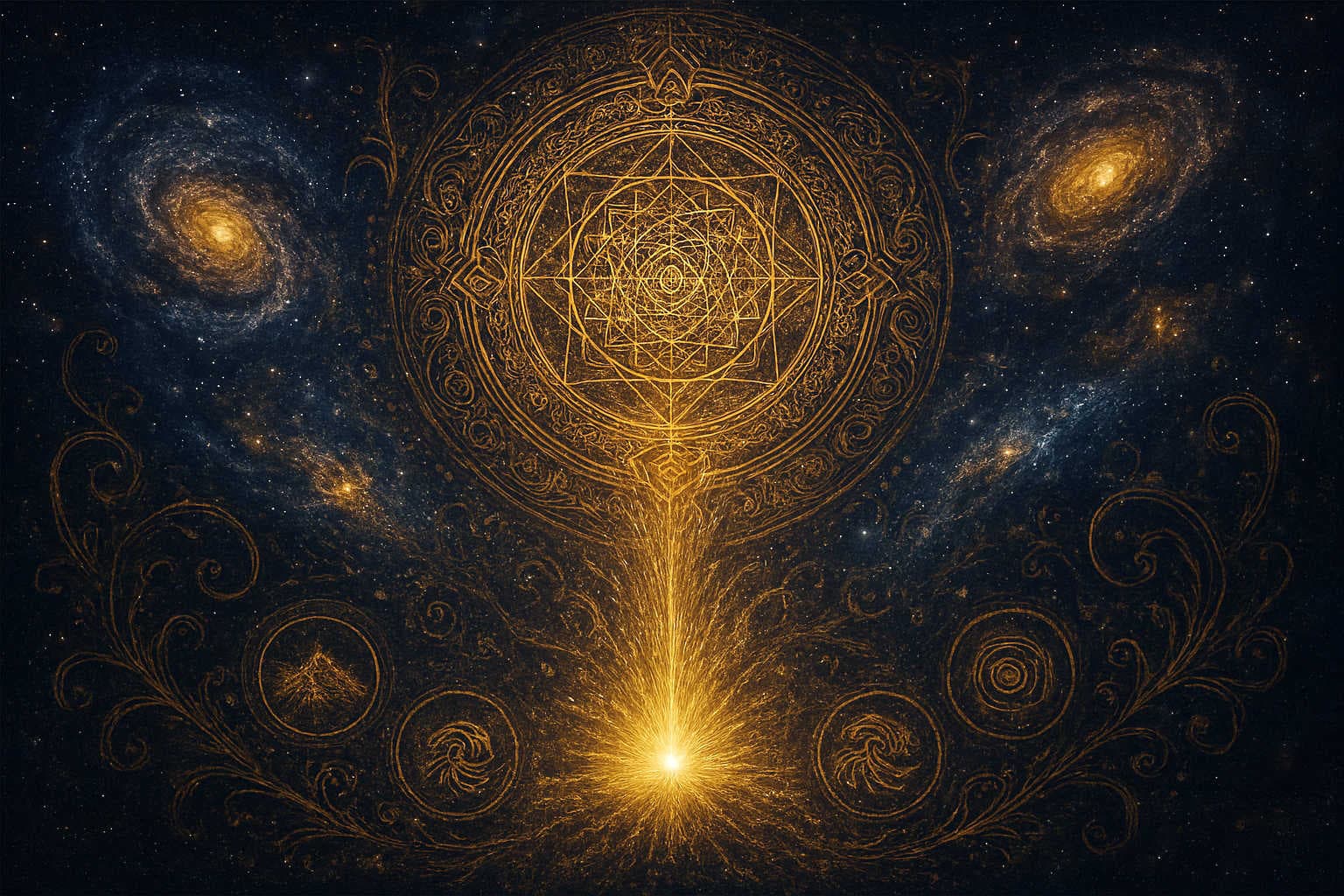
Vedic View on Creation – From One to Many
The question of how the universe came into existence has fascinated humanity since the beginning of time. The Vedic tradition offers one of the oldest and most profound explanations of creation—one that blends philosophy, spirituality, and cosmology in a deeply symbolic way. According to the Vedas, all creation emerges from One supreme, infinite consciousness, gradually manifesting into the many forms we see in the universe. This journey “from One to Many” captures the essence of how the cosmos unfolds and why diversity exists within an underlying unity.
The One – The Source of All Creation
The starting point of Vedic cosmology is Brahman, the infinite, formless, eternal reality. Brahman is described as:
-
Pure consciousness
-
Without beginning or end
-
Beyond space, time, and causation
-
The essence of everything that exists
Before creation, only Brahman exists—silent, unmanifest, and complete within itself. There is no duality, no separation, no universe. This state is called avyakta (the unmanifest).
The Vedas explain that creation is not something that happens “outside” Brahman. Instead, all forms arise within Brahman, just as waves arise within the ocean without ever being separate from it.
The First Stir: Desire to Manifest
The Rigveda says:
“In the beginning, there was neither existence nor non-existence… then arose the One with its power.”
This mysterious stirring is sometimes described as the desire to become many:
“He wished, ‘May I become many. May I be born.’” — Chandogya Upanishad
This is not a human-like desire but a poetic expression showing that the One Consciousness naturally unfolds into diversity.
From Brahman to Ishvara
When Brahman reflects upon itself through its own power (Maya), it appears as Ishvara—the personal, creative aspect of the Divine. In this form, the One becomes the conscious Creator who:
-
Designs the universe
-
Maintains cosmic order
-
Guides evolution
-
Resides within every being
Ishvara is not separate from Brahman but is Brahman with manifesting power.
Maya – The Creative Power
Maya is the mysterious force through which the One becomes Many. It is neither real nor unreal—often described as a cosmic illusion or creative principle. Through Maya:
-
Form arises from the formless
-
Time and space appear
-
Duality manifests
-
The universe begins its play (Lila)
Maya is not negative; it simply allows the infinite to express itself in countless ways.
The Three Gunas – Blueprint of Creation
Maya consists of three gunas that shape everything in the universe:
-
Sattva – balance, light, purity
-
Rajas – activity, movement, desire
-
Tamas – inertia, darkness, stability
These gunas mix in different proportions, giving rise to:
-
Atoms, planets, elements
-
Thoughts, emotions, personality
-
Devas, humans, animals, plants
Just as the three primary colors create infinite shades, the gunas create infinite forms.
The Five Elements – Building Blocks of the Universe
From the subtle gunas arise the panchamahabhutas (five great elements):
-
Ether (Akasha)
-
Air (Vayu)
-
Fire (Agni)
-
Water (Apas)
-
Earth (Prithvi)
Everything—from galaxies to our bodies—is made from these elements. They evolve step-by-step:
-
Akasha gives space for existence
-
Vayu gives motion
-
Agni gives transformation
-
Apas gives cohesion
-
Prithvi gives structure
This gradual manifestation shows how the One consciousness becomes the physical universe.
Creation as a Cyclic Process – Not a One-Time Event
Unlike Western linear creation stories, the Vedas describe creation as cyclical:
-
The universe is born
-
It expands
-
It is sustained
-
It dissolves
-
It is reborn again
These cycles are unimaginably vast, spanning billions of years (Mahakalpas). Just as day and night alternate, creation and dissolution alternate eternally.
Nothing is ever truly created or destroyed—only transformed.
The Role of Purusha and Prakriti
Some Vedic philosophies, especially Samkhya, describe creation through two eternal principles:
-
Purusha – pure consciousness
-
Prakriti – primal nature
Purusha does not act; it simply is.
Prakriti evolves when Purusha’s presence reflects upon it, causing the gunas to move and creation to unfold.
This beautifully explains how consciousness and nature interact to create life.
From Cosmic to Individual: The Microcosm
The Vedas assert a stunning truth:
Whatever exists in the universe exists within each human.
The macrocosm (brahmanda) is mirrored in the microcosm (pindanda):
-
Five cosmic elements ↔ five elements in the body
-
Cosmic intelligence ↔ human intellect
-
Universal mind ↔ individual mind
-
Cosmic consciousness ↔ Atman (the inner Self)
Thus, creation isn't “out there”—it’s happening within us at every moment.
Why the One Becomes Many – The Purpose of Creation
Vedic seers say creation is a divine Lila—a cosmic play. The One becomes Many:
-
To express infinite potential
-
To experience itself in countless forms
-
To give souls a field for growth, karma, and realization
-
To reveal unity through diversity
A wave cannot know it is the ocean unless it rises. Similarly, souls evolve through various lifetimes until they realize their oneness with Brahman.
Dissolution – Return to the One
Just as creation emerges from Brahman, it also returns to Brahman during cosmic dissolution (pralaya). All forms dissolve, but consciousness remains untouched.
This cycle symbolizes that diversity is temporary, but unity is eternal.
In Essence: From One to Many, and Many Back to One
The Vedic view of creation is not a literal story but a profound philosophical model. It teaches:
-
Everything is interconnected
-
All forms arise from one consciousness
-
Diversity is a play of the Divine
-
The goal of life is to rediscover our oneness
We may appear separate, but at the deepest level, we are expressions of the same infinite reality.
This understanding brings humility, harmony, and reverence for all beings—because everything is truly divine.