What Is Sat-Chit-Ananda? – Existence, Consciousness, Bliss
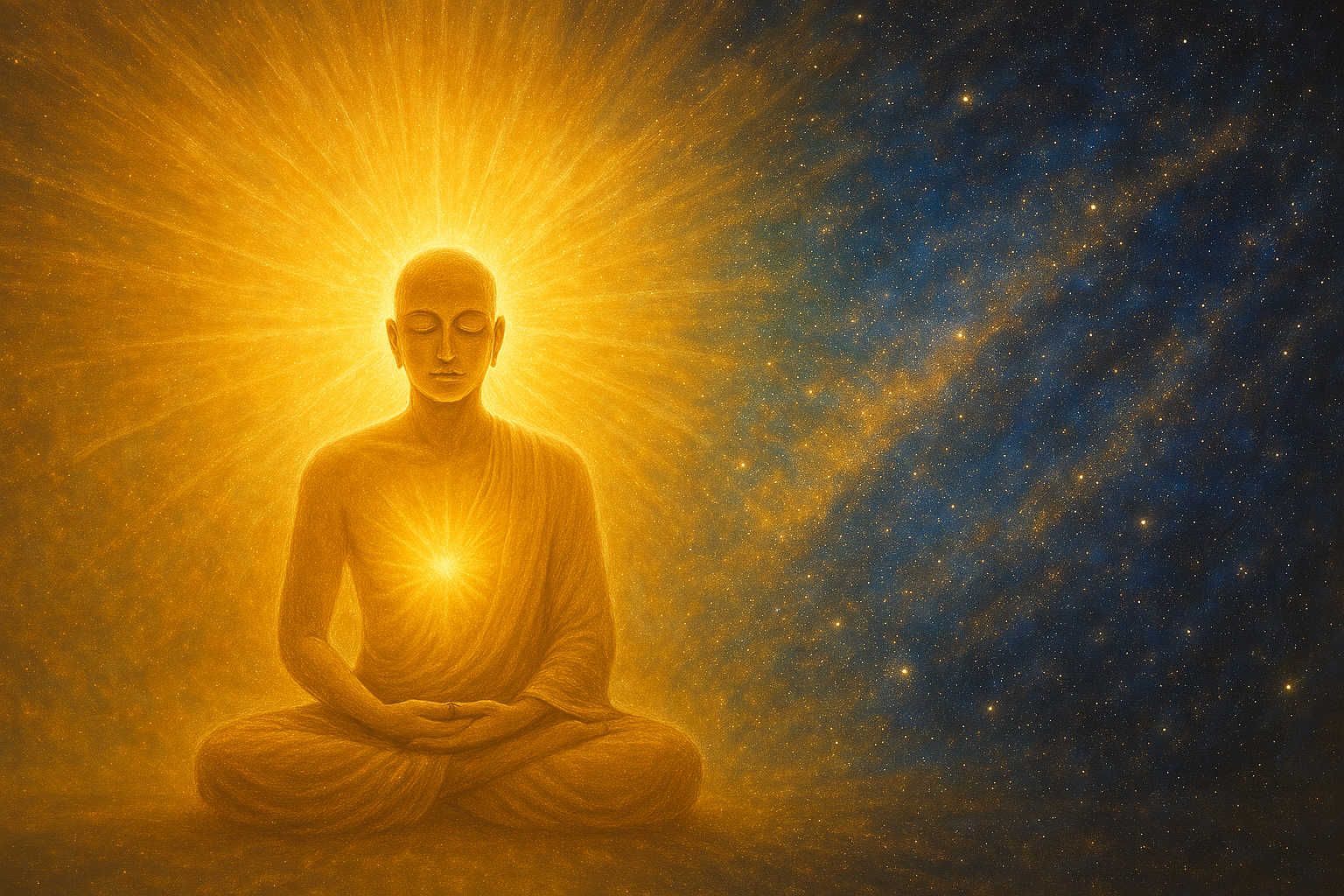
Among the deepest and most beautiful expressions in Vedanta philosophy is the term Sat-Chit-Ananda. It is not merely a phrase, but a complete definition of the nature of Brahman, the Supreme Reality, and the Atman, the true Self within every being. These three words—Sat, Chit, and Ananda—capture what cannot truly be described: the infinite, eternal, indivisible essence of existence itself.
Sat-Chit-Ananda is both a philosophical teaching and a direct spiritual experience. It is the state realized by sages who have gone beyond the illusions of the material world and awakened to their true identity.
Let us explore each part in depth and understand how they together reveal the ultimate truth.
1. Sat – Pure Existence
Sat means absolute existence—something that always was, always is, and always will be. It is beyond birth, change, and death. Everything we see in the world—objects, bodies, ideas—comes into existence, changes, and disappears. But Sat refers to that which never changes.
Characteristics of Sat
-
Eternal
-
Unchanging
-
Independent
-
Self-existent
-
The foundation of all that appears
Vedanta teaches that all objects borrow their existence from Sat, just as waves borrow their existence from the ocean. Without the ocean, there can be no waves. Without Sat, nothing can exist.
Your True Nature as Sat
When we say “I exist,” we are intuitively affirming this eternal truth. The body changes, the mind fluctuates, but the sense of “I am” remains constant. This unchanging awareness is Sat.
2. Chit – Pure Consciousness
Chit means consciousness—not the limited, personal consciousness associated with the brain, but the infinite awareness that illuminates all experience. It is the pure light of knowing that enables every perception, emotion, and thought.
Characteristics of Chit
-
Self-luminous
-
The witness of all mental modifications
-
Independent of the body and mind
-
All-pervading
-
The essence of intelligence
Chit is not something we possess.It is what we are. You do not "have" awareness—you are awareness.
The Illusion of Limited Consciousness
We often think consciousness is confined to the body. But Vedanta explains that:
-
The body is inert.
-
The mind is a subtle instrument.
-
Awareness alone gives life and meaning to both.
Just as electricity powers a machine but is not created by it, consciousness enlivens the body but is not produced by it.
3. Ananda – Pure Bliss
Ananda means bliss—not pleasure, comfort, or emotional happiness, but the deep, unbroken joy that is the intrinsic nature of the Self. This bliss does not depend on any external object.
Characteristics of Ananda
-
Unconditional
-
Eternal
-
Boundless
-
The nature of peace and fulfillment
-
Experienced when the mind is silent
Whenever we experience moments of joy—whether through love, beauty, or meditation—we are actually touching the radiance of our own inner nature. External objects do not create happiness; they merely quiet the mind for a moment, allowing Ananda to shine through.
The Unity of Sat, Chit, and Ananda
While we analyze Sat, Chit, and Ananda separately, Vedanta insists that they are not three different things, but one single, indivisible reality.
-
Because Brahman exists eternally → Sat
-
Because Brahman is conscious by nature → Chit
-
Because Brahman is full and complete → Ananda
The Self is not a composite of existence, consciousness, and bliss—it is these three simultaneously, in their pure form.
Just as a flame gives light, heat, and energy at once, Brahman expresses Sat-Chit-Ananda effortlessly and eternally.
Sat-Chit-Ananda and the Illusion of the World
In Advaita Vedanta, the world is seen as a temporary manifestation appearing within the infinite consciousness of Brahman. Due to Maya, we mistake the body-mind complex as the Self and suffer.
Recognizing Sat-Chit-Ananda breaks this illusion:
-
When you know yourself as Sat, you transcend fear of death.
-
When you know yourself as Chit, you stop identifying with thoughts and emotions.
-
When you know yourself as Ananda, you no longer seek happiness outside.
This realization leads to freedom from suffering.
Experiencing Sat-Chit-Ananda
Sat-Chit-Ananda is not an intellectual concept. It is meant to be realized. The great sages say this realization comes through:
1. Self-Inquiry (Who am I?)
Tracing your identity beyond body, mind, intellect.
2. Meditation
Silencing the mind to reveal the consciousness beneath.
3. Discrimination (Viveka)
Knowing what is permanent (Self) and what is impermanent (body, world).
4. Non-Attachment (Vairagya)
Letting go of desires and fears that veil bliss.
5. Devotion and Surrender
Opening the heart to the divine dissolves ego barriers.
When the mind becomes pure and still, Sat-Chit-Ananda shines forth naturally.
Every Being Is Sat-Chit-Ananda
Vedanta’s most compassionate teaching is that this state is not reserved for sages alone. Every living being—human, animal, plant—has the same eternal Self within. The only difference lies in awareness.
A sage knows,
A seeker tries to know,
Most people forget.
But the truth remains unchanged:
You are Sat-Chit-Ananda. You have always been so.
Why We Don’t Experience It All the Time
The mind is constantly active—thinking, worrying, planning, desiring. This agitation acts like clouds covering the sun. The sun never stops shining; we simply cannot see it.
When the mind becomes calm, the light of consciousness reveals our true nature.
Conclusion
Sat-Chit-Ananda is the ultimate description of the Self and the Supreme Reality. It teaches us that our essence is:
-
Sat – eternal existence
-
Chit – infinite consciousness
-
Ananda – boundless bliss
Understanding this transforms life. Instead of searching for happiness outside, we discover it within. Instead of fearing death, we recognize our immortality. Instead of feeling separate and limited, we awaken to our infinite nature.
To realize Sat-Chit-Ananda is to realize the deepest truth of who we are—timeless, conscious, blissful, and one with the Supreme.