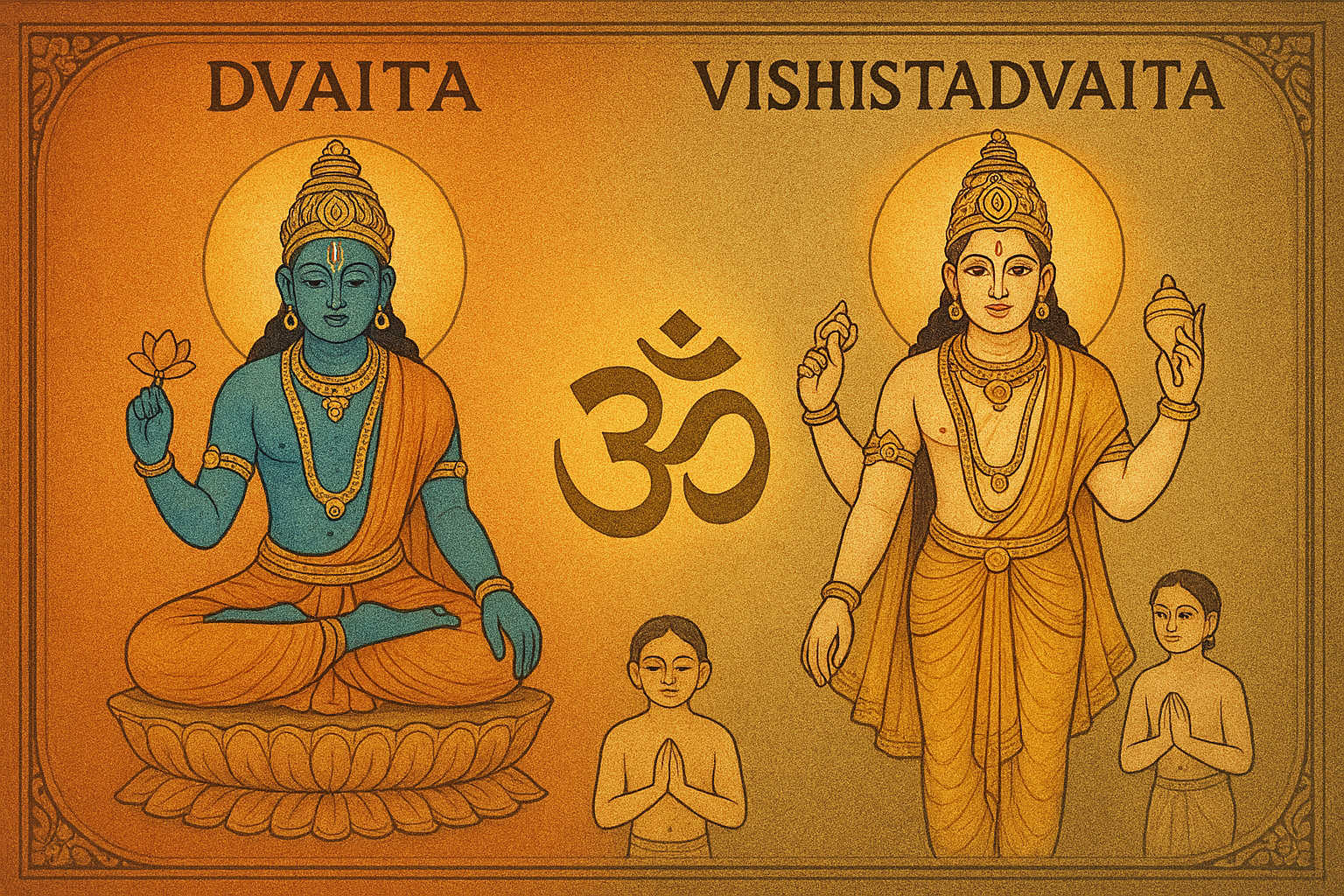
Dvaita & Vishishtadvaita – Dualistic and Qualified Non-Dualism
Within the vast and profound landscape of Hindu philosophy, the Vedanta system stands as one of the most influential schools of thought. While Advaita Vedanta speaks of pure non-dualism, two other major branches—Dvaita and Vishishtadvaita—present powerful alternative interpretations of the relationship between the jiva (individual soul) and Brahman (the Supreme Reality). Founded by Madhvacharya and Ramanujacharya respectively, these philosophies have shaped centuries of devotional practice, temple worship, and the spiritual worldview of millions.
Both schools are rooted in the Vedas and the Upanishads, yet they diverge significantly in how they understand God, creation, the soul, and the ultimate goal of life. Their perspectives illuminate the diversity and depth of Sanatan Dharma, offering seekers multiple paths suited to their temperament and spiritual inclination.
Understanding Dvaita – The Dualistic Philosophy of Madhvacharya
Dvaita Vedanta, propagated by the 13th-century philosopher Sri Madhvacharya, is a strong assertion of dualism. It maintains that God and the soul are eternally distinct, and this distinction can never be dissolved, even in liberation.
1. God as an Independent Reality
In Dvaita, Brahman is identified with Vishnu, who is the all-powerful, independent, eternal Supreme Lord (Ishwara). All other beings and objects depend on Him for their existence.
2. Eternal Distinction Between Jiva and Brahman
According to Madhvacharya, the jiva is real, individual, and eternally different from God. Liberation does not mean merging with Brahman, but reaching His abode and experiencing bliss through eternal service.
3. The Fivefold Differences (Pancha-Bheda)
Dvaita highlights five eternal distinctions:
-
God and soul
-
God and matter
-
Soul and matter
-
One soul and another
-
One material object and another
This establishes a world of real plurality, not illusion. The universe is not maya; it is a real creation of the Supreme.
4. Bhakti as the Only Means of Liberation
For Madhvacharya, devotion to Vishnu, combined with His grace, is the only path to liberation. Knowledge and rituals are secondary.
5. Liberation – Eternal Service to the Divine
Liberation (moksha) in Dvaita is a state where the soul remains distinct but experiences unbroken bliss by serving Vishnu. The individuality of the soul is not destroyed but perfected.
Dvaita’s clarity, logic, and emphasis on personal devotion have deeply influenced Vaishnavism, particularly regions like Karnataka and coastal India.
Understanding Vishishtadvaita – The Qualified Non-Dualism of Ramanujacharya
Vishishtadvaita Vedanta, expounded by Sri Ramanujacharya in the 11th century, offers a beautiful bridge between pure non-dualism and dualism. It teaches oneness, but with distinctions—a unity that includes diversity.
1. Brahman as a Personal God
Ramanuja identifies Brahman with Narayan, a personal, compassionate, and accessible deity. This God possesses infinite auspicious qualities and is the inner ruler of all beings.
2. One Reality with Attributes
Vishishtadvaita asserts that Brahman is one, but this oneness is “qualified” by the existence of souls (jivas) and matter (prakriti). They are real, not illusions.
3. The Body-Soul Relationship
A key concept of Vishishtadvaita is:
Brahman : Jivas & Universe = Soul : Body
Just as the body is inseparable from the soul but not identical to it, the universe and all souls are inseparably connected to Brahman. This creates a model of unity in diversity.
4. Liberation Through Surrender (Prapatti)
While devotion (bhakti) is important, Ramanujacharya emphasizes complete surrender to Narayan. Through this prapatti, the devotee is lifted by divine grace.
5. Moksha – Blissful Union Without Merger
In liberation, the soul reaches Vaikuntha, experiencing eternal bliss, but does not lose its individuality. It enjoys loving communion with the Supreme, not dissolution.
Vishishtadvaita has strongly shaped Sri Vaishnavism and the temple traditions of Tamil Nadu, especially the worship practices at Srirangam and Kanchipuram.
Key Differences Between Dvaita and Vishishtadvaita
| Aspect | Dvaita (Madhvacharya) | Vishishtadvaita (Ramanujacharya) |
|---|---|---|
| Nature of Reality | Completely dualistic | Qualified non-dualistic |
| Relation Between Jiva & Brahman | Eternally different | Distinct yet inseparable |
| Nature of Brahman | Vishnu as supreme, independent | Narayan as supreme with infinite qualities |
| Creation | Real and separate from God | Real but a mode or attribute of God |
| Path to Liberation | Bhakti and divine grace | Bhakti + surrender (prapatti) |
| State in Moksha | Eternal service while remaining separate | Loving union without losing individuality |
Similarities Between the Two Schools
Despite philosophical differences, both share many core beliefs:
-
Brahman is a personal God, not an impersonal force
-
The world is real, not maya
-
The soul is real and eternal
-
Divine grace is essential for liberation
-
Bhakti is the central spiritual path
Together, these paths strengthened Vaishnavism’s devotional movement across India.
The Beauty of Multiple Paths in Vedanta
Dvaita and Vishishtadvaita show how Sanatan Dharma accommodates diverse perspectives without contradiction. For some seekers, the idea of eternal duality and personal devotion resonates deeply. For others, the vision of unity-in-diversity inspires reverence.
Both offer:
-
A meaningful relationship with God
-
A devotional path enriched by scriptures
-
A worldview that affirms the reality and dignity of the soul
These philosophies remind us that ultimate truth can be approached from different angles while still celebrating one Supreme Reality.
Conclusion
Dvaita and Vishishtadvaita are two luminous jewels in the crown of Vedanta. While Dvaita emphasizes the eternal distinction between the soul and God, Vishishtadvaita embraces a divine oneness enriched with attributes. Their teachings, rooted in devotion, inspire seekers to see the divine not as an abstract concept but as a personal, loving presence.
Both paths guide the soul from ignorance to liberation—through devotion, surrender, and connection to the Supreme. In understanding these philosophies, we gain a deeper appreciation of the richness, inclusivity, and profound subtlety of Hindu spiritual thought.