Advaita Vedanta – Non-Dualism of Adi Shankaracharya
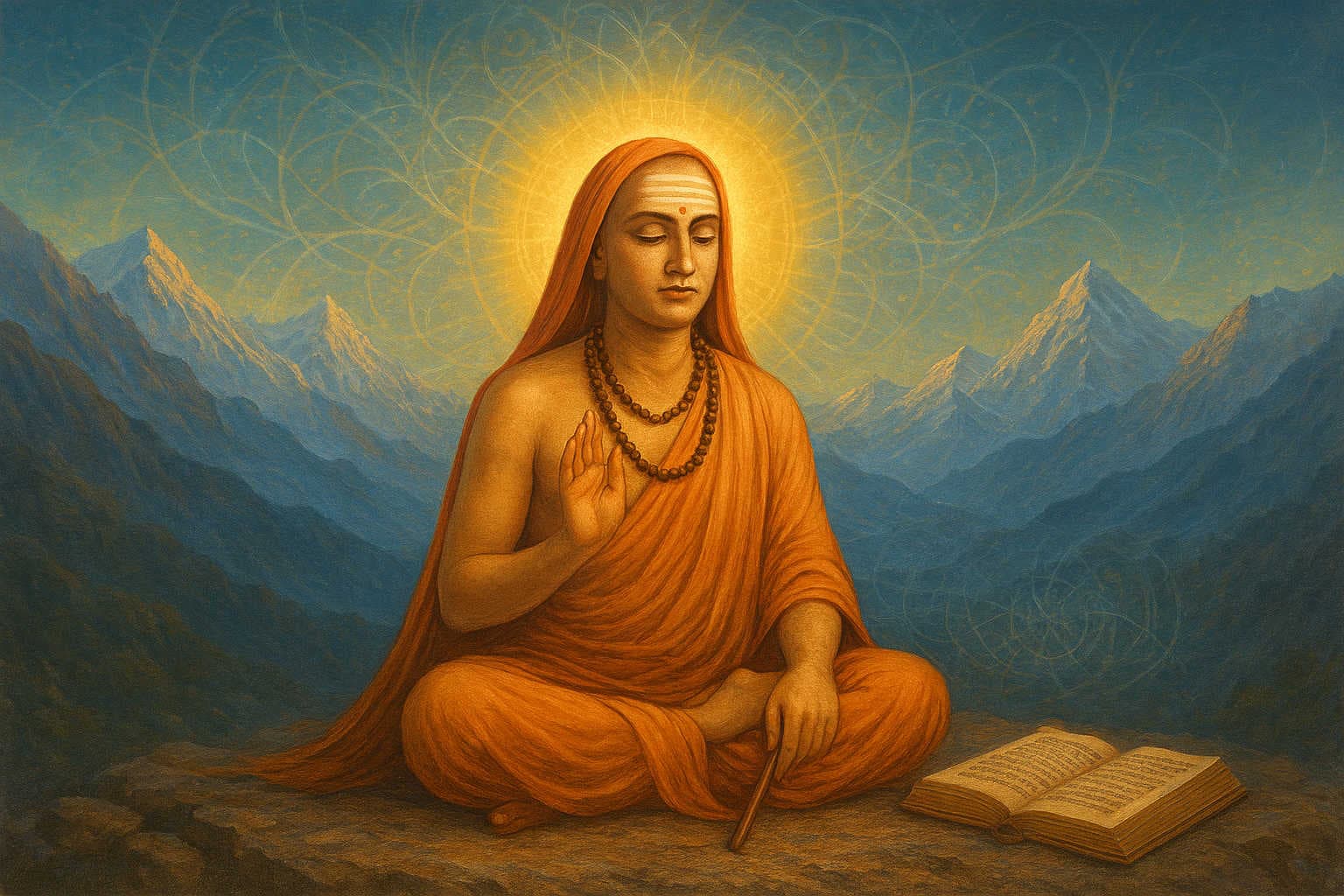
Advaita Vedanta, one of the most influential schools of Hindu philosophy, proclaims a bold and transformative truth: There is only One Reality. Everything else is a projection, an illusion arising from ignorance. This profound non-dualistic teaching was revitalized and systematized by the great philosopher-saint Adi Shankaracharya, who lived in the 8th century CE. His work reshaped Indian spirituality and continues to guide seekers across the world.
Advaita Vedanta draws its authority from the Upanishads, the Brahma Sutras, and the Bhagavad Gita. Through logic, deep meditation, and spiritual insight, Shankaracharya revealed that the essence of every being—Atman—is none other than Brahman, the infinite Supreme Reality. The separateness we perceive is not ultimately real; it is a temporary veil caused by ignorance (Avidya) and illusion (Maya).
This teaching is not just a philosophy—it is a path to liberation, a way of seeing the world as an expression of the divine, and a guide to experiencing the true nature of one’s own soul.
What Is Advaita Vedanta?
The word Advaita means “not-two” or “non-dual.”
Vedanta means “the end of the Vedas,” referring to the Upanishads, which contain the highest spiritual teachings of Sanatan Dharma.
Together, Advaita Vedanta teaches:
-
There is only one ultimate reality—Brahman.
-
The individual soul, Atman, is not different from Brahman.
-
The perception of multiplicity is an illusion caused by Maya.
-
Liberation is attained by dissolving ignorance and realizing this oneness.
This insight is captured in the famous Mahavakya (great saying):
“Aham Brahmasmi” — I am Brahman.
Shankaracharya’s Contribution
Before Adi Shankaracharya, India was filled with diverse philosophical debates and ritualistic interpretations. Shankara restored the purity of the Upanishadic message and emphasized that spirituality is ultimately about direct experience of truth.
His contributions include:
-
Clear commentaries on Upanishads, Bhagavad Gita, and Brahma Sutras
-
Establishment of four monastic centers across India (Mathas)
-
Revival of Vedic wisdom during a time of intellectual and spiritual decline
-
Logical refutation of dualistic and ritualistic interpretations
-
A universal spiritual vision that transcends caste, ritual, and dogma
Shankara’s brilliance lies not just in philosophy but in making complex truths accessible to sincere seekers.
Core Teachings of Advaita Vedanta
1. Brahman – The Only Reality
Brahman is:
-
Infinite
-
Changeless
-
Without form
-
Without attributes
-
Pure consciousness
Everything in the universe is nothing but Brahman appearing in different forms.
2. Atman – The True Self
Atman, the innermost essence of every being, is identical to Brahman. It is eternal and untouched by suffering. Realizing this identity dissolves fear, ego, and the cycle of rebirth.
3. Maya – The Cosmic Illusion
Maya is the mysterious power that makes the One appear as many. It causes humans to identify with body and mind instead of the Self. Maya is neither completely real nor unreal—it is indescribable.
4. Avidya – Ignorance
Ignorance of one’s true nature is the root of all bondage. The moment ignorance is removed through knowledge (Jnana), the truth becomes self-evident.
5. The World – Neither Real nor Unreal
According to Shankara, the world is relatively real.
It appears real while we are under illusion, just as a dream feels real until we wake up. Upon enlightenment, the world loses its independent existence and is seen as a manifestation of Brahman.
The Method of Realization: Jnana Yoga
Advaita emphasizes self-inquiry and knowledge as the primary path to liberation. The method involves:
1. Shravanam – Listening
Studying scriptures and absorbing the teachings from a qualified guru.
2. Mananam – Reflection
Deeply contemplating the teachings until doubts are resolved.
3. Nididhyasanam – Meditation
Meditating on the truth that “I am Brahman” until realization becomes an unbroken experience.
Self-inquiry often takes the form of the question:
“Who am I?”
This removes identification with body, mind, name, form, and ego, revealing the pure consciousness that remains.
The Role of Ethics and Mind Purification
While Advaita emphasizes knowledge, Shankaracharya also taught that the mind must be pure and steady to absorb the truth. This requires:
-
Non-violence
-
Truthfulness
-
Self-control
-
Dispassion
-
Discipline
-
Compassion
-
Inner peace
Without mental purification, the teachings remain intellectual and cannot transform one’s consciousness.
Misunderstandings About Advaita Vedanta
1. “The world is meaningless.”
Advaita does not deny the existence of the world—it denies its independent existence. It teaches detachment, not indifference.
2. “Everything is illusion, so actions don’t matter.”
Actions matter greatly because they purify the mind and reduce ego. Ethical living is essential for spiritual progress.
3. “Advaita is only for monks.”
While monks pursue realization full-time, householders can also walk the path through meditation, devotion, and self-inquiry.
Practical Relevance in Modern Life
Advaita Vedanta offers timeless psychological and spiritual clarity:
-
Dissolves fear by revealing the eternal Self
-
Reduces stress by loosening attachment
-
Encourages inner peace and acceptance
-
Cultivates compassion by seeing the Self in all beings
-
Eliminates ego-driven conflicts
-
Helps understand the purpose of life
Its teachings provide a foundation for living joyfully and wisely in a chaotic world.
The Ultimate Goal: Moksha
The culmination of Advaita Vedanta is Moksha—liberation from ignorance and rebirth.
This is not a journey to a place but a revelation of one’s already liberated nature.
The Upanishads declare:
“Brahman is reality, knowledge, and infinity.
Knowing this, a person becomes free.”
Conclusion
Advaita Vedanta, as taught by Adi Shankaracharya, is a philosophy of absolute oneness. It reveals that the universe, the soul, and the Supreme are not separate—but different expressions of the same consciousness. Through knowledge, meditation, and purity of mind, every human being can experience this divine truth.
In this realization, all sorrow ends, all fear dissolves, and the soul awakens to its infinite nature.
Advaita Vedanta is not just a school of thought—it is the highest vision of unity that liberates the spirit and illuminates the entire world.