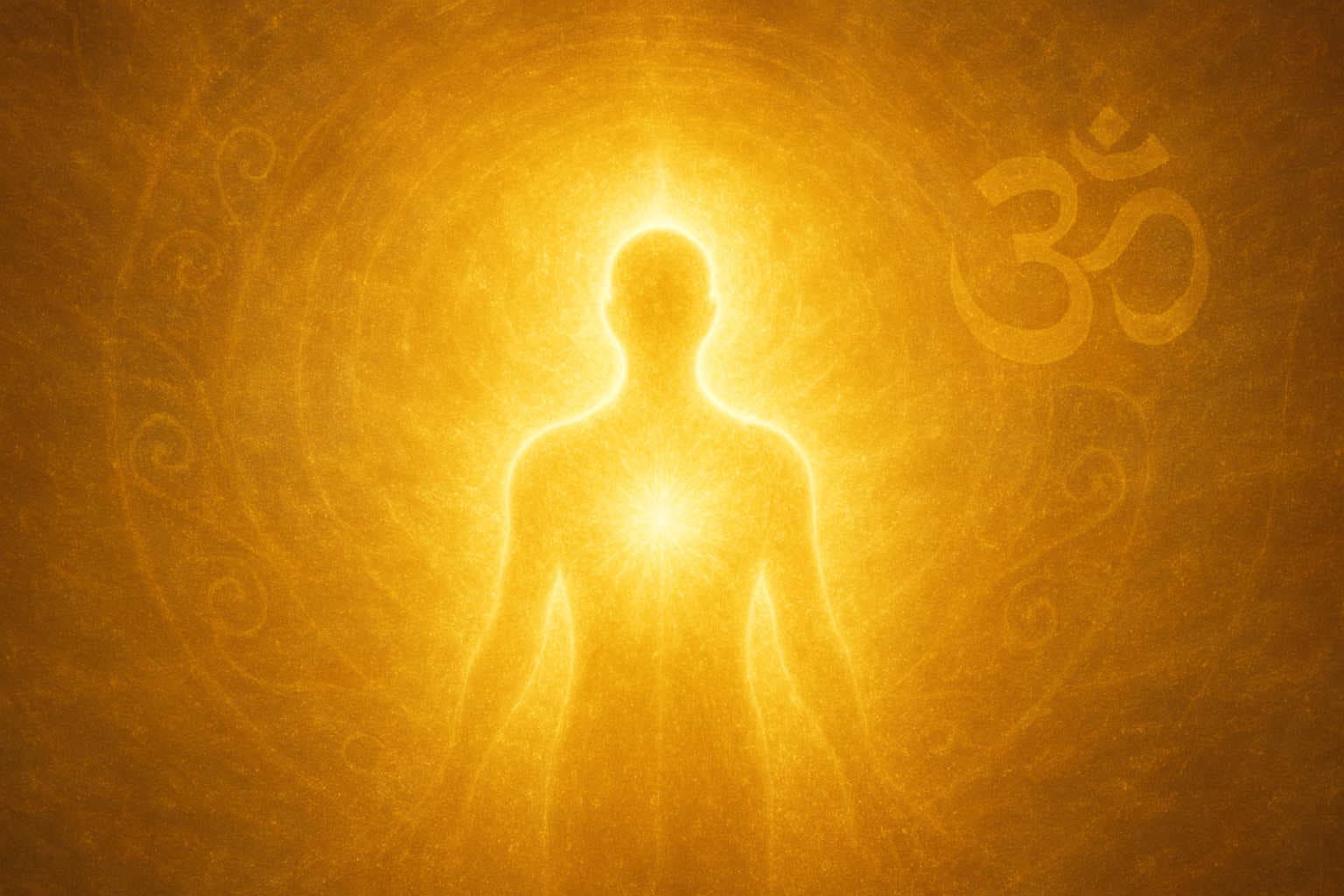
Atman & Brahman – The Soul and the Supreme
Among the most profound and transformative teachings of Sanatan Dharma is the relationship between Atman, the individual soul, and Brahman, the eternal Supreme Reality. These two concepts lie at the heart of the Vedas and Upanishads, forming the foundation of Hindu philosophy, especially Advaita Vedanta. Understanding them is not merely an intellectual exercise—it is a path to self-realization, liberation, and inner peace.
While Atman represents the deepest essence within each being, Brahman is the infinite source from which all creation arises. The great sages of India declared that the ultimate truth of existence lies in recognizing that Atman and Brahman are one and the same. The journey to realizing this unity is the spiritual quest at the core of human life.
What is Atman?
Atman refers to the true Self—the eternal, unchanging essence that lies beneath the layers of body, mind, and emotions. It is not defined by worldly identity, personality, or physical characteristics. The Atman:
-
Is eternal, indestructible, and unborn
-
Is pure consciousness
-
Cannot be harmed by weapons, fire, or decay
-
Transcends time and space
-
Remains untouched by pleasure or pain
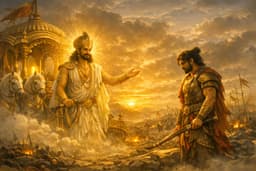
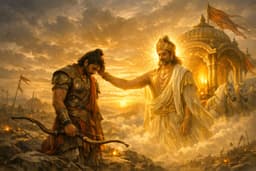
The Bhagavad Gita beautifully states:
“The Self is neither born nor does it ever die.”
The Atman is not something we acquire; it is who we fundamentally are. We are not the body, which ages; nor the mind, which changes; nor the emotions, which rise and fall. We are the witnessing consciousness that remains constant.
What is Brahman?
Brahman is the ultimate reality—the infinite, unchanging, all-pervasive consciousness that is the source and essence of everything. It is beyond form, beyond attributes, and beyond human comprehension. All creation, from galaxies to atoms, exists within Brahman.
The Upanishads describe Brahman as:
-
Sat (absolute existence)
-
Chit (pure consciousness)
-
Ananda (infinite bliss)
Brahman is not a deity in the conventional sense; rather, it is the boundless spiritual reality underlying all gods, beings, and universes. Everything emerges from Brahman, exists in Brahman, and ultimately merges back into Brahman.
The Relationship Between Atman and Brahman
One of the most revolutionary declarations in the Upanishads is:
“Tat Tvam Asi” — Thou art That.
This means that the Atman, the individual soul, is not separate from Brahman. The divine essence within every human is the same as the cosmic essence permeating the entire universe. The separation we perceive between “I” and the world is an illusion—called Maya.
When this illusion dissolves through spiritual insight, the seeker realizes:
-
“I am not the body.”
-
“I am not the mind.”
-
“I am the Eternal Self.”
-
“I am one with the Supreme.”
This realization is the essence of enlightenment.
Why We Fail to See the Unity
If Atman and Brahman are one, why do we experience ourselves as separate beings?
1. Maya – The cosmic illusion
Maya veils our true nature. It makes temporary things seem real and permanent, trapping us in worldly desires and attachments.
2. Avidya – Ignorance
A lack of knowledge of our own divine nature leads us to identify with the body and mind. This ignorance is the root cause of fear, suffering, and rebirth.
3. Ego – The false self
The ego creates a boundary between “me” and “the world.” Once the ego dissolves, unity becomes clear.
The Upanishadic Vision
The Upanishads use beautiful metaphors to explain the unity of Atman and Brahman:
-
The wave and the ocean:
The wave appears separate, but it is nothing but the ocean in another form. -
The spark and the fire:
A spark shares the same nature as the fire from which it emerges. -
Space in a pot vs. space outside:
When the pot breaks, the illusion of separate space disappears.
These illustrations remind us that individuality is temporary—the soul’s true nature is infinite.
How to Realize the Unity: Paths to Self-Realization
The unity of Atman and Brahman is not realized through logic alone but through deeper spiritual practice.
1. Jnana Yoga – The Path of Wisdom
Through self-inquiry and study of scriptures, one asks:
“Who am I?”
By peeling away layers of identity, the seeker discovers the unchanging Self.
2. Bhakti Yoga – The Path of Devotion
Devotion melts the ego. Surrendering to the Divine helps the seeker experience oneness with the Supreme.
3. Dhyana (Meditation)
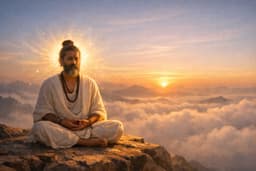
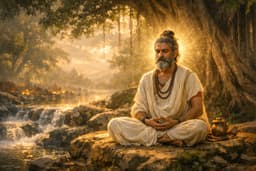
Meditation silences mental noise, allowing pure consciousness to shine through.
4. Karma Yoga – Selfless Action
By working without attachment, one purifies the mind, making it capable of perceiving truth.
The Experience of Realization
When one realizes the unity of Atman and Brahman:
-
Fear disappears, because death is understood as a bodily illusion.
-
Suffering dissolves, as one no longer clings to desires.
-
Compassion arises naturally, as all beings are seen as extensions of the same Self.
-
Inner peace becomes unshakable, independent of external circumstances.
This is the state of Moksha, or liberation.
Practical Relevance of This Teaching
In daily life, the understanding of Atman and Brahman leads to:
-
Greater self-awareness
-
Emotional stability
-
Reduced anxiety and fear
-
A deeper sense of purpose
-
Unconditional love for others
It reminds us that behind every face, every creature, and every moment lies the same divine consciousness.
Conclusion
The relationship between Atman and Brahman is one of the most profound truths taught by the Upanishads. Atman is the divine spark within, while Brahman is the infinite ocean of consciousness. The great revelation of Vedic wisdom is that these two are not separate—they are one.
Realizing this unity transforms the seeker’s life, dissolving fear, ending suffering, and opening the path to liberation. Through devotion, knowledge, meditation, and selfless action, every individual can experience this truth and awaken to the divine presence within themselves.
Atman and Brahman are not merely philosophical ideas—they are the spiritual essence of existence itself.