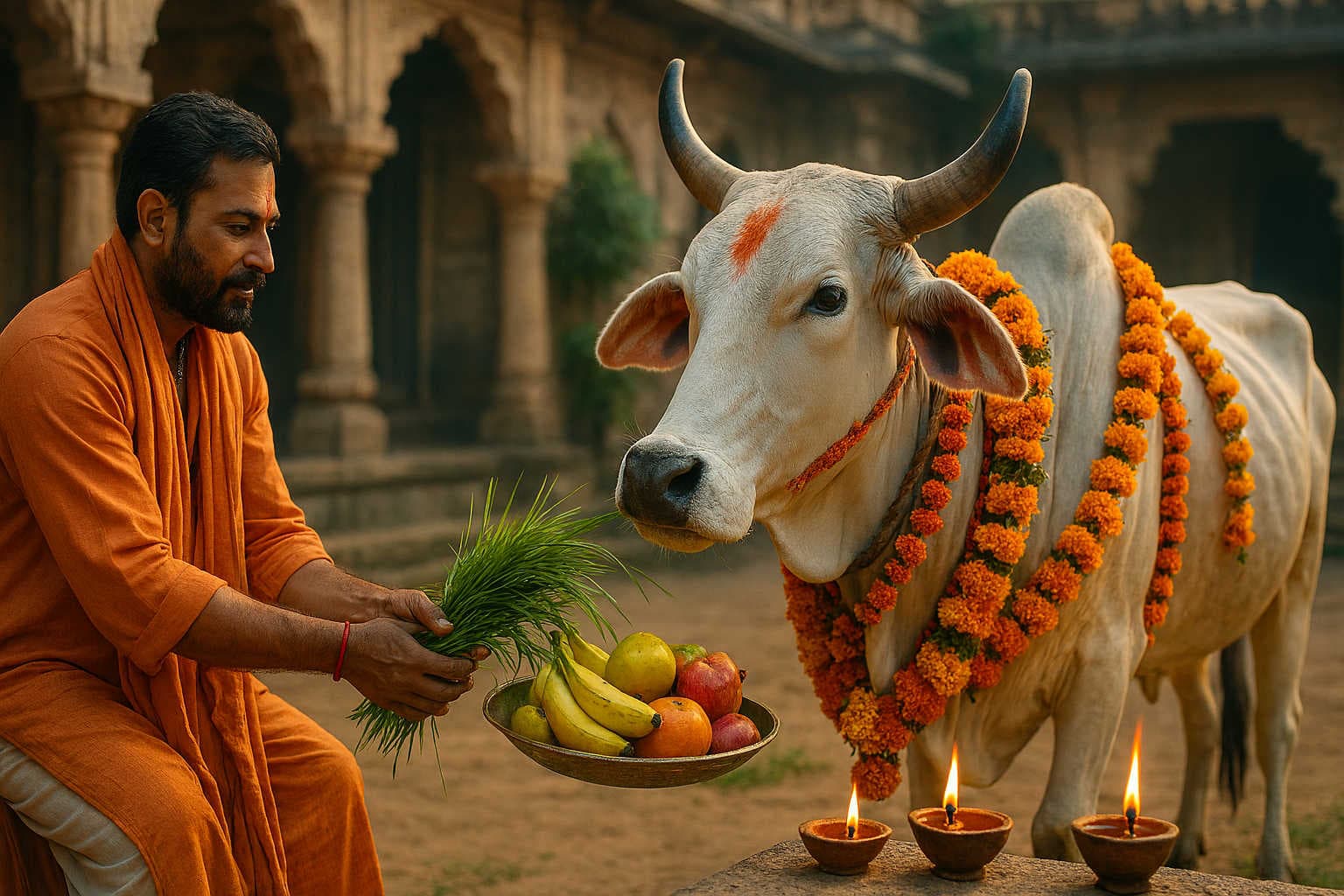
Cow Feeding – A Sacred Duty
In Hindu culture, few acts of devotion are considered as meritorious as feeding cows (Gau Seva). The cow is revered as a symbol of motherhood, nourishment, and divine grace, often addressed as “Gau Mata”—the universal mother. Caring for and feeding cows is not only a spiritual practice but also an ecological and ethical responsibility deeply rooted in Sanatan Dharma.
This article explores the significance of cow feeding, its scriptural basis, methods, and benefits that extend across the physical, spiritual, and social dimensions of life.
The Sacredness of the Cow in Hinduism
The cow holds a unique and exalted position in Hindu thought:
-
The cow is considered the embodiment of all gods and goddesses. Scriptures state, “Sarva Deva Maya Gau”—all deities reside within the cow.
-
Lord Krishna, known as Govinda and Gopala, spent his youth among cows, protecting and nurturing them in Vrindavan.
-
Cows are associated with prosperity and sustenance, providing milk, ghee, curd, and dung—all considered pure and sacred in rituals.
-
The Rigveda praises the cow as Aghnya (never to be killed), highlighting her sanctity since ancient times.
Thus, feeding and protecting cows is equal to serving divinity itself.
Scriptural References to Cow Feeding
Many Hindu scriptures extol the merit of feeding cows:
-
The Mahabharata declares that caring for cows brings more punya (spiritual merit) than elaborate sacrifices.
-
In the Garuda Purana, it is stated that offering food to cows removes sins and ensures peace in the afterlife.
-
Skanda Purana emphasizes that feeding cows during festivals like Ekadashi or Sankranti is especially auspicious.
Because of this, Gau Seva has become an integral practice in daily life as well as during important religious ceremonies.
Why is Feeding Cows a Sacred Duty?
-
Spiritual Merit (Punya) – Feeding cows is believed to wash away sins and grant blessings of health, wealth, and spiritual growth.
-
Symbol of Nurturing – Just as the cow selflessly provides milk, serving her nurtures qualities of compassion and gratitude in humans.
-
Connection with Lord Krishna – Offering food to cows is equivalent to serving Krishna himself, the eternal cowherd.
-
Environmental Harmony – Caring for cows sustains ecological balance, as cow dung and urine are used in organic farming, purifying soil and water.
-
Social Value – Cow shelters (gaushalas) rely on donations and feeding, making this practice an act of charity.
Method of Daily Cow Feeding
Feeding cows can be performed simply and devotionally:
-
Choose the Offering – Cows are fed fresh green grass, vegetables, jaggery, rice, and fruits. In many regions, rotis (chapatis) smeared with ghee are prepared specifically for cows.
-
Cleanliness and Devotion – Food is offered with pure intention, after bathing and prayer.
-
Mantras – While feeding, devotees chant:
“Gavo me, mata gavo me, pita gavo me, swaha”
(The cow is my mother, the cow is my father, the cow is my life.) -
Circumambulation – Devotees often walk around the cow reverently, touching her and seeking blessings.
-
Lighting a Lamp – In temples and gaushalas, lamps are lit near cows in the evening as a sign of respect.
This daily act not only honors the sacred animal but also brings inner satisfaction and peace.
Special Occasions for Cow Feeding
While daily Gau Seva is encouraged, certain days carry special blessings:
-
Monday (Somvar) – Dedicated to Lord Shiva, who is associated with Nandi the bull.
-
Thursday (Guruvar) – Considered auspicious for prosperity and knowledge.
-
Krishna Janmashtami – Feeding cows pleases Lord Krishna.
-
Makar Sankranti and Pongal – Cows are decorated and fed with sweet offerings.
During festivals, entire communities come together to feed cows, turning it into a celebration of divinity and gratitude.
Benefits of Cow Feeding
Spiritual Benefits:
-
Removes karmic debts and obstacles.
-
Grants peace of mind and inner purity.
-
Brings blessings of Goddess Lakshmi for prosperity.
Practical and Social Benefits:
-
Promotes animal welfare and sustains gaushalas.
-
Helps in organic farming and ecological preservation.
-
Strengthens bonds of community service and charity.
Health Benefits (Indirect):
-
Cows produce nourishing dairy that forms a vital part of sattvic (pure) diet.
-
Their dung and urine have medicinal and purifying qualities in Ayurveda.
Thus, Gau Seva serves both the divine and the material world.
Cow as the Universal Mother
Hindus refer to the cow as “Gau Mata” because she nourishes selflessly like a mother. Just as a mother provides food and love without expectation, the cow sustains life by providing milk and other resources. Feeding her is an act of gratitude for this unconditional giving.
This concept is central to Hindu dharma—acknowledging all forms of life as sacred and interconnected.
Conclusion
Cow feeding, or Gau Seva, is more than a ritual; it is a sacred duty that bridges devotion, ecology, and compassion. By feeding and protecting cows, devotees serve both the divine presence embodied in Gau Mata and the greater good of society.
In today’s times, when industrialization and neglect threaten natural harmony, the simple act of offering food to a cow becomes an expression of spiritual responsibility and ecological balance.
As the scriptures say:
“Where cows are happy, gods rejoice. Where cows are protected, dharma thrives.”