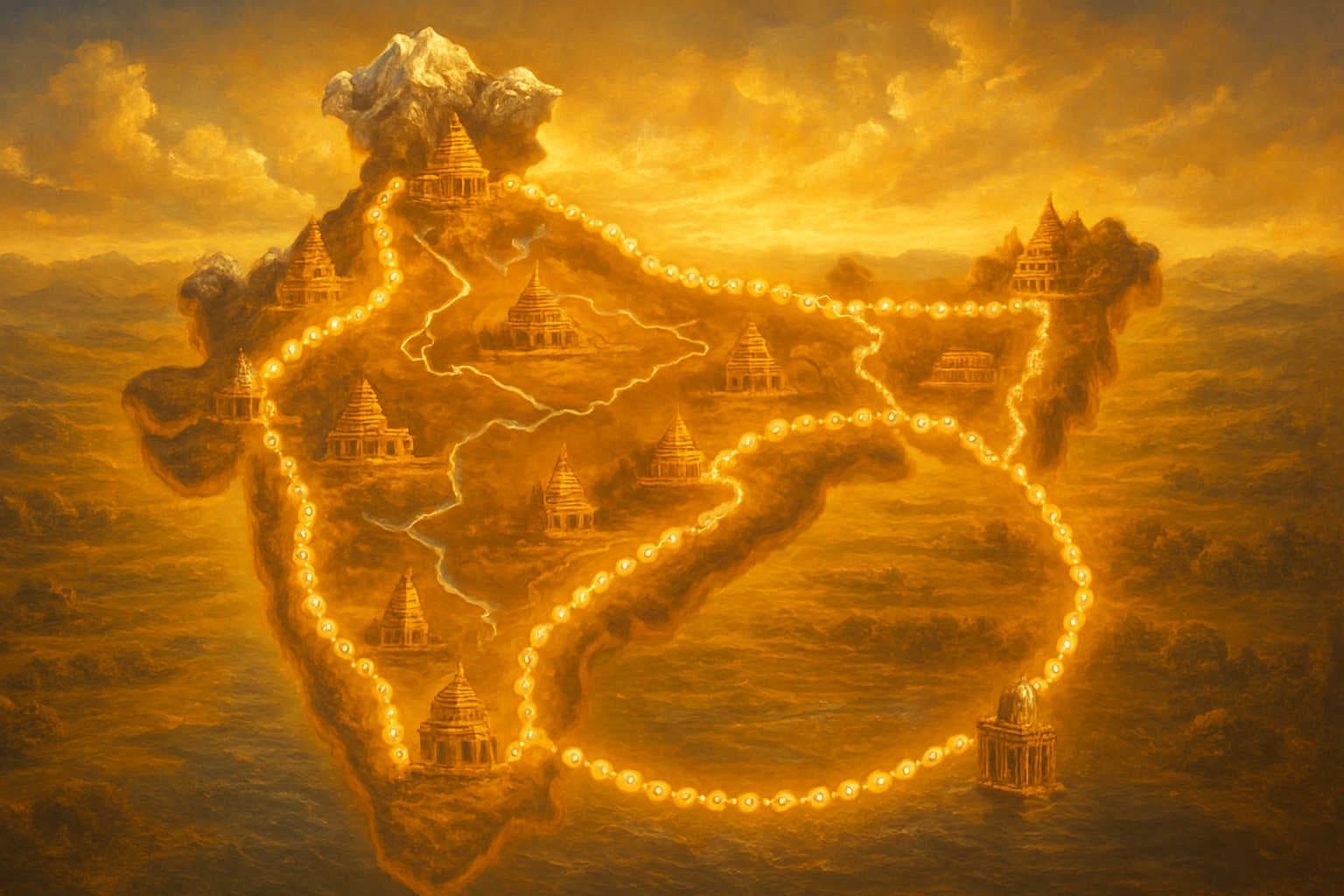
Bharatmala – The Pilgrimage Circuit of India
India has always been seen as the land of spirituality, where rivers, mountains, forests, and temples are not just geographical or architectural wonders, but sacred living presences. Among the various traditions of Hindu pilgrimage, the concept of Bharatmala is deeply symbolic. The word Bharatmala literally means the “Garland of Bharat”, representing a sacred circuit that connects holy shrines, rivers, mountains, and temples into one vast journey of the spirit.
Just as flowers are strung together to form a garland, the shrines of India are bound together in the Bharatmala, symbolizing unity in diversity. For pilgrims, undertaking the Bharatmala Yatra is like traversing the entire sacred geography of India, embracing the wholeness of the land and the divinity that flows through it.
The Idea of Bharatmala
The concept of Bharatmala is both spiritual and cultural. It is not limited to one sect, deity, or region but integrates the different circuits of pilgrimage such as:
-
Char Dham Yatra – Badrinath, Dwarka, Puri, Rameswaram.
-
Sapta Puri – Kashi, Kanchi, Ayodhya, Mathura, Haridwar, Ujjain, Dwarka.
-
Jyotirlinga Circuit – 12 sacred shrines of Lord Shiva across India.
-
18 Shaktipeeths and 51 Shaktipeeths – Shrines of the Divine Mother.
-
Divya Desams – The 108 Vishnu temples glorified in Tamil hymns.
-
Pancha Bhoota Sthalams – Temples of Shiva representing the five elements.
-
Sapta Moksha Puris – Cities of liberation.
Together, these circuits form the Bharatmala, a holistic pilgrimage that embraces every corner of the Indian subcontinent.
Key Pilgrimage Sites in Bharatmala
While Bharatmala can be interpreted differently by traditions, a general outline includes major shrines spread across the four directions of India:
-
North – Himalayas as the abode of Shiva and Shakti, with shrines like Badrinath, Kedarnath, Amarnath, Vaishno Devi, and Haridwar.
-
South – Temples like Rameswaram, Madurai Meenakshi, Kanchipuram, and Tirupati, representing Vishnu, Shiva, and Devi in their grandeur.
-
East – Jagannath Puri, Kamakhya in Assam, Tarapith in Bengal, and Kalighat of Kolkata, symbolizing devotion and Shakti.
-
West – Dwarkadhish of Gujarat, Somnath Jyotirlinga, Mount Abu’s Dilwara temples, and Shamlaji.
Along with these, central India adds to the Bharatmala with Khajuraho, Ujjain’s Mahakaleshwar, and Chhattisgarh’s Bhoramdeo.
Symbolism of the Sacred Garland
The Bharatmala is not just a collection of temples but a spiritual philosophy:
-
Unity in Diversity – Just as different flowers together form one garland, Bharatmala unites Shaiva, Shakta, Vaishnava, and Smarta traditions.
-
Sacred Geography – It acknowledges the land of India as divine, where every river, hill, and forest has sanctity.
-
Spiritual Wholeness – Pilgrimage is not about visiting isolated shrines but weaving together a full experience of the sacred.
Pilgrimage as a Journey of Transformation
The Bharatmala Yatra is more than physical travel; it is a journey of the self. Each temple, city, and river represents a stage of transformation:
-
Rivers like Ganga, Yamuna, and Godavari cleanse sins and purify the soul.
-
Shakti temples empower devotees with courage, protection, and energy.
-
Jyotirlingas deepen devotion to Lord Shiva, reminding one of the eternal cosmic power.
-
Vaishnava shrines like Tirupati and Dwarka guide pilgrims toward surrender and devotion.
In this way, the Bharatmala becomes an inward journey, leading pilgrims from outer travel to inner realization.
Cultural and Social Dimensions
The Bharatmala pilgrimage also reflects India’s cultural fabric:
-
Architecture – From Dravidian temples in the South to Nagara style in the North, Bharatmala showcases India’s architectural diversity.
-
Festivals – The yatra passes through countless festivals like Ratha Yatra in Puri, Navaratri in Gujarat, Kumbh Mela in Prayagraj, and Ambubachi in Assam.
-
Unity of Bharat – Pilgrims from different regions and languages gather in one circuit, strengthening national and cultural identity.
Modern Relevance of Bharatmala
Today, as India modernizes, the Bharatmala Yatra continues to inspire millions. Many spiritual groups organize yatra circuits combining important Shaktipeeths, Jyotirlingas, and Char Dhams. The Indian government’s initiatives to connect pilgrimage centers through better infrastructure also reflect the vision of making Bharatmala accessible to seekers.
For urban devotees, even symbolically visiting or remembering the Bharatmala temples through prayer is seen as spiritually beneficial.
Conclusion
The Bharatmala Pilgrimage Circuit is more than a route across India—it is a garland of sacred experiences, binding temples, rivers, mountains, and people into one spiritual vision. For devotees, it offers a chance to experience the wholeness of Dharma, the unity of traditions, and the eternal sanctity of Bharat as a land of divine energy.
Undertaking the Bharatmala is not merely about visiting temples but about embracing India itself as a temple, where every step becomes a prayer and every destination a shrine.