Pancha Bhoota Sthalams – Shiva as Five Elements
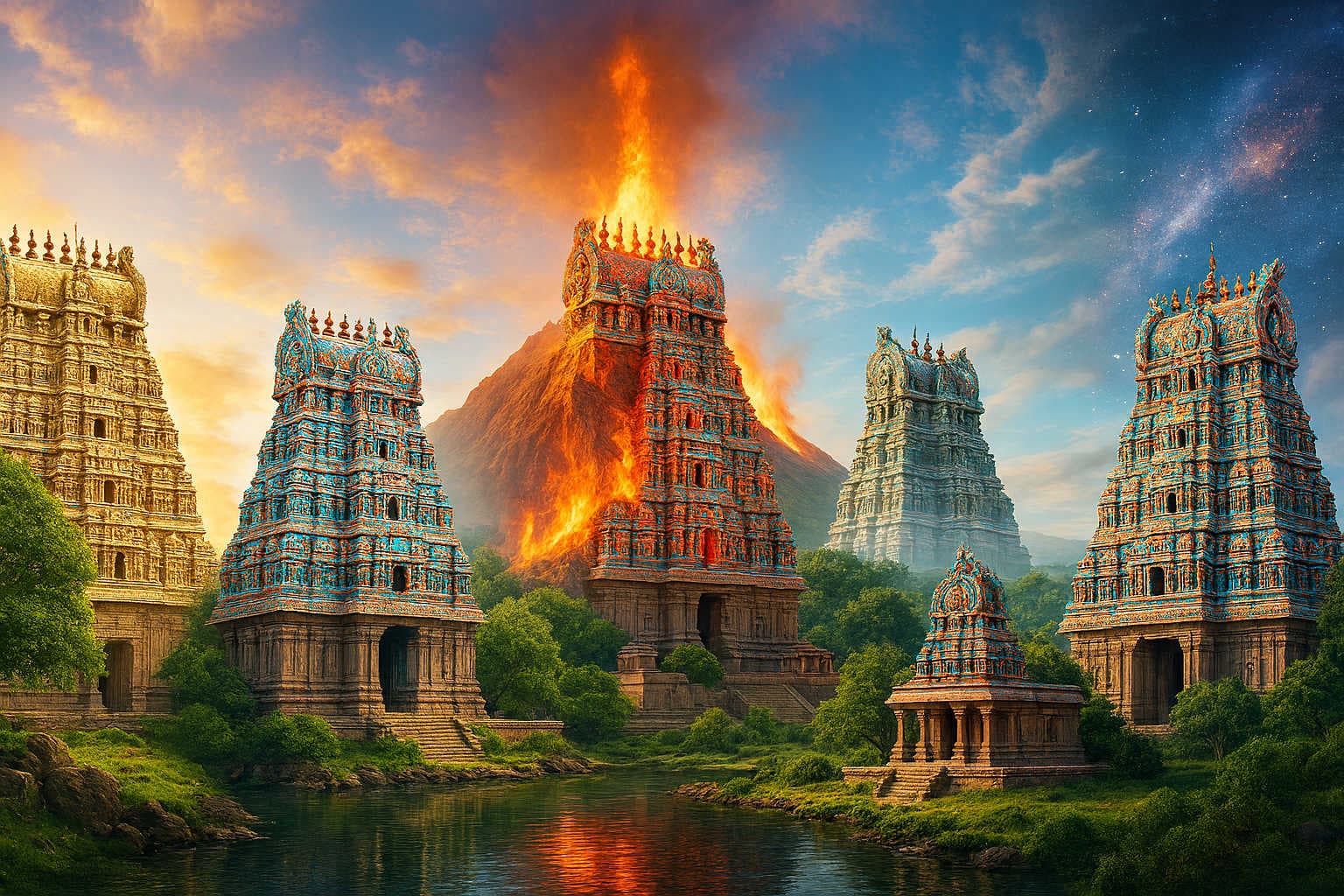
In Hindu philosophy, the universe is composed of the five great elements, or Pancha Bhootas—Earth (Prithvi), Water (Apas), Fire (Agni), Air (Vayu), and Space (Akasha). Lord Shiva, as the eternal cosmic presence, is believed to manifest through these elements in the form of five sacred temples across South India. Collectively known as the Pancha Bhoota Sthalams, these shrines are not only architectural marvels but also profound centers of spirituality, representing the intimate link between the divine and nature.
The Pancha Bhoota Sthalams are spread across Tamil Nadu and Andhra Pradesh, and each temple is associated with one of the five elements. Together, they form a sacred pilgrimage circuit revered by Shaivites and spiritual seekers alike.
1. Ekambareswarar Temple – The Earth Element (Prithvi Lingam)
Located in Kanchipuram, Tamil Nadu, the Ekambareswarar Temple symbolizes the element of Earth. The presiding deity, Lord Shiva, is worshiped here as the Prithvi Lingam.
According to legend, Goddess Parvati performed penance under a mango tree, creating a lingam out of sand to worship Shiva. To test her devotion, Shiva sent floods, but Parvati embraced the lingam, and Shiva appeared, moved by her devotion. The sacred mango tree, believed to be over 3,500 years old, still stands within the temple complex, yielding fruits of four different tastes, symbolizing the unity of the four Vedas.
The temple, sprawling across 25 acres, is one of the largest in South India, with a towering 59-meter Raja Gopuram and intricately carved stone halls. Pilgrims believe that worship at this shrine bestows stability, prosperity, and strength—qualities of the Earth element itself.
2. Jambukeswarar Temple – The Water Element (Appu Lingam)
Situated in Tiruvanaikaval, near Trichy, Tamil Nadu, the Jambukeswarar Temple represents the element of Water. The deity is worshiped as the Appu Lingam.
Legend narrates that Goddess Parvati, as Akilandeswari, once performed penance here under the guidance of Lord Shiva. To symbolize humility, she created a lingam out of water from the Cauvery River and worshiped it. To this day, water continuously flows around the sanctum, making the shrine a living symbol of the water element.
Architecturally, the temple is a masterpiece of Dravidian style, featuring five concentric walls and seven gopurams. Rituals here are unique: every day, the chief priest, dressed as a woman (embodying Parvati), offers worship to Shiva, re-enacting the goddess’s devotion. Devotees believe that worship here purifies the mind and nourishes spiritual life, just as water sustains the body.
3. Arunachaleswarar Temple – The Fire Element (Agni Lingam)
At the base of the sacred Arunachala hill in Tiruvannamalai, Tamil Nadu, stands the Arunachaleswarar Temple, dedicated to the element of Fire. Shiva is worshiped here as the Agni Lingam.
According to mythology, when Vishnu and Brahma quarreled about who was supreme, Shiva appeared as an infinite pillar of fire. Neither deity could find its beginning or end, and thus, Shiva revealed himself as the cosmic truth. To commemorate this, Arunachala hill itself is regarded as a manifestation of Shiva.
Every year, during Karthigai Deepam, a massive lamp is lit atop the hill, visible for miles around, symbolizing the eternal flame of Shiva. Pilgrims also perform the ritual of Girivalam (circumambulation of the hill), believed to cleanse sins and bestow enlightenment. The temple’s towering gopurams, expansive courtyards, and association with saints like Ramana Maharshi make it a spiritual epicenter of Shaivism.
4. Srikalahasteeswara Temple – The Air Element (Vayu Lingam)
The Srikalahasteeswara Temple, located in Srikalahasti, Andhra Pradesh, represents the element of Air. Lord Shiva is worshiped here as the Vayu Lingam.
The temple is renowned for the legend of a spider (Sri), a snake (Kala), and an elephant (Hasti) who worshiped Shiva in their own ways, leading to the name Srikalahasti. The lingam here is said to be self-manifested (Swayambhu) and constantly surrounded by an unseen yet perceptible airflow—symbolizing the element of Vayu.
Srikalahasti is also closely associated with Rahu-Ketu dosha nivarana pujas (remedies for astrological afflictions). The temple’s position near the Swarnamukhi River, along with its intricate carvings and murals, makes it a significant pilgrimage site. Worship here is said to grant freedom, vitality, and spiritual liberation—qualities of the wind.
5. Chidambaram Nataraja Temple – The Space Element (Akasha Lingam)
The Chidambaram Nataraja Temple, located in Tamil Nadu, represents the element of Space (Akasha). It is unique among the Pancha Bhoota Sthalams, as it worships Shiva not merely as a lingam but as Nataraja—the cosmic dancer.
According to legend, Shiva performed his Ananda Tandava (Dance of Bliss) here, symbolizing the eternal rhythm of the cosmos. The sanctum houses the idol of Nataraja and beside it, an empty space veiled by golden curtains, representing the formless Akasha Lingam. This is considered the most subtle of the five elements, beyond the grasp of senses, yet the basis of all existence.
The temple is architecturally magnificent, featuring the Chit Sabha, where the golden-roofed sanctum glows resplendently. Philosophically, Chidambaram embodies the union of spirituality, art, and cosmic truth—where space itself becomes divine.
Spiritual Significance of the Pancha Bhoota Sthalams
Together, the Pancha Bhoota Sthalams are not just temples but a cosmic map of existence:
-
Earth (Stability) – Ekambareswarar, grounding spiritual life.
-
Water (Purity) – Jambukeswarar, cleansing body and mind.
-
Fire (Transformation) – Arunachaleswarar, burning ignorance.
-
Air (Freedom) – Srikalahasteeswara, granting liberation.
-
Space (Infinity) – Chidambaram, symbolizing transcendence.
Pilgrimage to all five temples is considered highly auspicious, believed to harmonize the devotee with the five elements of nature, leading to balance and spiritual awakening.
Conclusion
The Pancha Bhoota Sthalams represent the essence of Hindu cosmology: that the divine permeates all aspects of creation. By venerating Shiva in his elemental forms, devotees connect not only with God but with the very building blocks of existence. From the grounding earth of Kanchipuram to the infinite space of Chidambaram, these shrines embody the journey of the soul—from material stability to spiritual liberation.
For seekers, visiting the Pancha Bhoota Sthalams is not just a pilgrimage but a transformative journey through the elements, culminating in the realization that Shiva is both the universe and the soul within.