63 Nayanars and 12 Alvars – Bhakti Through Pilgrimage
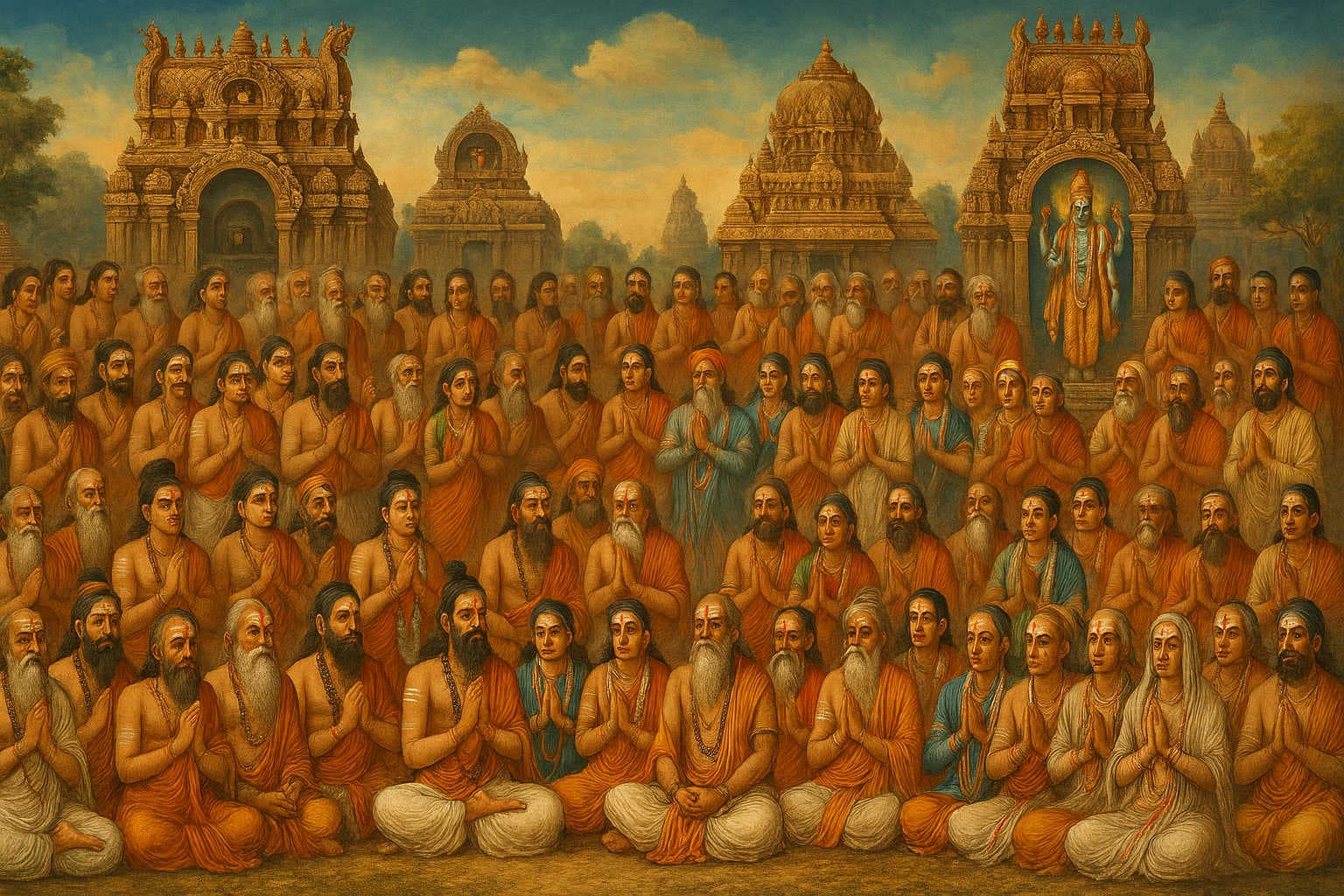
The Bhakti movement in South India is one of the most remarkable chapters in India’s spiritual history. At its heart stand two groups of saints: the 63 Nayanars of Shaivism and the 12 Alvars of Vaishnavism. Their hymns, songs, and personal lives, filled with devotion, transformed religious practice into an intimate, emotional, and accessible form of worship. For centuries, these saints have inspired millions of devotees, shaping the culture of Tamil Nadu and spreading the essence of Bhakti across India.
The Nayanars – Devotees of Shiva
The 63 Nayanars were Shaivite saints who lived between the 6th and 9th centuries CE. Coming from diverse backgrounds—kings, peasants, hunters, potters, women, and even untouchables—they exemplified that love for Shiva transcends social divisions.
Their hymns are preserved in the Tirumurai, a twelve-volume collection of Shaiva devotional poetry, which remains central to Shaivite liturgy today. Among them, Appar (Tirunavukkarasar), Sundarar, and Sambandar are regarded as the most prominent. Their verses were sung in temples and eventually canonized, elevating Tamil devotional poetry to a spiritual tradition.
Some Nayanars, like Kannappa, expressed devotion through extraordinary acts—Kannappa famously plucked out his own eyes to offer them to Shiva. Others, like Karaikkal Ammaiyar, renounced worldly life, wandering as a ghostly devotee singing praises of Shiva. Each life story became a parable of unconditional devotion.
The Nayanars also played a key role in reviving Shaivism during times when Jainism and Buddhism were influential in South India. Their songs rekindled temple culture, encouraging people to see temples not just as ritual spaces but as centers of emotional and personal devotion.
The Alvars – Devotees of Vishnu
Parallel to the Nayanars, the 12 Alvars were saint-poets devoted to Lord Vishnu, active between the 6th and 9th centuries CE. Their compositions, known as the Nalayira Divya Prabandham, consist of over 4,000 hymns glorifying Vishnu and his abodes, especially the 108 Divya Desams (sacred Vishnu temples).
Like the Nayanars, the Alvars came from diverse castes and walks of life. Nammalvar, considered the foremost among them, composed verses filled with mystical experiences of union with the divine. Andal, the only woman Alvar, expressed her devotion through love-poetry, envisioning herself as the bride of Lord Ranganatha of Srirangam. Her hymns, especially the Tiruppavai, are sung daily across South Indian temples.
The Alvars’ contribution was not merely literary. They shaped Sri Vaishnavism, providing the devotional foundation that would later be codified by theologians like Ramanuja. For them, Bhakti was the highest path, one that could transcend karma and lead directly to moksha (liberation).
Unity in Diversity – Two Currents of Bhakti
Though the Nayanars and Alvars were devoted to different deities—Shiva and Vishnu—their central message was the same: Bhakti as the path to God. Both groups emphasized:
-
Personal devotion over ritual – True worship came from the heart, not just from elaborate rituals.
-
Inclusivity – Devotees from all castes, genders, and social positions could achieve the highest spiritual state.
-
Sacred geography – Temples and pilgrimage became integral, with hymns tied to specific shrines, making the landscape itself a living canvas of devotion.
This inclusivity and focus on love for God laid the groundwork for the larger Bhakti movement across India, influencing later saints like Mirabai, Tulsidas, and Kabir.
Pilgrimage and Sacred Landscapes
One of the most enduring contributions of the Nayanars and Alvars is their mapping of sacred space through hymns.
-
The Nayanars’ Tirumurai describes hundreds of Shaiva temples across Tamil Nadu, turning the region into a sacred landscape of Shiva. The Pancha Bhoota Sthalas (five elemental temples) and the many shrines of Chidambaram, Madurai, and Kanchipuram became central pilgrimage destinations.
-
The Alvars’ Prabandham celebrates the 108 Divya Desams, including major centers like Srirangam, Tirupati, and Badrinath, extending the sacred geography beyond Tamil Nadu to the entire Indian subcontinent.
Through their songs, these saints transformed temples into living centers of Bhakti, where devotion was expressed through music, dance, festivals, and pilgrimage.
Cultural Impact
The legacy of the Nayanars and Alvars extends far beyond religion:
-
Tamil Literature – Their hymns elevated Tamil as a sacred language, making it a vehicle of divine expression.
-
Temple Rituals – Daily temple liturgies often include recitations of their hymns.
-
Performing Arts – Bharatanatyam and Carnatic music often draw from their devotional works.
-
Festivals – Annual festivals, such as the Arupathumoovar procession in Chennai, celebrate the Nayanars, while Andal’s Aadi Pooram festival is one of Tamil Nadu’s most beloved celebrations.
Their devotional works continue to inspire poetry, music, and drama, ensuring that the flame of Bhakti remains alive.
The Message of Bhakti
At their core, the lives and hymns of the Nayanars and Alvars convey a timeless truth: God is accessible to all through love and surrender. Their message broke down barriers of caste, gender, and ritual complexity, emphasizing that the divine resides in the heart of the devotee.
This Bhakti spirit continues to resonate, not only in Tamil Nadu but throughout India and beyond. By walking in the footsteps of these saints—visiting the temples they praised, singing their hymns, and embodying their devotion—pilgrims participate in a living tradition that spans more than a millennium.
Conclusion
The 63 Nayanars and 12 Alvars are not just historical figures but luminous beacons of the Bhakti path. Through their songs and sacrifices, they redefined spirituality, making devotion the heart of Hindu practice. Their contributions continue to inspire millions, reminding us that the path to God is not bound by birth, ritual, or status, but by the depth of love within the devotee’s heart.
The Bhakti movement they championed transformed the religious, cultural, and spiritual landscape of India—and their legacy of pilgrimage and song remains a timeless invitation to divine love.