Maa Tarini Temple – Odisha’s Forest Goddess
Among the many sacred shrines of Odisha, the Maa Tarini Temple in Ghatagaon, Keonjhar district, holds a special place in the hearts of devotees. Known as the Forest Goddess of Odisha, Maa Tarini is not only a divine mother figure but also a fierce protector who is believed to safeguard her children against misfortune, dangers, and enemies. Her worship is deeply intertwined with Odisha’s tribal traditions, folk culture, and ancient spiritual practices.
The temple is a vibrant confluence of faith, simplicity, and nature. Nestled amidst dense forests, the shrine attracts lakhs of devotees every year, who come to seek the blessings of Maa Tarini, revered as one of the most compassionate and approachable goddesses of the region.
Origins and Legends of Maa Tarini
The name Tarini is derived from the Sanskrit word Tarana, meaning “to save” or “to protect.” True to her name, Maa Tarini is worshipped as the savior goddess who rescues her devotees from calamities and grants them strength in life.
One popular legend tells that King Purusottam Dev of the Gajapati dynasty brought Maa Tarini from Puri to Keonjhar. It is said that when the king was returning with the goddess’s idol, he had to halt at Ghatagaon. Maa Tarini expressed her wish to stay there permanently amidst the forests, and thus, her shrine was established in its present location.
Another story states that Maa Tarini was originally worshipped by local tribal communities, especially the Bhuyan tribe, long before she became a mainstream deity. The assimilation of tribal worship with Hindu practices reflects the cultural inclusiveness of Odisha’s spiritual traditions.
The Temple and Its Architecture
Unlike grand stone temples such as the Lingaraj or Konark Sun Temple, the Maa Tarini Temple is marked by its simplicity. The shrine does not focus on architectural grandeur but emphasizes direct devotion and accessibility to the goddess.
-
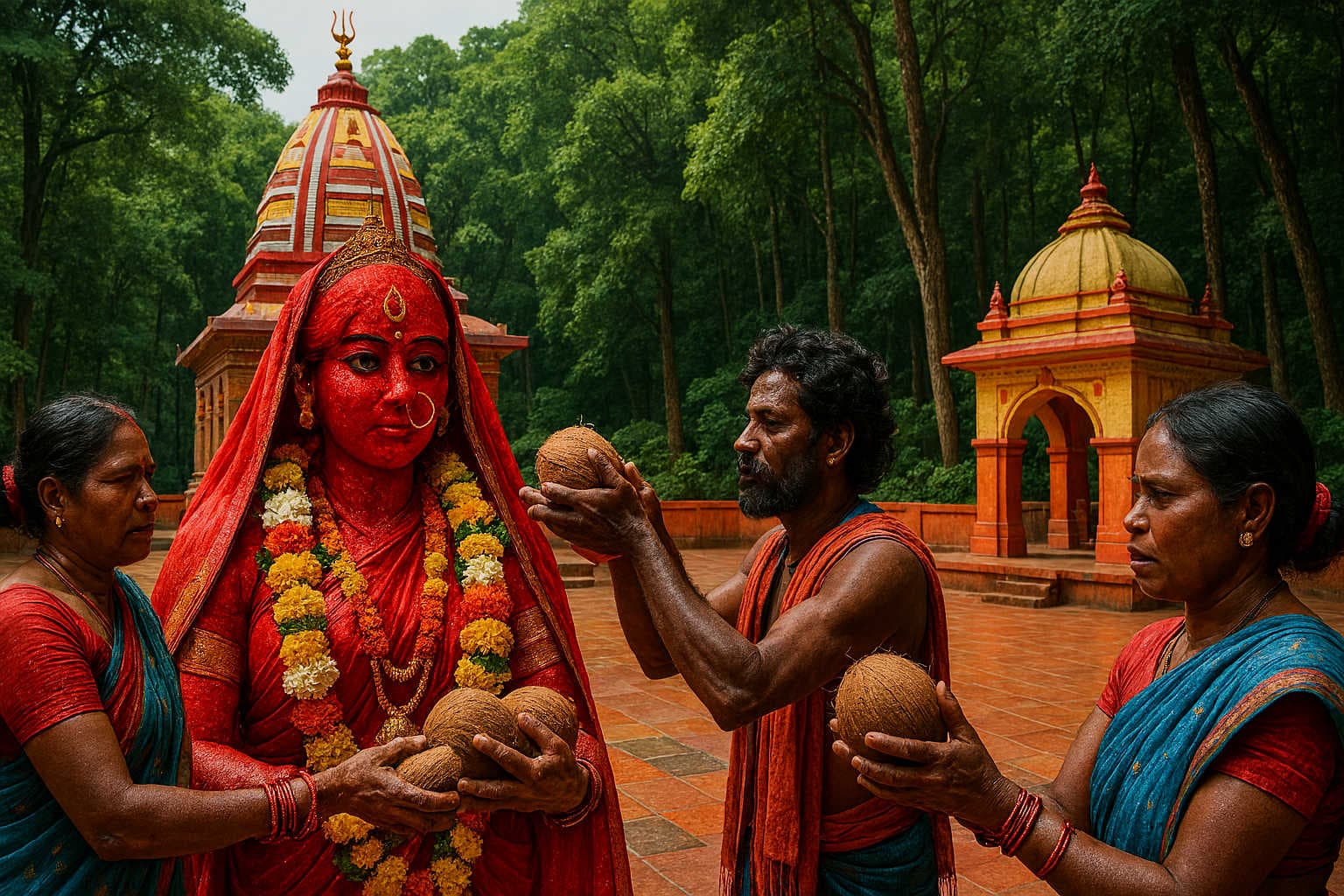
The Idol: The deity is represented not in human form but as a large stone idol smeared with vermilion (sindoor) and adorned with a red cloth. This raw and unembellished form connects strongly with the tribal roots of her worship.
-
Sanctum: The sanctum is a modest chamber, yet it radiates immense spiritual energy. Devotees often experience a sense of maternal love and reassurance upon entering the shrine.
-
Surroundings: The temple complex is surrounded by lush forests, reinforcing Maa Tarini’s identity as the forest goddess who thrives in the lap of nature.
The simplicity of the temple is its true charm—it embodies devotion without ostentation.
Rituals and Worship
The rituals at Maa Tarini Temple are unique and simple, reflecting the goddess’s tribal origins.
-
Offering of Coconuts: The most important ritual is the offering of coconuts. Thousands of coconuts are offered daily by devotees as a symbol of surrender and devotion.
-
Sindoor and Red Cloth: The idol is perpetually adorned with vermilion and draped in red cloth, representing strength, power, and motherhood.
-
Festivals: The temple comes alive during Chaitra Mela (March–April), when lakhs of devotees gather to celebrate the goddess. During Durga Puja and Magha Mela, the shrine also witnesses massive crowds.
-
Tribal Traditions: Tribal groups from surrounding forests continue to worship Maa Tarini with their own folk rituals, songs, and dances, keeping alive centuries-old traditions.
Maa Tarini as the Mother Goddess
To her devotees, Maa Tarini is more than a deity—she is the universal mother. Pilgrims believe she responds quickly to prayers, fulfilling wishes related to health, family, and livelihood. Her compassionate nature makes her especially beloved among rural and tribal communities.
In Odisha’s folk culture, Maa Tarini is often invoked in songs, proverbs, and village rituals. She is regarded as a protector of travelers and warriors, ensuring safe journeys and victory in battles. Many truck drivers and traders in Odisha also keep her image or symbol on their vehicles, seeking her blessings for protection on the road.
The Annual Chaitra Festival
The Chaitra festival, held in March–April, is the biggest annual event at Maa Tarini Temple.
-
Devotees from across Odisha, Jharkhand, and West Bengal arrive barefoot, carrying offerings on their heads.
-
Folk music, traditional dances, and devotional songs fill the air.
-
Tribal groups participate in large numbers, showcasing their cultural expressions and deep-rooted devotion to the goddess.
This festival not only strengthens religious devotion but also highlights the unity of Odisha’s diverse communities under the motherly care of Maa Tarini.
Cultural and Social Significance
Maa Tarini Temple is not just a religious site—it is a cultural landmark.
-
The goddess’s worship reflects the fusion of tribal spirituality and Hindu traditions, making it a symbol of inclusivity.
-
It serves as a center of faith for millions, cutting across caste, class, and community barriers.
-
Her protective image resonates strongly with rural and marginalized groups, giving them hope and strength in everyday struggles.
The temple also plays a vital role in the local economy, with fairs, markets, and tourism generating livelihood opportunities for the surrounding villages.
Visiting the Temple
-
Location: The temple is situated in Ghatagaon, Keonjhar district, about 200 km from Bhubaneswar.
-
Best Time to Visit: October to March offers pleasant weather, though the temple is open year-round. The Chaitra festival is the most vibrant time to visit.
-
Accessibility: Ghatagaon is well-connected by road, with frequent buses from Bhubaneswar, Cuttack, and Keonjhar.
Conclusion
The Maa Tarini Temple of Ghatagaon is not just a shrine—it is a living embodiment of Odisha’s cultural and spiritual ethos. Rooted in tribal worship yet embraced by all, Maa Tarini stands as a symbol of protection, compassion, and strength.
Her temple’s simplicity, the deep forest surroundings, and the heartfelt devotion of millions make it a unique place of worship. For devotees, she is the eternal mother who saves and nurtures; for travelers, she is a window into Odisha’s rich traditions; and for the land itself, she is the Forest Goddess who continues to guard her children with love and power.