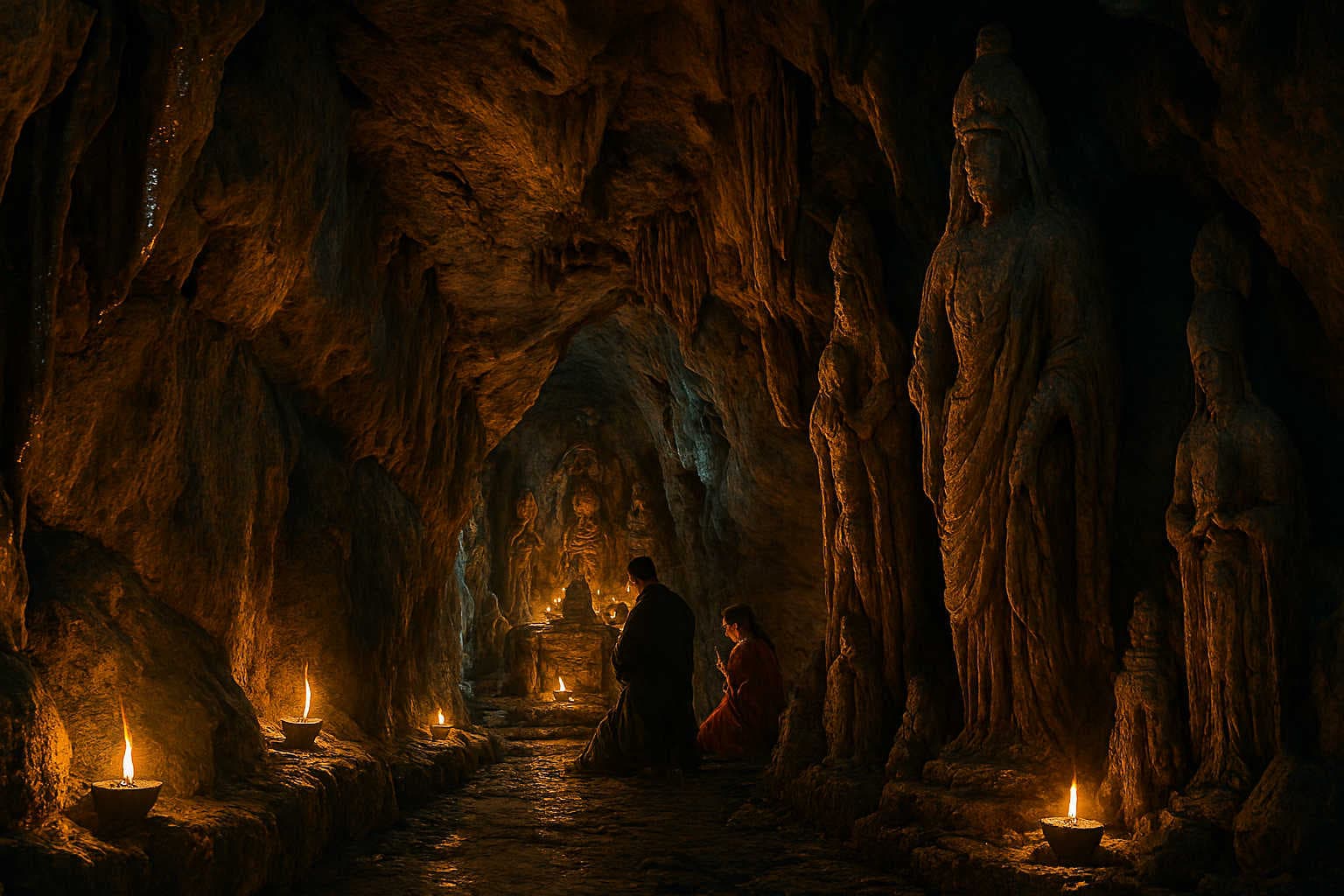
Patal Bhubaneshwar – Cave Temples of the Divine
High in the Kumaon region of Uttarakhand, tucked away in the quiet pine forests, lies one of India’s most mysterious and sacred sites – Patal Bhubaneshwar. Unlike grand stone temples or towering shikharas, this shrine is hidden deep inside a limestone cave. To enter it is to journey not only into the heart of the earth but also into the heart of Sanatan spirituality.
Revered as a place where the divine, the cosmic, and the mythical converge, Patal Bhubaneshwar is described in scriptures like the Skanda Purana as a site that holds within its womb the presence of countless deities, sages, and even the underworld realms.
The Mythical Origins
According to legend, Patal Bhubaneshwar was first discovered in Treta Yuga by King Rituparna, a ruler of the Surya dynasty. However, it was in Kali Yuga that the sage Shankaracharya rediscovered the cave in the 8th century CE, re-establishing it as a pilgrimage site.
The Skanda Purana describes the cave as a microcosm of the universe itself – a place where the gods reside in secret forms. Devotees believe that visiting Patal Bhubaneshwar is equivalent to visiting all the four dhams of Uttarakhand – Badrinath, Kedarnath, Gangotri, and Yamunotri.
The Cave Experience
Reaching the sanctum of Patal Bhubaneshwar is an adventure in itself.
-
The Descent: Devotees crawl through a narrow tunnel, barely wide enough for a single person. The steep passage is slippery, and one must use chains or support ropes to navigate down.
-
The Inner Chambers: Once inside, the cave opens into multiple chambers with stalactites and stalagmites. These natural formations are believed to resemble various gods, animals, and mythical figures.
-
The Atmosphere: Dimly lit by oil lamps, the cave exudes an aura of mystery, silence, and sacredness. The air is cool and moist, and every sound echoes, amplifying the spiritual mood.
Divine Forms Inside the Cave
The cave is said to house representations of gods and myths in stone forms created by nature itself:
-
Sheshnag – A massive rock formation resembling the thousand-hooded serpent said to support the earth.
-
Kailash Parvat – Stalactites that look like the abode of Lord Shiva.
-
Ganesha’s Trunk – A natural structure shaped like Lord Ganesha’s elephant trunk.
-
Amarnath Ice Lingam Connection – Some say the cave has a secret connection to Amarnath in Kashmir, another sacred cave of Shiva.
-
Doorways to Patal Lok – Legends claim that deep recesses of the cave lead to the netherworld, where gods and demons once roamed.
The most remarkable aspect is that all these images are not carved by human hands but are the natural result of centuries of mineral deposition – a sign to devotees of divine presence manifesting in nature itself.
Spiritual Significance
The symbolism of Patal Bhubaneshwar runs deep:
-
Journey Within – Entering the cave is symbolic of the seeker’s journey into the inner self, leaving behind the external world.
-
Unity of Faiths – The cave is sacred not only to Shaivites but also to Vaishnavites and Shakti devotees, as forms of Shiva, Vishnu, Durga, and other gods are said to be present here.
-
Cosmic Microcosm – Believers see the cave as a condensed version of the cosmos, where heaven, earth, and the underworld converge.
Pilgrimage and Rituals
The temple is a living place of worship. Priests from the Bhandari family, said to be serving here for over a thousand years, perform daily rituals. Pilgrims offer flowers, bel leaves, and incense at natural rock formations believed to embody the divine.
During Shivratri, thousands of devotees gather here to honor Lord Shiva, with chants of “Har Har Mahadev” reverberating through the cave’s chambers.
Visiting Patal Bhubaneshwar
-
Location: Pithoragarh district, Kumaon region, Uttarakhand.
-
Altitude: Around 1,350 meters above sea level.
-
Access: The cave is reached after a short trek through dense pine forests, offering beautiful views of the Himalayas.
-
Best Time to Visit: April to June and September to November, when the weather is pleasant. Monsoons and heavy snow in winters can make the journey difficult.
The journey itself feels like a pilgrimage – walking through forest trails, descending into the earth, and emerging into light again after darshan.
Cultural and Historical References
Over centuries, saints, yogis, and poets have praised Patal Bhubaneshwar. Local folklore is filled with stories of divine visions and miracles linked to the cave. Some believe that meditating here can grant deep spiritual experiences, as the cave is charged with mystical energies.
Even today, scholars and geologists marvel at the natural formations, while devotees see them as proof of faith. The site remains a fascinating intersection of science, spirituality, and mythology.
Conclusion
The Patal Bhubaneshwar Cave Temple is not just a monument but a living experience of the sacred. It embodies the mysteries of the underworld, the power of nature, and the devotion of countless pilgrims. To step inside is to step into a different realm – one where myth and reality blur, and where the seeker feels the divine presence in every stone and shadow.
For those who seek spirituality beyond grand structures and rituals, Patal Bhubaneshwar offers something profound – a reminder that the divine resides not just above in the skies but also deep within the womb of the earth.