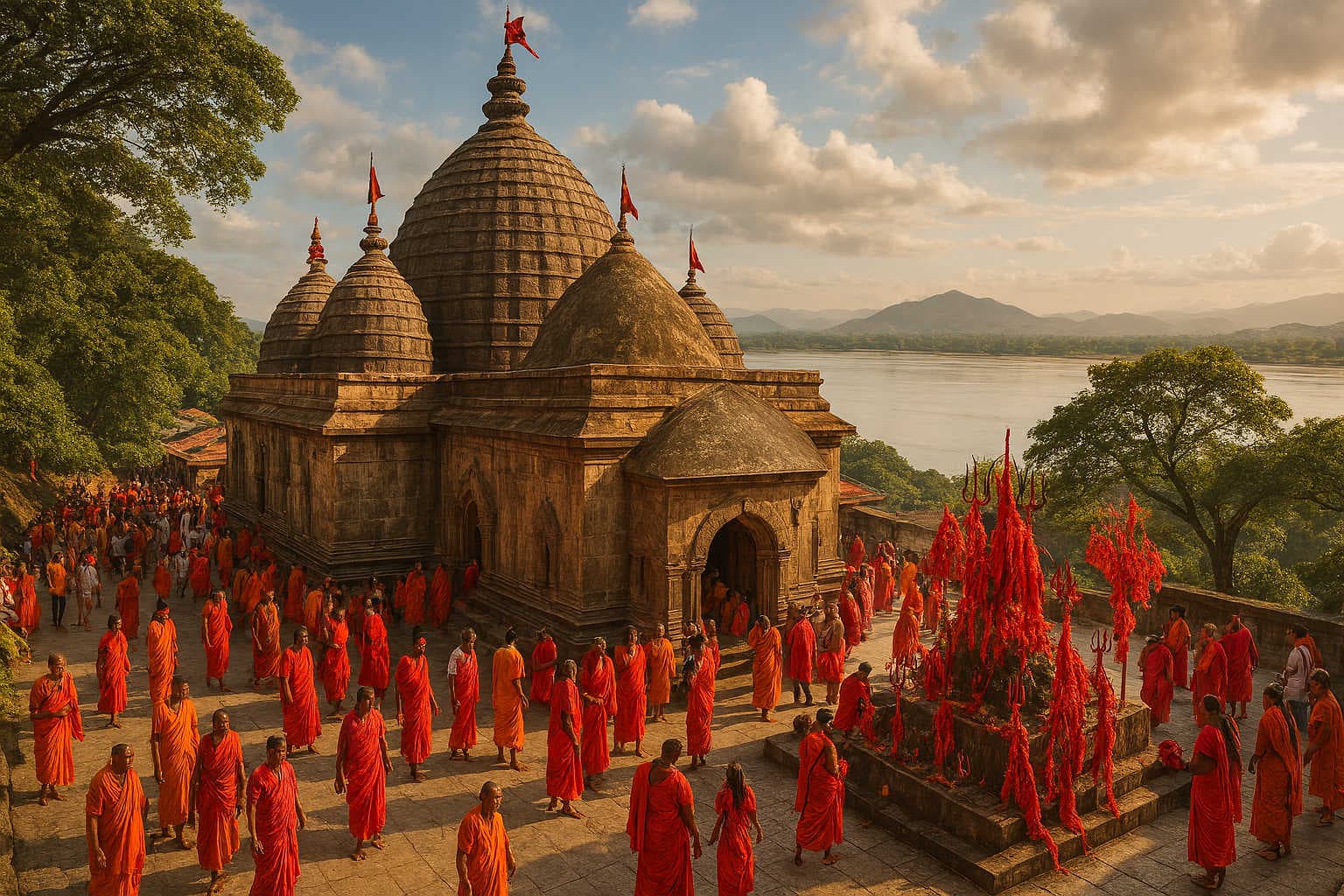
Kamakhya – Tribal and Tantric Traditions
On the sacred Nilachal Hill in Guwahati, Assam, stands one of the most enigmatic temples of India — the Kamakhya Temple. Unlike most Hindu temples that worship deities in anthropomorphic forms, Kamakhya celebrates the yoni (female generative organ) of the goddess, symbolizing Shakti, fertility, and the power of creation.
This temple is not only one of the 51 Shakti Peethas but also a vibrant blend of tribal faiths, tantric practices, and mainstream Hinduism. To step into Kamakhya is to enter a space where ancient fertility cults merge seamlessly with esoteric tantric worship, making it both revered and mysterious.
The Legend of Kamakhya
The origin of Kamakhya is deeply linked with the story of Sati and Shiva. When Sati immolated herself at Daksha’s yagna, Lord Shiva, stricken with grief, carried her body across the cosmos. Lord Vishnu, to save the world from destruction, cut her body into pieces with his Sudarshan Chakra. These body parts fell across the Indian subcontinent, forming the Shakti Peethas.
It is believed that Sati’s yoni fell on Nilachal Hill, and here arose the Kamakhya shrine. Worship at this temple, therefore, celebrates the divine feminine in her most primal, creative form.
The Temple and Its Architecture
The present Kamakhya Temple, rebuilt in the 17th century by the Koch kings, stands as a blend of Nagara and local styles. Its most striking feature is the beehive-shaped shikhara, adorned with sculpted panels of gods, goddesses, and floral motifs.
Unlike most temples where devotees see the deity in idol form, Kamakhya houses a yoni-shaped stone set in a cleft, perpetually washed by an underground spring. This sacred spot is considered the very embodiment of the goddess.
Around the main temple are several smaller shrines dedicated to other forms of the goddess, collectively called the Dasa Mahavidyas (Ten Wisdom Goddesses).
Tribal Roots of Kamakhya
Long before it became part of the Shakti Peeth tradition, the hill of Kamakhya was worshipped by the Khasis and other tribal groups of the region. For them, the goddess represented fertility, nature, and the cycles of life. Animal sacrifice, a common tribal practice, became associated with the temple and continues in controlled forms even today, though increasingly symbolic.
Thus, Kamakhya represents a rare case where tribal goddess worship was absorbed into mainstream Hinduism, retaining its distinct identity while gaining pan-Indian recognition.
Tantric Traditions at Kamakhya
Kamakhya is also the most important tantric center of India. Tantra, often misunderstood, is a spiritual path emphasizing direct experience of the divine through rituals, mantras, and energy practices.
At Kamakhya, tantra is not about external show but about accessing Shakti — the raw power of the feminine. The temple is particularly associated with left-hand tantra (Vamachara), which integrates unconventional rituals like offerings of meat and liquor, symbolizing transcendence of societal norms to reach higher truths.
The temple priests, known as Bhairavas, perform esoteric rites during specific times, especially at night, aligning with the goddess’s fierce aspects.
The Ambubachi Mela – Festival of Fertility
The most famous festival of Kamakhya is the Ambubachi Mela, held in June. It marks the annual menstruation of the goddess, when the temple remains closed for three days. Devotees believe that during this time, the earth itself becomes fertile.
On the fourth day, the temple reopens with grand celebrations, and pilgrims receive Angodak (holy water) and Angvastra (blessed cloth) believed to carry the goddess’s power.
The mela draws thousands of sadhus, aghoris, tantrics, and pilgrims, creating a surreal atmosphere where orthodoxy, mysticism, and faith converge.
Other Rituals and Practices
-
Animal Sacrifice – Goats and buffaloes are sometimes offered, especially during Durga Puja, though many devotees choose symbolic substitutes now.
-
Shakti Pooja – Special pujas are performed to the goddess in her forms as Dasa Mahavidyas, each representing a facet of divine power.
-
Fertility Blessings – Women seeking children often visit Kamakhya, believing the goddess’s energy grants them fertility and family happiness.
Cultural and Spiritual Significance
Kamakhya is more than a temple — it is a cultural meeting point. On one hand, it is rooted in indigenous tribal practices, and on the other, it is central to Hindu Shakti worship. Its tantric associations make it unique among Indian temples, offering a counterpoint to purely orthodox rituals.
The temple also highlights the profound respect accorded to the female principle in Indian spirituality. By celebrating menstruation, Kamakhya challenges taboos and reminds devotees that creation itself flows from the feminine power.
Modern-Day Pilgrimage
Today, Kamakhya is one of the most visited temples in the northeast. With improved connectivity to Guwahati, pilgrims from across India come to seek blessings. The temple also attracts spiritual seekers from abroad, fascinated by its tantric traditions.
At the same time, the temple remains a living reminder of how faith evolves — absorbing tribal, tantric, and Hindu traditions into a single sacred tapestry.
Visiting Kamakhya Temple
-
Location: Nilachal Hill, Guwahati, Assam.
-
Nearest Airport: Lokpriya Gopinath Bordoloi International Airport (20 km).
-
Nearest Railway Station: Guwahati Railway Station (7 km).
-
Best Time to Visit: October to March; June for Ambubachi Mela (though very crowded).
Conclusion
The Kamakhya Temple stands as a rare confluence of tribal faith, tantric practices, and Shakti worship. It celebrates the goddess not as a distant idol but as the very essence of fertility and creation. From the legends of Sati to the tribal roots and tantric rituals, Kamakhya continues to intrigue, inspire, and challenge spiritual seekers.
For devotees, it is a place of blessings and fulfillment. For scholars, it is a living window into India’s diverse spiritual traditions. And for all, it is a reminder that the divine feminine, in her most primal form, remains the foundation of life itself.