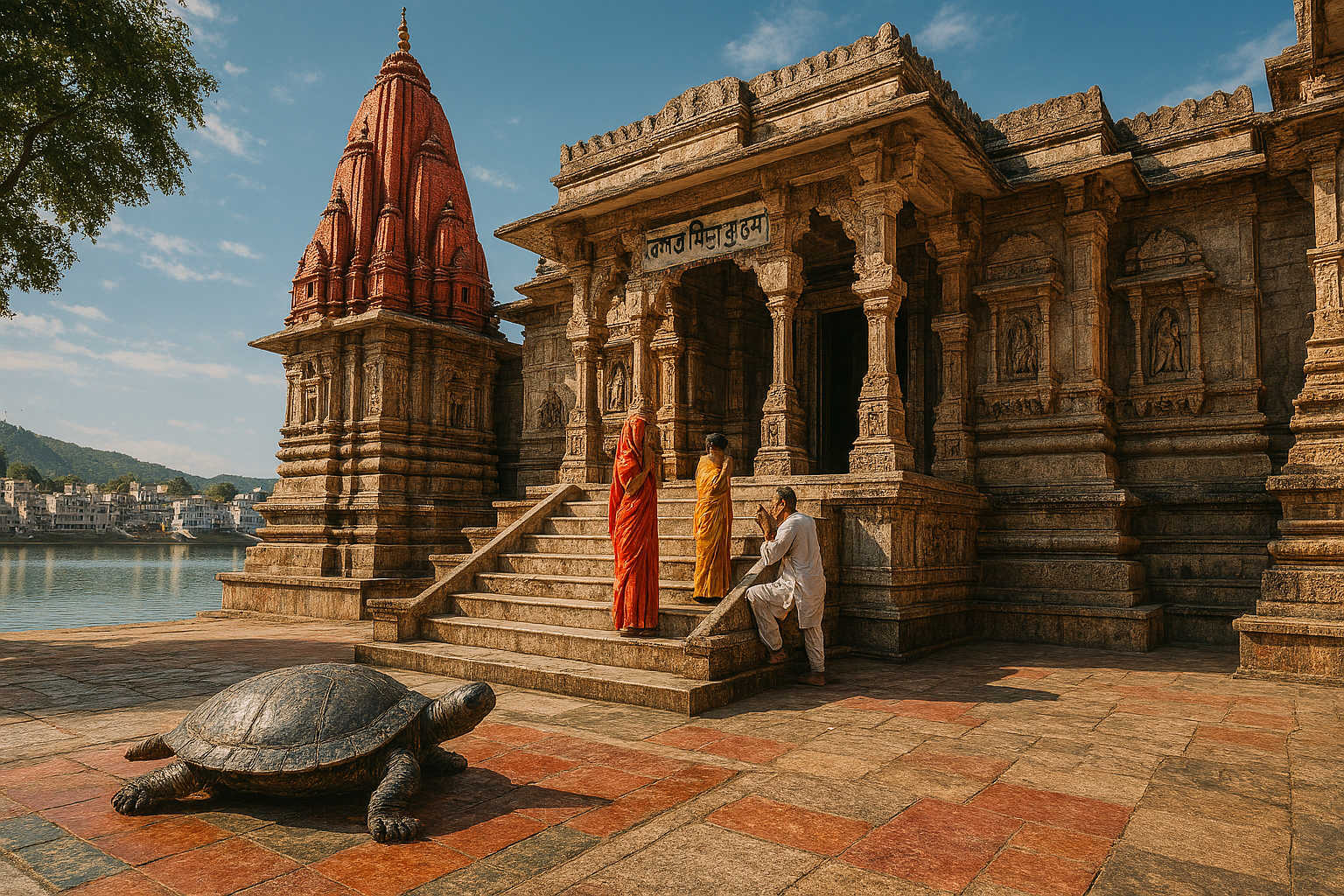
Jagatpita Brahma Mandir – The Rare Brahma Temple
In the sacred town of Pushkar, Rajasthan, lies one of the rarest and most revered temples in Hinduism – the Jagatpita Brahma Mandir. While temples dedicated to Lord Vishnu and Lord Shiva are found across India, temples for Lord Brahma, the Creator of the Universe, are extremely uncommon. Among the few that exist, the Pushkar Brahma Mandir stands out as the most prominent and sacred, drawing thousands of pilgrims and seekers from all over the world.
Why Brahma Temples Are Rare
According to Hindu mythology, Lord Brahma is the creator of the cosmos, part of the Trimurti (Brahma the Creator, Vishnu the Preserver, and Shiva the Destroyer). Yet, despite his importance, very few temples are dedicated to him.
This rarity is explained by a legend. It is said that when Brahma performed a yajna (sacrifice) at Pushkar, his consort Savitri (or Saraswati) was delayed in attending. To complete the ritual, Brahma married another goddess, Gayatri, and performed the yajna with her. Angered by this act, Savitri cursed Brahma that he would not be widely worshipped on Earth, and temples dedicated to him would remain rare. Pushkar, however, was spared from the curse, and thus became home to the Jagatpita Brahma Mandir.
History of the Temple
The Brahma Mandir is believed to have been originally constructed in the 14th century, though its foundations may be much older. Over time, it has undergone restorations, particularly during the Mughal period and later under the rule of Maharaja Jawat Raj of Ratlam.
The temple has been a center of devotion for centuries and remains one of the most important pilgrimage sites, especially during the holy month of Kartik (October–November), when the famous Pushkar Camel Fair also takes place.
Architectural Features
The Jagatpita Brahma Mandir reflects traditional Rajasthani temple architecture blended with elements of spiritual symbolism.
-
Red Shikhara: The temple’s towering red spire (shikhara) is visible from afar, symbolizing divine energy.
-
Marble Steps and Courtyard: Devotees climb marble steps to enter the sanctum. In the courtyard lies a silver turtle, considered sacred.
-
Sanctum Sanctorum: Inside, the idol of Lord Brahma is depicted with four heads, facing the four cardinal directions, representing his all-seeing presence. He holds the rosary, book of knowledge, kusha grass, and a water pot (kamandalu).
-
Images of Goddesses: Idols of his consorts, Savitri and Gayatri, are also enshrined, symbolizing knowledge, power, and devotion.
-
Pushkar Lake Connection: The temple lies near the holy Pushkar Lake, where pilgrims take ritual baths before offering prayers.
The simplicity of the temple contrasts beautifully with its spiritual importance.
Spiritual Significance
The Jagatpita Brahma Mandir holds immense importance in Hindu pilgrimage traditions:
-
Only Major Brahma Temple – It is considered the principal temple of Lord Brahma in the world.
-
Creator’s Blessings – Devotees believe worshipping here brings blessings of wisdom, prosperity, and clarity of thought.
-
Pushkar Lake Rituals – Pilgrims bathe in the sacred Pushkar Lake before entering the temple, as the waters are believed to purify sins.
-
Spiritual Energy of Pushkar – Pushkar itself is counted among the five sacred dhams (holy pilgrimage sites) in India, alongside Badrinath, Rameswaram, Dwarka, and Puri.
Festivals at the Temple
The temple becomes the heart of festivities during Kartik Purnima, when thousands gather to celebrate Lord Brahma. Rituals, yajnas, and prayers fill the atmosphere with devotion.
The Pushkar Camel Fair, held around the same time, transforms the town into a colorful blend of spirituality, culture, and tradition, attracting international travelers and spiritual seekers alike.
Experience of Visiting the Temple
Visiting the Jagatpita Brahma Mandir is an experience that combines spirituality, culture, and serenity.
-
Location: Situated near Pushkar Lake in Ajmer district, Rajasthan.
-
Rituals: Pilgrims first bathe in the lake before offering prayers at the temple.
-
Atmosphere: The temple resonates with chanting, the ringing of bells, and the sight of devotees making offerings of flowers and incense.
-
Nearby Attractions: The Savitri Temple on the hilltop, dedicated to Brahma’s consort, offers panoramic views of Pushkar.
The town itself, dotted with ghats and temples, has a timeless charm, making it not just a religious destination but also a cultural treasure.
Why the Temple is Unique
The Jagatpita Brahma Mandir is not just rare but also symbolically important. While Lord Brahma represents creation and the origin of life, his limited worship reminds humanity of the balance of power among the Trimurti and the need for humility, even in divinity.
It stands as a testament to ancient traditions, mythology, and the power of faith that has preserved it through centuries.
Conclusion
The Jagatpita Brahma Mandir in Pushkar is a rare gem in Hindu spirituality. It is not merely a temple but a reminder of India’s mythological depth, where legends influence worship traditions. Standing by the sacred Pushkar Lake, the temple offers a unique opportunity to connect with Lord Brahma, the Creator, in one of the very few places on Earth where his worship flourishes.
For pilgrims, it is a once-in-a-lifetime spiritual journey. For travelers, it is an unforgettable cultural experience. Above all, it is a symbol of devotion that continues to shine across centuries.