Thousand Pillar Temple – Intricate Craftsmanship
In the heart of Warangal, Telangana, stands one of the most remarkable testaments to South Indian temple architecture—the Thousand Pillar Temple. Built in the 12th century by the Kakatiya dynasty, this temple is not just a place of worship but also a stunning work of art. As its name suggests, the temple is famed for its thousand intricately carved pillars, each uniquely designed, making it a marvel of engineering, devotion, and aesthetics.
Historical Background
The Thousand Pillar Temple, locally known as Rudreshwara Swamy Temple, was constructed around 1163 CE during the reign of King Rudra Deva of the Kakatiya dynasty. Dedicated to the Hindu Trinity—Shiva, Vishnu, and Surya—the temple reflects the dynasty’s artistic brilliance and its deep religious devotion.
This temple was not only a center of worship but also a hub of cultural and social gatherings, showcasing the grandeur of the Kakatiyas. Despite facing damage and invasions in later centuries, it remains one of the most iconic monuments of Telangana’s heritage.
Architectural Splendor
The Thousand Pillar Temple is a masterpiece of Kakatiya architecture, which blends Chalukyan and Dravidian styles into a unique identity.
-
Star-Shaped Design
-
The temple is built on a raised platform in the shape of a star, which is a hallmark of Kakatiya design.
-
The layout provides a rhythmic flow of space, guiding visitors through mandapas and sanctums seamlessly.
-
-
The Thousand Pillars
-
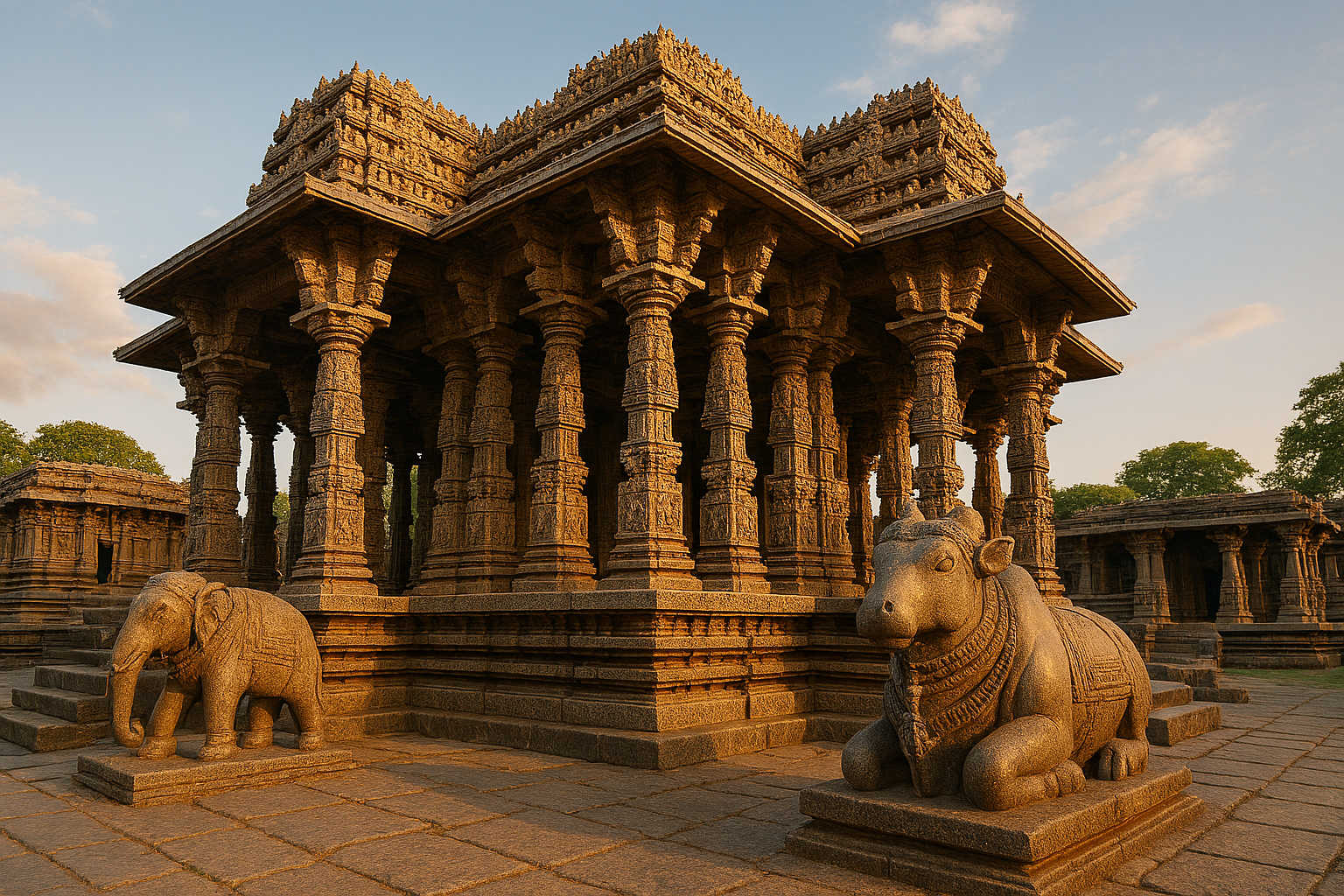
The highlight of the temple, the thousand pillars, are arranged in such a way that they provide structural strength while also serving decorative purposes.
-
Each pillar carries detailed carvings—lotus flowers, animals, dancers, deities, and mythological motifs.
-
-
Trikuta Layout
-
The temple houses three sanctums (garbhagrihas), dedicated to Lord Shiva (Rudreshwara), Lord Vishnu, and Lord Surya.
-
The central mandapa (hall) connects all three sanctums, emphasizing the unity of divine powers.
-
-
Nandi Mandapa
-
A massive monolithic sculpture of Nandi, Lord Shiva’s bull mount, sits on a platform outside.
-
The detailing on Nandi is so precise that even the folds of its skin are visible.
-
-
Sculptural Beauty
-
The ceilings are decorated with intricate rosettes and floral patterns.
-
Walls feature detailed depictions of deities, scenes from epics, and symbolic motifs of fertility and prosperity.
-
Engineering Excellence
The Kakatiya architects were not only artists but also skilled engineers. The interlocking system of the pillars ensured the temple’s stability. Even today, the precision of stone joints amazes modern engineers. The use of granite and dolerite, tough stones to carve, demonstrates the sheer dedication and skill of artisans who spent decades perfecting their craft.
Spiritual Importance
The Thousand Pillar Temple is more than an architectural wonder—it is a deeply spiritual space.
-
Rudreshwara (Shiva) represents destruction and renewal.
-
Vishnu symbolizes preservation and cosmic balance.
-
Surya (Sun God) embodies energy and life force.
Together, the three deities signify the eternal cycle of creation, preservation, and dissolution. Pilgrims believe that visiting the temple brings balance and prosperity in life.
Legends and Folklore
Local folklore enriches the temple’s spiritual aura:
-
It is said that no two pillars in the temple are alike—each was designed to represent a unique aspect of creation.
-
The temple once had a musical pillar that could produce distinct notes when tapped, though much of this feature has been lost to time.
-
The precision of Nandi’s carving is often described as divine intervention, as it seems impossible to achieve such detailing with medieval tools.
Decline and Restoration
Over centuries, the Thousand Pillar Temple faced neglect and invasions, which damaged parts of the structure. Many of its original sculptures and carvings were desecrated. However, in recent years, extensive restoration work by the Archaeological Survey of India (ASI) has revived much of its former glory.
Today, the temple is not only a pilgrimage center but also a major tourist attraction, drawing historians, architects, and art lovers from across the world.
Visiting the Temple
-
Location: Hanamakonda, Warangal district, Telangana.
-
Best Time to Visit: October to March, when the weather is pleasant.
-
Timings: Open daily, generally from 6 AM to 8 PM.
-
Dress Code: Modest clothing is expected as it is an active temple.
The temple complex is often included in Warangal heritage tours, alongside the Warangal Fort and Ramappa Temple, offering a complete glimpse of Kakatiya art.
Conclusion
The Thousand Pillar Temple of Warangal is a magnificent symbol of India’s rich heritage—an ode to the craftsmanship, spirituality, and vision of the Kakatiya dynasty. Its star-shaped design, intricately carved pillars, and divine sanctums make it a unique blend of art, faith, and engineering genius.
To step into the Thousand Pillar Temple is to step into history itself—a reminder of how devotion and artistry can leave behind legacies that stand strong for nearly a millennium.