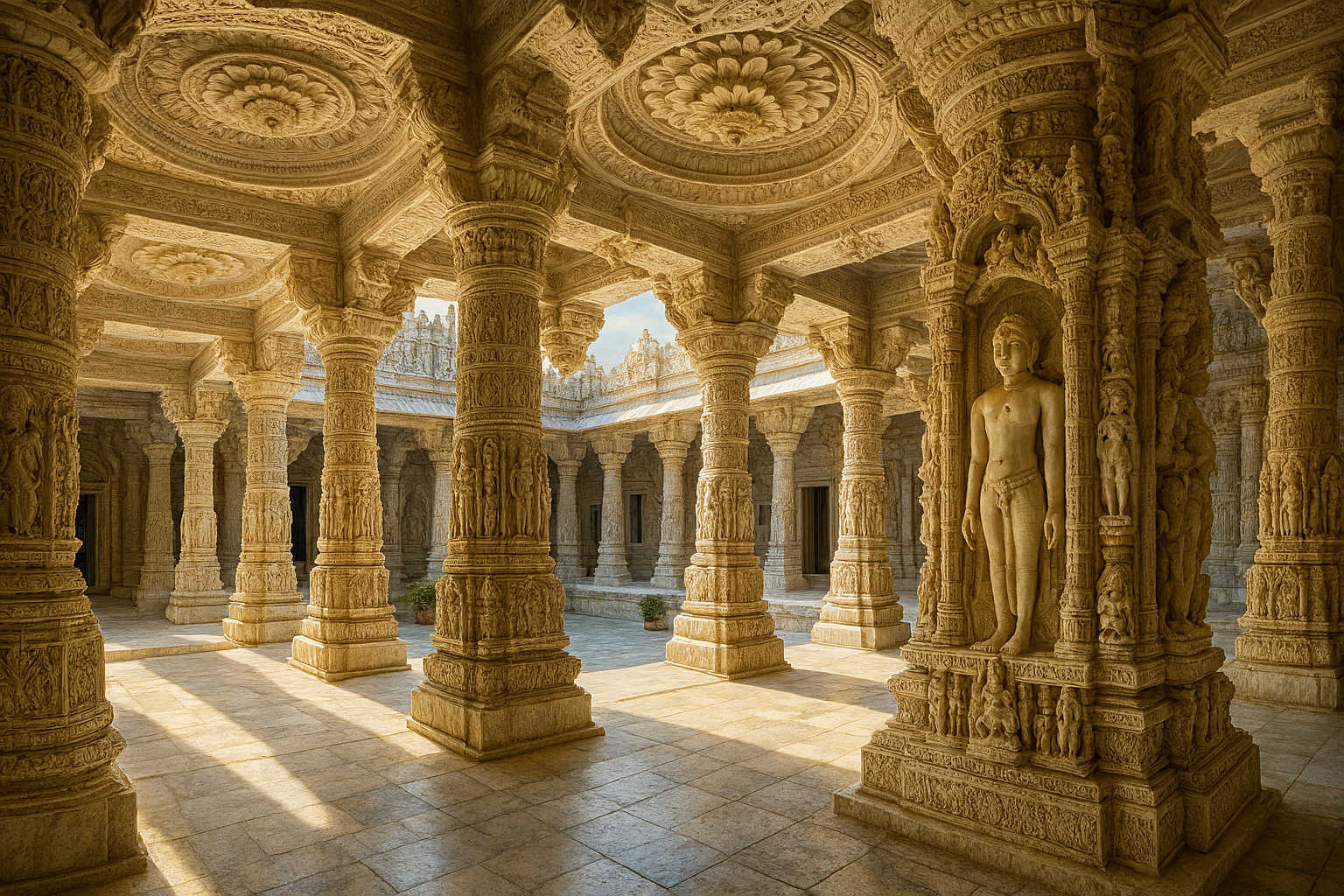
Dilwara Temples – Jain Marvels in White Marble
High in the Aravalli Hills of Rajasthan, near the hill station of Mount Abu, lies one of India’s most exquisite architectural treasures—the Dilwara Temples. Renowned for their stunning white marble artistry, these Jain temples are celebrated not just as places of worship but as masterpieces of craftsmanship, devotion, and timeless beauty.
Built between the 11th and 13th centuries CE, the Dilwara Temples continue to mesmerize visitors with their flawless stonework—where ceilings bloom with lotus carvings, pillars are draped in lace-like patterns, and every inch of marble whispers a story of faith and artistry.
History and Patronage
The Dilwara Temples were commissioned during the reign of the Solanki dynasty of Gujarat, known for their patronage of Jainism and temple architecture. The construction took place over several generations, funded by wealthy Jain ministers and merchants.
Each temple within the complex was built by different patrons, yet all reflect a unified devotion to Lord Mahavira and other Jain Tirthankaras. Despite the grandeur of the carvings, the temples embody the Jain principle of simplicity and inner purity, with minimal external ornamentation but breathtaking interiors.
The Five Temples of Dilwara
The complex consists of five distinct temples, each dedicated to a Jain Tirthankara and each with unique artistry:
-
Vimal Vasahi Temple (1031 CE)
-
Dedicated to the first Tirthankara, Lord Adinath.
-
Built by Vimal Shah, a minister of Solanki King Bhimdev I.
-
Famous for its grand central hall (Rang Mandap), richly carved pillars, and detailed ceiling with concentric rings of lotus designs.
-
-
Luna Vasahi Temple (1230 CE)
-
Dedicated to Lord Neminath, the 22nd Tirthankara.
-
Built by brothers Vastupal and Tejpal, ministers of the Vaghela dynasty.
-
Considered the most ornate of all, featuring the legendary “Ranga Mandap” with 72 intricately carved Tirthankara statues and a magnificent central dome.
-
-
Pittalhar Temple
-
Dedicated to Lord Rishabhnath.
-
Named after the massive idol made of “Pittal” (five metals).
-
Built by Bhima Shah, minister of Sultan Begada of Ahmedabad.
-
-
Parshvanath Temple
-
Dedicated to Lord Parshvanath, the 23rd Tirthankara.
-
Known for its four-faced idol and the outer walls decorated with beautiful sculptures.
-
-
Mahavir Swami Temple
-
Dedicated to Lord Mahavira, the 24th Tirthankara.
-
The smallest of the five but adorned with delicate paintings and carvings dating back to the 15th century.
-
Architectural Brilliance
The Dilwara Temples showcase the zenith of Maru-Gurjara architecture. Unlike many temples with imposing exteriors, the Dilwara Temples keep their grandeur hidden inside.
-
Marble Carvings: Every surface—from ceilings to doorways—is carved with precision, featuring floral motifs, dancers, elephants, and divine beings.
-
Lotus Ceilings: The central domes display giant marble lotus flowers that seem to bloom out of stone.
-
Pillared Halls: Thousands of intricately designed pillars, each uniquely decorated, create a lace-like effect in marble.
-
Delicate Sculptures: Despite being carved in hard stone, the figures convey softness, grace, and fluidity of movement.
The sheer detail and finesse of the carvings make it hard to believe they were created nearly a millennium ago.
Spiritual Significance
For Jains, the Dilwara Temples are not just monuments but sacred spaces embodying the core values of their faith—ahimsa (non-violence), aparigraha (non-possessiveness), and spiritual purity. Pilgrims visit to meditate, seek blessings, and immerse themselves in the serene atmosphere that contrasts with the grandeur of the carvings.
The temples’ design, with their plain outer walls, reflects Jain ideals: true beauty lies within, not in external appearance—a profound spiritual metaphor.
Legends and Folklore
Local legends add charm to the Dilwara Temples:
-
It is said that the artisans were so dedicated to honesty that they charged their patrons only for the weight of the marble chips they used each day.
-
Another tale suggests that celestial beings helped guide the carving, explaining the temple’s near-supernatural precision.
Preservation and Recognition
Today, the Dilwara Temples are maintained as both sacred pilgrimage centers and heritage monuments. Photography inside is restricted to preserve the sanctity, ensuring the temples remain spiritual spaces rather than tourist attractions.
They are widely recognized as one of the finest marble temples in the world, often compared with the Taj Mahal for their artistry, though far older and carved entirely by hand.
Visiting the Dilwara Temples
-
Location: About 2.5 km from Mount Abu, Rajasthan.
-
Best Time to Visit: October to March, when the weather is pleasant.
-
Timings: Open daily from 12 PM to 5 PM for tourists; mornings are reserved for devotees.
-
Dress Code: Modest attire is required as it is a place of worship.
Conclusion
The Dilwara Temples of Mount Abu are more than just Jain shrines—they are timeless works of art that blend devotion with craftsmanship. Every marble carving, every pillar, and every dome speaks of human dedication to the divine.
In their simplicity and grandeur, the temples remind us that spirituality and art can merge into something eternal. For anyone traveling to Rajasthan, the Dilwara Temples are not merely a destination but a journey into faith carved in white marble.