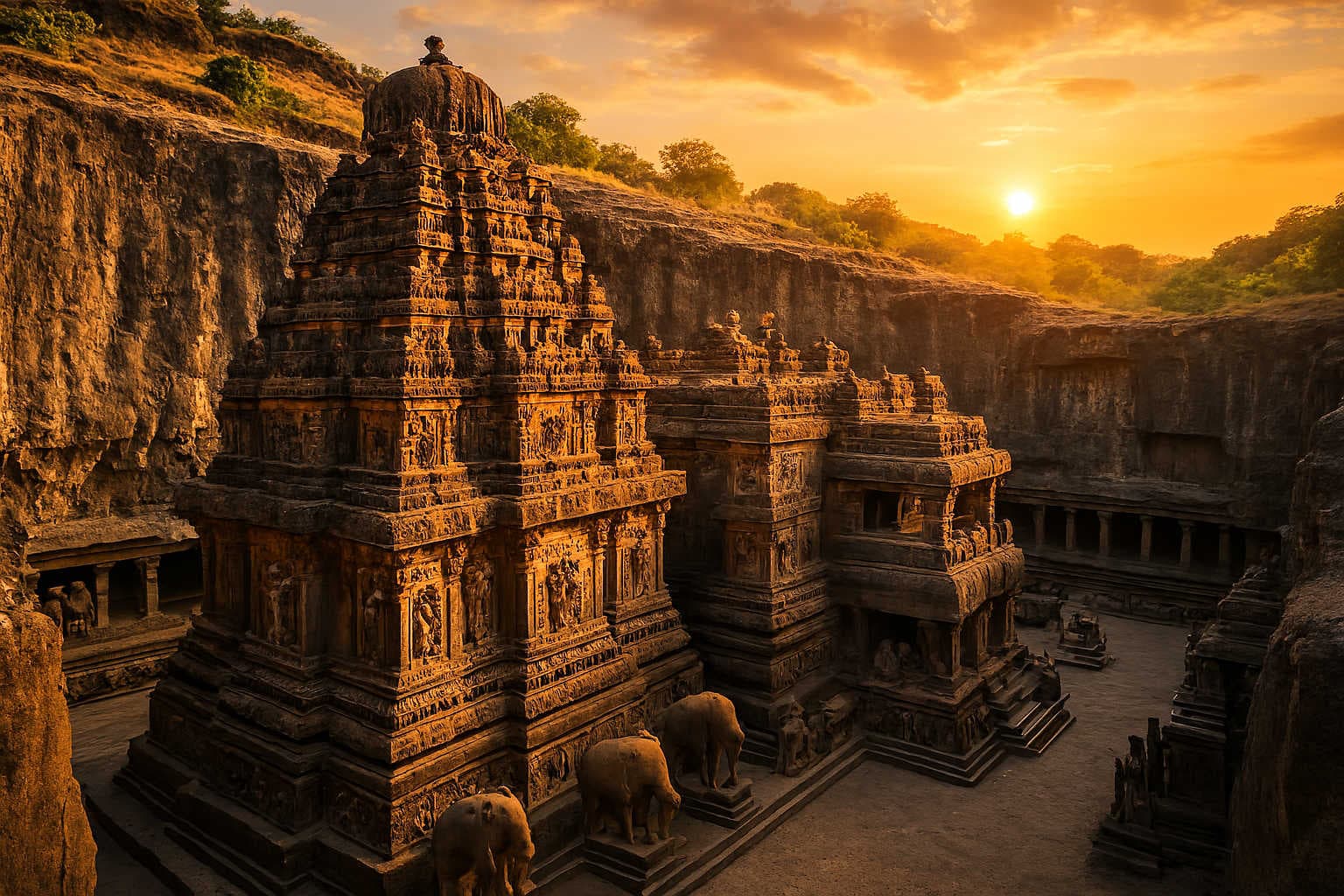
Kailasa Temple at Ellora – Carved from a Single Rock
Deep within the rugged hills of Maharashtra lies one of the greatest feats of human craftsmanship—the Kailasa Temple at Ellora. Carved entirely out of a single monolithic rock, this 8th-century shrine dedicated to Lord Shiva stands as an eternal testimony to devotion, determination, and unparalleled architectural genius.
Part of the world-famous Ellora Caves, a UNESCO World Heritage Site, the Kailasa Temple is not merely a structure—it is an entire temple complex hewn from living rock, complete with mandapas, gopurams, courtyards, and intricate sculptures. Scholars, architects, and devotees continue to marvel at how such a colossal monument was created more than 1,200 years ago, with nothing but hammer, chisel, and unwavering faith.
The Patronage of the Rashtrakutas
The Kailasa Temple was commissioned in the 8th century CE by King Krishna I of the Rashtrakuta dynasty. The Rashtrakutas, known for their patronage of art and architecture, sought to outshine previous dynasties with a monument that symbolized both spiritual grandeur and imperial power.
Kailasa was envisioned as a physical representation of Mount Kailash, the mythical abode of Lord Shiva and Goddess Parvati. What emerged was a temple that dwarfed imaginations—an earthly Kailash carved into basalt cliffs.
Carving a Mountain – The Architectural Feat
Unlike most rock-cut temples, which are excavated front-to-back or bottom-to-top, the Kailasa Temple was carved from the top down. Craftsmen began at the summit of the basalt hill and worked their way downward, removing nearly 200,000 tons of rock over decades.
This technique ensured structural precision and avoided collapse, but it required extraordinary planning and labor. Historians estimate that thousands of artisans and workers toiled for nearly a century to complete the temple.
Layout and Structure
The Kailasa Temple is not just a shrine but an entire complex, designed in the Dravidian style of architecture, yet uniquely monolithic.
-
Entrance Gateway: A towering gopuram greets visitors, leading into the vast courtyard.
-
Courtyard: The temple is surrounded by high rock walls, creating the impression of entering a divine fortress.
-
Main Shrine: The sanctum houses a massive Shiva Lingam, symbolizing Lord Shiva’s cosmic presence.
-
Nandi Mandapa: Facing the sanctum is a pavilion with a grand statue of Nandi, Shiva’s sacred bull.
-
Pillared Mandapas: Ornate halls with stone pillars for gatherings and rituals.
-
Sculptures: Intricate carvings depict scenes from Hindu epics—the Ramayana, Mahabharata, and stories of Shiva and Vishnu.
Despite being carved from one rock, the temple creates the illusion of multiple independent structures.
Sculptural Wonders
The Kailasa Temple is alive with sculptures that breathe divinity into stone:
-
Elephants appear to hold up the temple base, symbolizing strength and stability.
-
Ravana shaking Mount Kailash, a famous panel showing his devotion and power.
-
Shiva as Nataraja, the cosmic dancer, surrounded by celestial beings.
-
Vishnu’s avatars and stories from the Puranas, reflecting the temple’s inclusivity of Vaishnavite traditions as well.
These carvings display not just religious symbolism but also remarkable artistry, capturing movement, expression, and detail with lifelike precision.
Mysteries of Kailasa Temple
The construction of Kailasa continues to intrigue experts:
-
Sheer Scale: How could artisans remove such vast quantities of rock with primitive tools?
-
Engineering Precision: The symmetry, alignment, and stability of the temple defy modern logic.
-
Timeframe: Some legends suggest it was completed in just 18 years, though scholars argue it took far longer.
Such mysteries have fueled theories that the temple’s creation was aided by divine inspiration.
Legends and Folklore
Local legends enrich Kailasa’s aura:
-
It is said that the queen of Krishna I vowed to fast until she saw the temple’s shikhara (tower). To fulfill her wish quickly, the chief architect began carving from the top, ensuring the shikhara appeared first—a story that explains the temple’s unique top-down excavation.
-
Another belief holds that the temple is protected by divine forces, which is why it has survived centuries of invasions and natural wear.
Kailasa in the Ellora Complex
Ellora Caves house 34 rock-cut temples—12 Buddhist, 17 Hindu, and 5 Jain—built between the 6th and 10th centuries. The Kailasa Temple is the centerpiece, representing the zenith of Hindu rock-cut architecture. Its coexistence with Buddhist and Jain shrines highlights India’s pluralistic heritage.
UNESCO World Heritage Site
The Ellora Caves, including Kailasa Temple, were declared a UNESCO World Heritage Site in 1983. Today, the temple attracts scholars, architects, pilgrims, and travelers from across the world, all eager to witness this fusion of engineering genius and divine devotion.
Visiting Kailasa Temple
-
Location: Ellora, near Aurangabad, Maharashtra.
-
Best Time: October to March, with pleasant weather for exploring the caves.
-
Timings: Open daily (except Tuesdays) from 9:00 AM to 5:30 PM.
-
Nearby Attractions: Ajanta Caves, Daulatabad Fort, and Grishneshwar Jyotirlinga Temple.
Conclusion
The Kailasa Temple at Ellora is not merely an ancient structure—it is a living paradox of faith and engineering. Hewn from a single rock, it is as much a spiritual pilgrimage as it is a historical wonder.
To stand before Kailasa is to stand before the vision of an empire, the devotion of countless artisans, and the timeless presence of Lord Shiva himself. Truly, it is one of the greatest monuments ever built by human hands—a mountain transformed into a temple, frozen in eternity.