Brihadeeswarar Temple – Architectural Marvel of Tamil Nadu
In the fertile heartland of Tamil Nadu lies one of India’s most celebrated monuments—the Brihadeeswarar Temple of Thanjavur, also known as the Big Temple. Built over a thousand years ago, this masterpiece of Chola dynasty architecture continues to astonish historians, architects, and devotees alike with its scale, symmetry, and spiritual grandeur.
A UNESCO World Heritage Site, the Brihadeeswarar Temple is dedicated to Lord Shiva, and it reflects the zenith of the Chola Empire’s cultural and artistic achievements. Its towering vimana, intricate carvings, and monumental Nandi are more than stone structures—they are eternal testaments to devotion and vision.
The Vision of Raja Raja Chola I
The temple was commissioned by Raja Raja Chola I in the year 1010 CE, during the height of the Chola Empire. His ambition was to construct a temple that would surpass all others in grandeur and proclaim the might of both his empire and his devotion to Shiva.
What resulted was an architectural wonder that remains unparalleled even today—a temple built entirely of granite, despite no known granite quarries in the immediate vicinity of Thanjavur. The sheer logistics of transporting and assembling such massive stone blocks over a millennium ago remain a subject of awe and study.
Towering Vimana – The Crown Jewel
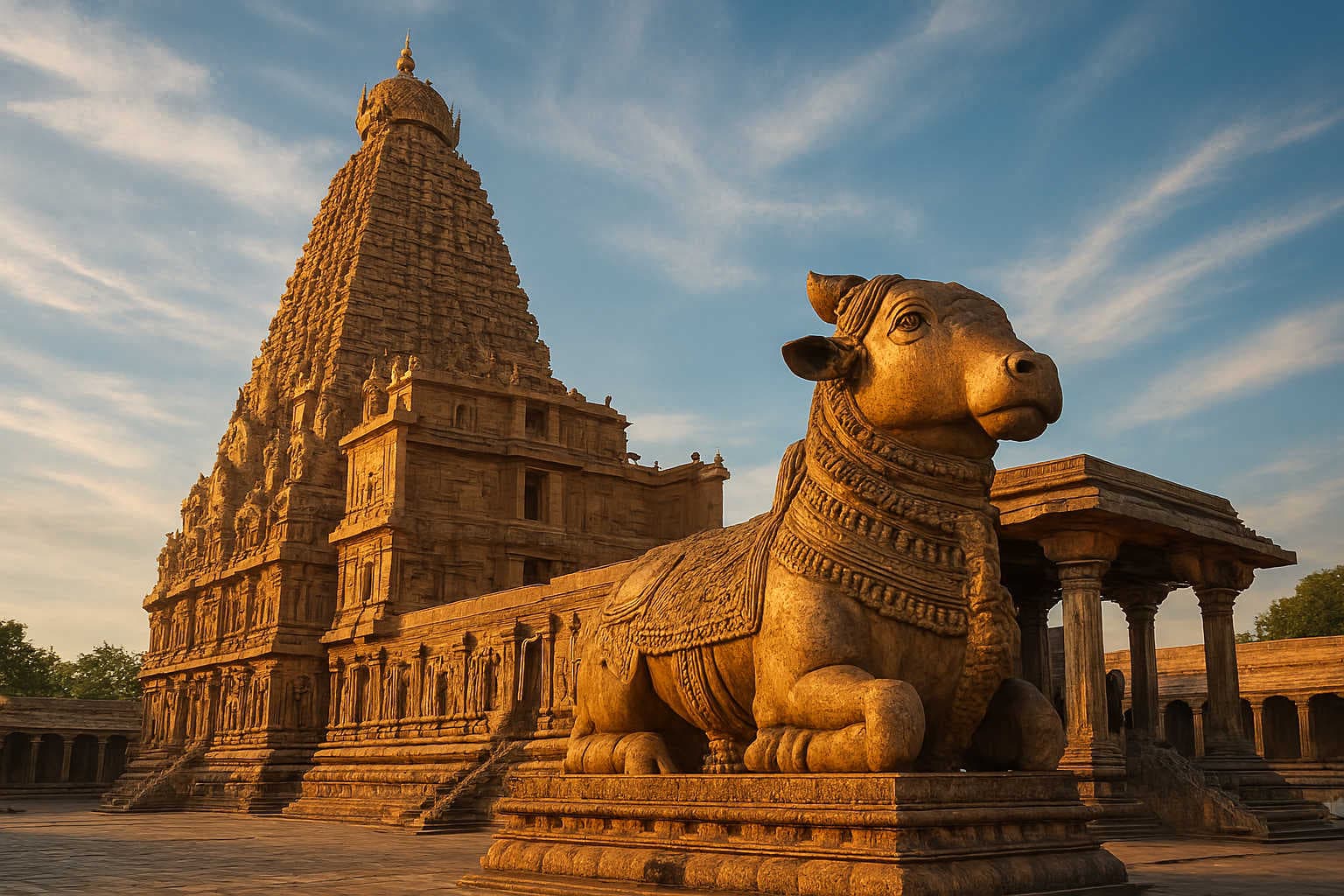
The most striking feature of the Brihadeeswarar Temple is its vimana (temple tower), which soars to a height of about 66 meters (216 feet). Unlike most temple towers that taper with diminishing weight, the vimana here is crowned with a massive monolithic stone weighing around 80 tons.
Legends suggest that an inclined ramp stretching several kilometers was built to hoist the stone to its summit—a feat of engineering brilliance. The tower’s grandeur dominates the skyline of Thanjavur and stands as a symbol of architectural ingenuity.
The Sanctum and the Shiva Lingam
Inside the sanctum (garbhagriha) lies a colossal Shiva Lingam, around 4 meters high, revered as Brihadeeswarar or the “Great Lord.” Devotees believe the temple radiates immense spiritual energy, making it a powerful center of worship even today.
The Great Nandi
Another highlight is the monumental statue of Nandi (the bull mount of Shiva), placed in a separate mandapa facing the sanctum. Carved from a single stone, this Nandi measures about 6 meters long and 3.7 meters high, ranking among the largest in India. Despite its weight of approximately 25 tons, the sculpture is polished to a smooth finish, a testimony to Chola craftsmanship.
Murals and Carvings
The temple walls are richly adorned with:
-
Sculptures of deities, mythological figures, dancers, and animals.
-
Murals depicting stories from Shaivism, Vaishnavism, and Shaktism.
-
Inscriptions detailing the temple’s construction, land grants, and the socio-economic life of the Chola period.
These records make Brihadeeswarar not just a temple but also a historical archive in stone.
Unique Features of the Temple
-
Shadowless Tower: It is said that the vimana never casts a shadow on the ground at noon—an architectural mystery that continues to intrigue visitors.
-
Granite Wonder: The temple is built entirely of granite, though no quarries exist nearby. Historians still debate how the stones were sourced and transported.
-
Precision Engineering: The layout follows strict Vastu Shastra and alignment with celestial principles, reinforcing the Cholas’ mastery of sacred architecture.
Living Temple of Shiva
Unlike many monuments preserved as museums, Brihadeeswarar remains a living temple, where daily rituals, prayers, and festivals continue with devotion. The temple is particularly vibrant during:
-
Maha Shivaratri, when thousands of devotees gather to honor Shiva.
-
Raja Raja Chola’s birthday festival, celebrated with grandeur to remember the visionary king.
UNESCO World Heritage Site
Brihadeeswarar Temple, along with the Gangaikonda Cholapuram and Airavatesvara temples, forms the Great Living Chola Temples, inscribed as a UNESCO World Heritage Site in 1987. This recognition underscores its universal value as a cultural treasure.
Symbolism and Spiritual Significance
The temple is a microcosm of the cosmos, representing the eternal cycle of creation, preservation, and destruction. The soaring vimana symbolizes the spiritual aspiration of humanity, while the lingam within grounds the devotee in divine consciousness.
Visiting Brihadeeswarar Temple
-
Location: Thanjavur, Tamil Nadu.
-
Best Time: October to March, when the climate is pleasant.
-
Timings: Open daily for darshan, with special pujas during festivals.
-
Nearby Attractions: Thanjavur Palace, Saraswathi Mahal Library, and the art-rich town of Kumbakonam.
Conclusion
The Brihadeeswarar Temple is not just a monument but a living embodiment of Tamil culture, devotion, and architectural genius. Its sheer scale, engineering brilliance, and spiritual aura make it one of the greatest temples in the world.
A visit to this temple is more than sightseeing—it is a journey into the soul of India’s cultural and spiritual heritage, where stone transforms into poetry and devotion into eternity.