Konark Sun Temple – Time Frozen in Stone
On the eastern coast of India, where the Bay of Bengal meets the rising sun, stands one of the greatest architectural wonders of the world—the Konark Sun Temple of Odisha. Known as the Black Pagoda by early sailors for its towering dark stone structure, this 13th-century marvel captures the spirit of time, divinity, and artistry like no other monument in India.
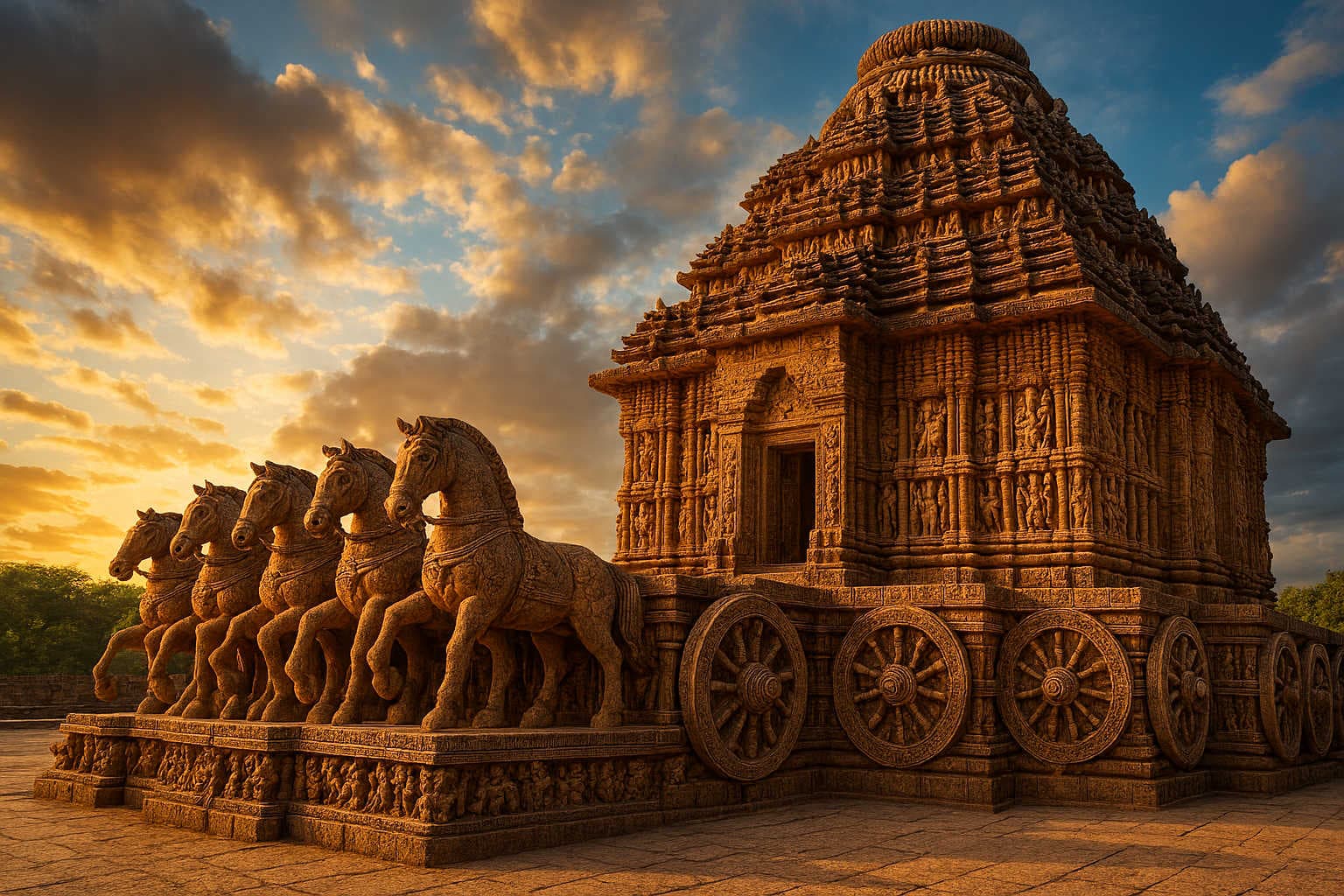
Dedicated to Surya, the Sun God, the temple is designed as a colossal chariot drawn by stone horses, with intricately carved wheels symbolizing the cosmic cycle of time. Even in its partially ruined state, Konark radiates grandeur, embodying the vision of the Eastern Ganga dynasty.
The Vision of Narasimhadeva I
The Konark Sun Temple was commissioned in 1250 CE by King Narasimhadeva I of the Eastern Ganga dynasty. His ambition was to create a temple so magnificent that it would reflect the supremacy of his reign and honor Surya, the giver of life.
The temple’s design was inspired by the concept of a celestial chariot. With twelve massive wheels and seven horses carved out of stone, the temple represents Surya’s divine vehicle journeying across the heavens.
Architecture of a Cosmic Chariot
Konark’s design is not just symbolic—it is mathematical precision turned into art.
-
The Wheels: Each of the twelve wheels measures nearly 10 feet in diameter and represents a month of the year. The detailed carvings on the spokes and rims function like sundials, allowing the passage of time to be read through the play of light and shadow.
-
The Horses: Seven powerful stone horses pull the chariot, symbolizing the seven days of the week and the eternal forward motion of time.
-
The Temple Layout: Originally, the temple complex included the main sanctum (now collapsed), the Jagamohana (audience hall), and the Natamandapa (dance hall), richly adorned with sculptures.
The entire structure embodies the fusion of spirituality and astronomy, making it a cosmic calendar in stone.
Sculptural Mastery
Konark is celebrated not only for its grand scale but also for the intricacy of its carvings. The stone walls and pillars are alive with sculptures depicting:
-
Deities such as Surya in various forms.
-
Musicians, dancers, and courtly life.
-
Animals including elephants, lions, and mythical beasts.
-
Erotic figures, symbolic of fertility and the cosmic creative force.
These carvings reflect the vitality of medieval Odisha’s culture, where spirituality, art, and everyday life merged seamlessly.
The Natamandapa – Dance in Stone
The Natamandapa (dance hall) showcases detailed carvings of dancers and musicians, representing Odisha’s classical dance tradition, which later evolved into Odissi dance. Scholars believe that this hall was once used for devotional performances dedicated to Surya, merging art with worship.
The Decline and Ruin
The grandeur of Konark did not last untouched. Over the centuries, natural calamities, neglect, and invasions took their toll. The main sanctum, once crowned with a 70-meter-high tower, collapsed in the 17th century. Legends also speak of a mystical lodestone at the temple’s apex—believed to have disrupted ships’ navigation—that may have been removed by Portuguese sailors, hastening the temple’s decline.
Despite its partial ruin, what survives of Konark continues to awe visitors with its timeless beauty.
Konark in Myth and Legend
Local folklore adds a spiritual aura to the temple:
-
It is said that Samba, the son of Krishna, was cursed with leprosy and worshipped Surya here to regain his health. In gratitude, he established the first Sun temple, and Konark is seen as a continuation of that sacred tradition.
-
Another legend tells of a 12-year-long construction where thousands of workers labored under strict deadlines. The temple was finally completed with the sacrifice of a young boy named Dharmapada, whose story symbolizes devotion and duty.
UNESCO World Heritage Site
Recognizing its architectural and cultural significance, the Konark Sun Temple was declared a UNESCO World Heritage Site in 1984. Today, it remains one of India’s most visited monuments, drawing historians, architects, devotees, and travelers alike.
Festivals and Cultural Significance
Konark continues to be a living center of art and culture through festivals:
-
Konark Dance Festival: Every year in December, the temple complex hosts a grand festival where classical dance forms such as Odissi, Bharatanatyam, and Kathak are performed under the open sky, echoing the temple’s artistic spirit.
-
Chandrabhaga Mela: A major religious fair dedicated to Surya, where thousands gather to worship the rising sun.
Symbolism – Time Frozen in Stone
The temple is often described as time itself frozen in stone. Its wheels mark the months, its horses symbolize days, and its carvings represent the eternal play of life. Though centuries have weathered its structure, Konark still carries the power to transport visitors into a world where art, science, and spirituality unite seamlessly.
Visiting Konark
-
Location: Konark is situated in Puri district, Odisha, about 35 km from Puri and 65 km from Bhubaneswar.
-
Best Time: October to March, when the weather is pleasant.
-
Nearby Attractions: The Jagannath Temple in Puri and the beaches of Chandrabhaga make for a perfect cultural and spiritual circuit.
Conclusion
The Konark Sun Temple stands as a monumental expression of India’s architectural genius and spiritual depth. Even in its incomplete form, it continues to inspire awe with its cosmic symbolism, intricate artistry, and timeless beauty.
A visit to Konark is more than a historical journey—it is an experience of stepping into a stone chariot of the gods, where time itself stands still.