%20Symbol.png&w=3840&q=75)
Meaning and Power of the Om (ॐ) Symbol
Om — written as ॐ in Devanagari and often spelled “Aum” — is one of the most sacred sounds and symbols in Hinduism. Revered across many Indian spiritual traditions including Sanatan Dharma, Jainism, and Buddhism, Om is not just a sound, but a profound representation of the universe, consciousness, and the Self.
Whether chanted in temples, whispered in meditation, or seen inscribed on ancient texts and temple walls, Om holds a deep spiritual resonance that transcends words. It is the seed of all mantras — the vibrational essence of existence itself.
The Sound of Creation
According to the Mandukya Upanishad, Om is the sound from which the entire universe originates. Before creation began, there was only silence and void. From that silence emerged Om — the primordial vibration — and from Om came everything: matter, energy, space, time, consciousness.
In this way, Om is not just a symbol or chant, but the energetic foundation of the cosmos.
A-U-M – The Threefold Nature of Om
Though written as a single symbol (ॐ), Om is made of three syllables: A (अ), U (उ), and M (म). Each syllable represents a different aspect of existence:
-
A (अ) – The waking state (Jagrat): Conscious awareness of the external world.
-
U (उ) – The dreaming state (Swapna): The inner world of dreams and imagination.
-
M (म) – The deep sleep state (Sushupti): A state of rest, without dreams or awareness.
Beyond these three is the silence that follows the sound — representing Turiya, the fourth state, or pure consciousness, which transcends all experiences and dualities.
Thus, Om is a symbolic summary of the entire human experience and consciousness.
The Om Symbol (ॐ)
The written form of Om is equally powerful. Each part of the symbol carries meaning:
-
The lower curve represents the waking state.
-
The middle curve represents the dreaming state.
-
The upper curve is the state of deep sleep.
-
The semi-circle and dot above symbolize Turiya, or absolute consciousness.
-
The semi-circle represents illusion (maya), separating the dot from the rest — a reminder that illusion prevents us from realizing the Supreme.
It is a map of the journey from the material to the divine.
Om in Meditation and Yoga
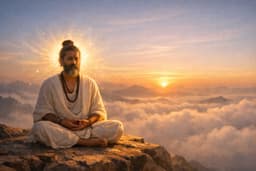
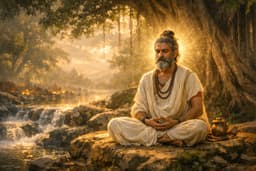
In spiritual practices like meditation, japa (mantra repetition), and yoga, Om plays a central role.
Chanting Om is believed to:
-
Calm the mind and nervous system
-
Align the body’s energy centers (chakras)
-
Enhance focus and spiritual awareness
-
Connect the practitioner to a universal energy
The vibration of Om harmonizes the mind with the sound of the universe, creating an experience of inner stillness and unity.
Yogic traditions consider Om the “sound of the soul”, and beginning or ending a yoga session with Om sets a sacred intention.
Om in the Vedas and Upanishads
Om appears at the beginning and end of many Vedic chants and Upanishadic verses. It is the spiritual thread connecting all Vedic knowledge.
For instance:
“Om iti etad akṣaram idam sarvam.”
– Mandukya Upanishad
(“Om is this whole universe.”)
The Bhagavad Gita also references Om as a representation of the Supreme Brahman:
“I am the syllable Om in all the Vedas…”
– Bhagavad Gita 7.8
Thus, Om is not only sound — it is consciousness, divinity, and the infinite.
Om Across Indian Religions
-
In Hinduism, Om is sacred and associated with all major deities, often invoked at the beginning of prayers, pujas, and rituals.
-
In Buddhism, Om is part of mantras like Om Mani Padme Hum, symbolizing compassion and enlightenment.
-
In Jainism, Om is connected to the five supreme beings (Pancha Parameshti) and represents the path to liberation.
Despite theological differences, all these traditions agree on one thing: Om is a gateway to spiritual awareness.
Scientific Views on Om
Modern science has started to study the vibrational effects of chanting Om:
-
Research using EEG scans shows that chanting Om can calm brain activity and increase alpha waves — linked to relaxation and focus.
-
Some studies suggest that Om chanting can reduce stress, lower blood pressure, and even support mental clarity.
While science cannot capture its spiritual essence, these studies affirm what the sages have long known — Om has tangible healing power.
Living with Om
The true power of Om lies not just in chanting it but in living its essence:
-
To move from confusion to clarity
-
To evolve from ego to spirit
-
To remember the interconnectedness of all things
Whether silently recited during a morning meditation or softly chanted in a sacred space, Om brings the mind home to the soul.
Conclusion: Om Is the Universe Within You
Om is the seed sound of existence, the cosmic pulse, and the voice of divinity. It is the breath before the word, the silence after the sound, and the eternal vibration that connects all beings.
When you chant Om, you are not just making a sound — you are aligning with the source of creation. You are awakening your awareness, dissolving boundaries, and entering the space of infinite peace.
As the sages say:
“Om is the bow, the soul is the arrow, and Brahman is the target.”
– Mundaka Upanishad
May the sound of Om guide you toward your highest self.