Annapurna Devi Temple – The Goddess of Food
Among the sacred shrines of Varanasi, the Annapurna Devi Temple holds a special place, not for grandeur but for its profound spiritual and symbolic significance. Dedicated to Goddess Annapurna, revered as the Goddess of food and nourishment, this temple emphasizes one of the simplest yet most powerful truths of existence—without food, there is no life. Located near the famous Kashi Vishwanath Temple, it embodies the inseparable bond between sustenance and spirituality.
Who is Goddess Annapurna?
The name Annapurna comes from two Sanskrit words—Anna (food or grains) and Purna (full or complete). Together, it means “the one who is full of food” or “provider of nourishment.”
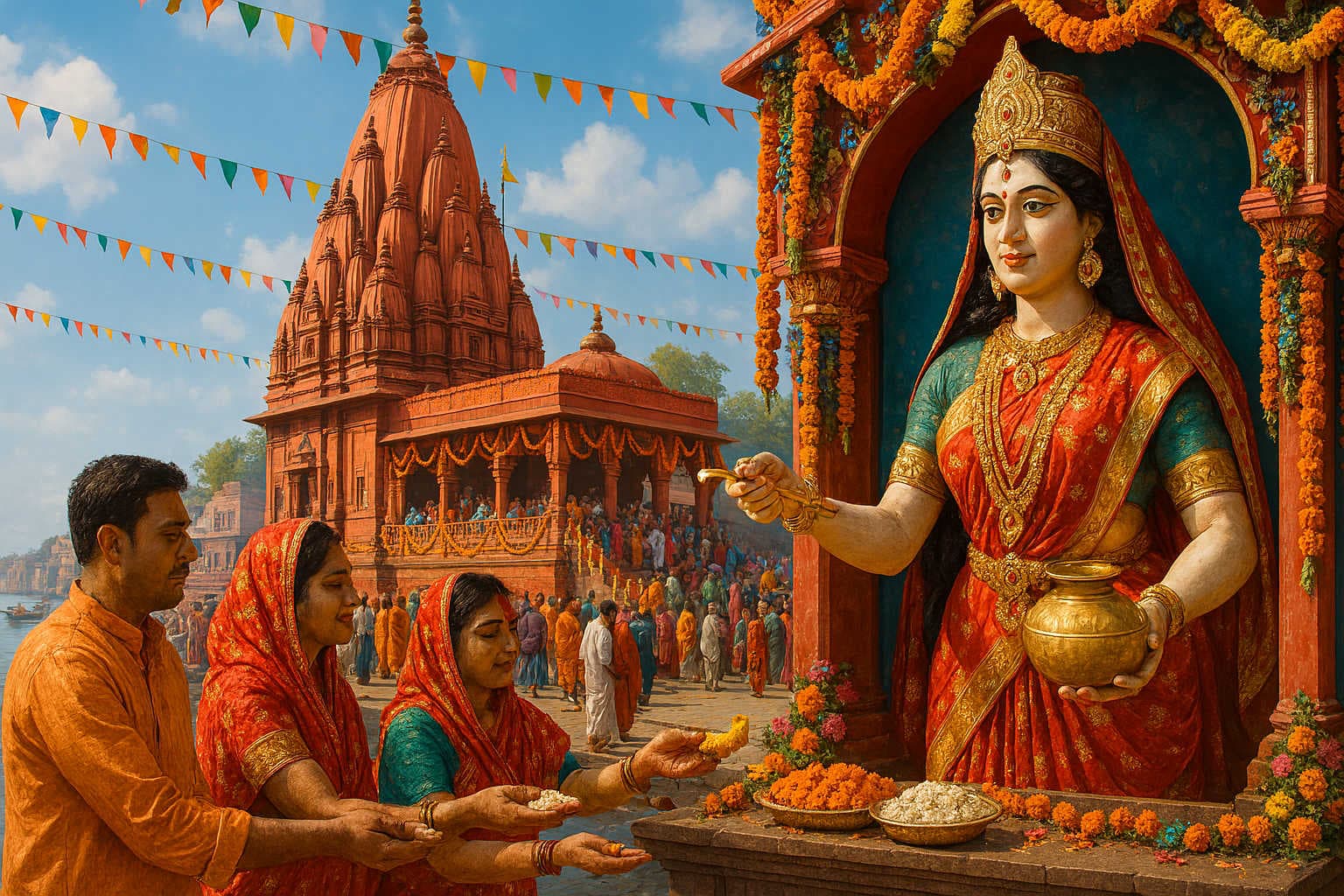
Goddess Annapurna is considered a form of Parvati, consort of Lord Shiva. She is often depicted seated with a golden ladle in one hand and a pot of food in the other, symbolizing abundance and generosity. Her worship is rooted in the belief that food is sacred, and serving food to others is equivalent to serving the divine.
The Legend of Annapurna and Shiva
The most famous story associated with Annapurna Devi begins with Lord Shiva once declaring that the material world, including food, was an illusion (Maya). To test his claim, Goddess Parvati disappeared from the world, taking with her all sources of food. Instantly, famine spread across the universe, and beings—humans, animals, even gods—suffered from hunger.
Finally, even Shiva realized that food could never be dismissed as mere illusion, for without it life could not exist. He humbly sought forgiveness from Parvati. Taking the form of Annapurna, she reappeared in Kashi (Varanasi) and offered food with her own hands to Shiva, restoring balance.
This story highlights the spiritual truth that food is divine, and feeding others is the highest form of worship.
History of Annapurna Devi Temple
The Annapurna Devi Temple is situated close to the Kashi Vishwanath Temple, reflecting the deep connection between Lord Shiva and Goddess Annapurna.
The present structure of the temple is relatively simple, compared to other grand shrines of Varanasi. It is believed to have been built and renovated multiple times by local kings and devotees over centuries. Historical accounts suggest that the Maratha rulers, particularly Queen Ahilyabai Holkar of Indore, who was instrumental in restoring many temples in Varanasi during the 18th century, contributed to its development.
Even today, the temple remains a vital stop for pilgrims visiting Kashi, especially before or after seeking blessings at Kashi Vishwanath.
Architecture of the Temple
The Annapurna Devi Temple is a modest structure, but its simplicity carries deep spiritual resonance.
-
Sanctum: The sanctum houses the idol of Annapurna Devi, adorned with ornaments and often depicted holding a ladle and a pot of food. On certain occasions, the idol is made of gold, symbolizing her boundless generosity.
-
Design: Built in traditional North Indian temple style, the temple features a small shikhara (spire) and a spacious courtyard for devotees.
-
Golden Idol Festival: On special occasions like Annakut and Diwali, the golden idol of Annapurna is brought out for darshan, attracting thousands of devotees.
Spiritual Significance
The temple’s significance lies not in its size but in its philosophy. Worship at the Annapurna Devi Temple emphasizes the principle that Anna daan (donation of food) is the highest form of charity.
Devotees believe that:
-
Worshipping Goddess Annapurna ensures prosperity and abundance in the household.
-
Feeding the hungry pleases the Goddess more than elaborate rituals.
-
Spiritual progress cannot be attained without first satisfying the body’s need for food.
Thus, Annapurna represents the divine mother who nurtures all beings equally.
Festivals and Rituals
The Annapurna Devi Temple comes alive during certain festivals, especially:
-
Annakut Festival: Celebrated the day after Diwali, when hundreds of dishes are prepared and offered to the Goddess. Devotees throng the temple to witness the idol decorated in gold and to receive prasad.
-
Navratri: Special prayers are offered during the nine nights of worship dedicated to Goddess Durga.
-
Daily Worship: Devotees bring grains, vegetables, and cooked food as offerings, which are later distributed among pilgrims and the poor.
The temple thus serves both as a spiritual center and a hub of community service.
Annapurna and Kashi Vishwanath
A unique aspect of the Annapurna Devi Temple is its closeness to the Kashi Vishwanath Temple. Symbolically, it reinforces the idea that Shiva (consciousness) and Shakti (nourishment) are inseparable.
Just as Lord Shiva requires Annapurna’s food for life, devotees are reminded that true spiritual awakening must go hand in hand with compassion and service.
Pilgrimage Experience
Visiting the Annapurna Devi Temple is a serene experience:
-
Pilgrims usually visit after darshan at Kashi Vishwanath, completing their spiritual circuit.
-
Devotees offer grains, rice, or cooked food to the Goddess, symbolizing gratitude for sustenance.
-
Many choose to perform anna daan (food distribution) on temple premises, considering it the highest form of seva.
The simplicity of the temple combined with the profoundness of its philosophy leaves a lasting impression on visitors.
Conclusion
The Annapurna Devi Temple in Varanasi is a unique shrine that elevates food from being merely physical sustenance to something sacred and divine. It reminds us that nourishment is life itself, and sharing food is sharing divinity.
While grand temples inspire awe through architecture, Annapurna Devi’s shrine inspires humility, compassion, and gratitude. For pilgrims in Kashi, visiting the temple is not just about seeking blessings but also about learning the timeless truth—“Feeding the hungry is feeding God.”