Chamundeshwari Temple – Slaying of Mahishasura
Perched atop the scenic Chamundi Hill in Mysuru, Karnataka, the Chamundeshwari Temple stands as a glorious reminder of devotion, mythology, and history. Dedicated to Goddess Chamundeshwari, a fierce form of Durga, the temple draws lakhs of devotees every year who revere her as the slayer of the demon Mahishasura. Beyond being a center of faith, the temple is a cultural emblem of Mysuru, whose very identity is tied to this powerful Goddess.
The Legend of Mahishasura
The central myth of Chamundeshwari Temple revolves around the slaying of Mahishasura, a demon king with the power to change form at will. Mahishasura, born of a demon father and buffalo mother, performed severe penance and obtained a boon from Lord Brahma that no man or god could kill him. Empowered by this, he unleashed terror upon the heavens and earth.
The gods, unable to defeat him, united their divine energies to create Durga, the invincible warrior Goddess. Mounted on a lion and armed with weapons bestowed by the gods, she fought Mahishasura for nine days and nights. On the tenth day—celebrated as Vijayadashami—she slew the demon atop Chamundi Hill. From then on, she came to be worshipped as Chamundeshwari, protector of the land and destroyer of evil.
This myth not only symbolizes the triumph of good over evil but also deeply connects the temple with Mysuru’s cultural traditions, especially the famous Dasara festival.
History of the Temple
The Chamundeshwari Temple is one of the 18 Maha Shakti Peethas, making it an important pilgrimage site. Its antiquity dates back to the 12th century, during the rule of the Hoysala kings. Later, the temple received royal patronage from the Vijayanagara rulers and the Wodeyars of Mysuru, who considered Goddess Chamundi their family deity.
Inscriptions suggest that significant renovations were carried out in the 17th century by the Mysuru kings, who added the towering gopuram and expanded the sanctum. Over centuries, the temple has remained a center of both political reverence and spiritual devotion.
Architecture of Chamundeshwari Temple
The temple is a fine example of Dravidian-style architecture, blending elegance with spiritual grandeur.
-
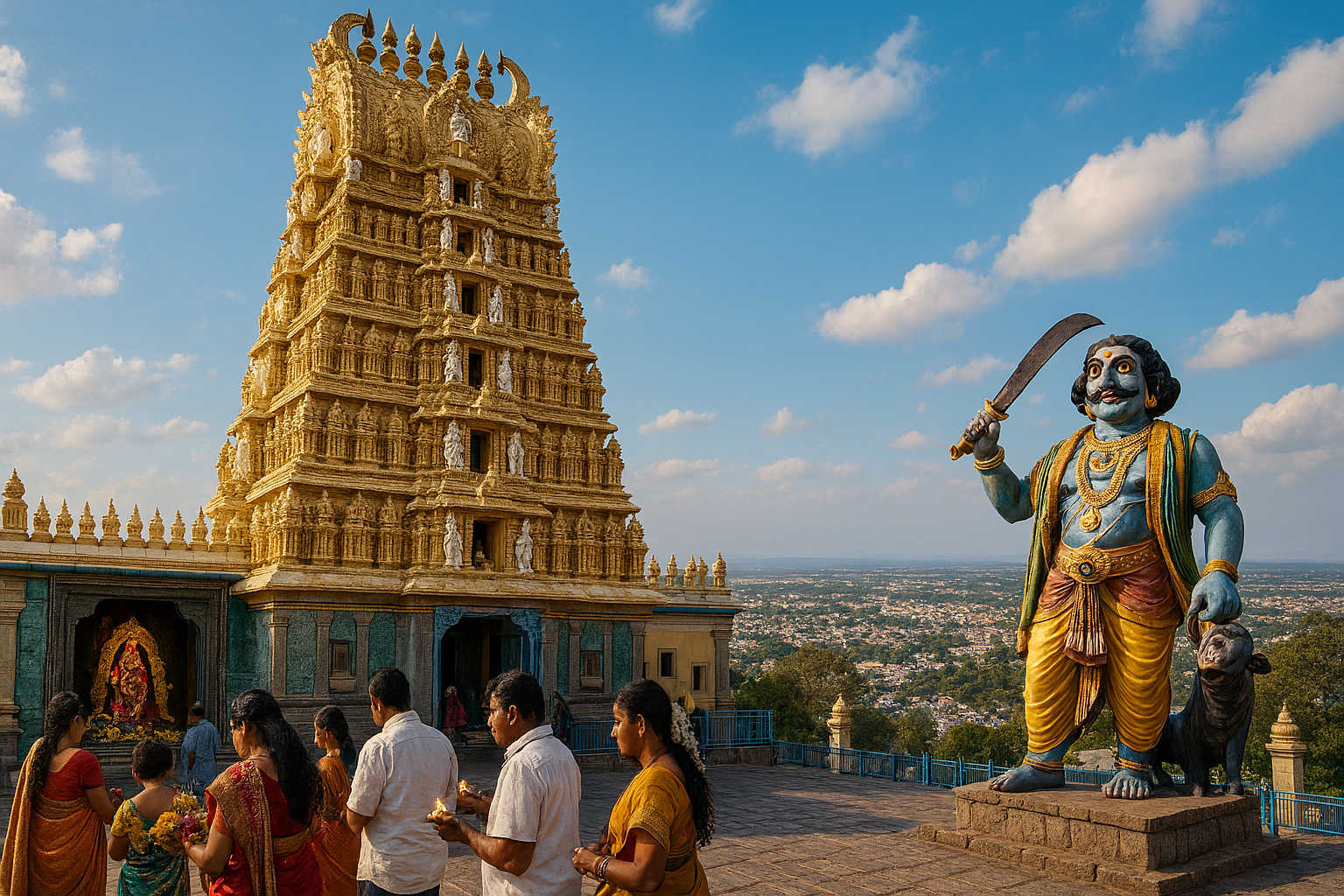
Towering Gopuram: The seven-tiered gopuram (gateway tower) is adorned with intricate carvings of gods, goddesses, and mythological figures.
-
Sanctum (Garbhagriha): The sanctum houses the idol of Chamundeshwari, a striking depiction of the Goddess with eight arms holding various weapons. She is portrayed standing triumphantly over Mahishasura, symbolizing her victory.
-
Mahishasura Statue: At the entrance of the hilltop, a large colorful statue of Mahishasura holding a sword and serpent welcomes visitors—a reminder of the legend.
-
Nandi Statue: Halfway up the 1,000 steps leading to the temple is a colossal Nandi (bull) statue carved out of granite, measuring nearly 15 feet tall, believed to be a sacred protector.
The temple’s setting atop Chamundi Hill, at a height of 3,489 feet, offers a panoramic view of Mysuru city, adding natural beauty to its divine aura.
Spiritual Significance
Chamundeshwari is revered as the guardian deity of Mysuru, and her blessings are sought for protection, strength, and victory over adversities. Devotees believe that:
-
Worshipping her removes obstacles and grants courage.
-
She symbolizes the eternal triumph of dharma over adharma (righteousness over evil).
-
The temple is a Shakti Peetha, where the hair of Goddess Sati is said to have fallen.
The combination of mythology, history, and Shakti worship makes it a spiritual powerhouse.
Festivals and Celebrations
The Chamundeshwari Temple is most vibrant during Navaratri and Mysuru Dasara:
-
Navaratri: For nine days, the Goddess is worshipped in different forms of Durga, attracting thousands of devotees. On the tenth day, Vijayadashami, grand processions and rituals mark the slaying of Mahishasura.
-
Chamundi Jayanti: This festival celebrates the appearance of the Goddess, with special poojas and cultural programs.
-
Weekly Worship: Tuesdays and Fridays are considered most auspicious, with devotees offering flowers, coconuts, and special prayers.
These celebrations not only highlight the spiritual importance but also connect the temple with Mysuru’s cultural identity.
Chamundi Hill and Pilgrimage Experience
Pilgrims and tourists alike find the journey to Chamundeshwari Temple enriching:
-
By Steps: Many devotees choose to climb the 1,000 stone steps, stopping at the Nandi statue midway. This is considered a mark of devotion and penance.
-
By Road: For those unable to climb, the temple is accessible by road, with buses and taxis available from Mysuru city.
-
Panoramic Views: The hilltop offers breathtaking views of Mysuru, including landmarks like Mysore Palace, Lalitha Mahal, and Karanji Lake.
The experience combines physical effort, natural beauty, and spiritual fulfillment.
Chamundeshwari and Mysuru’s Identity
The connection between the temple and the city of Mysuru is profound:
-
Mysuru’s very name is derived from Mahishasura-uru (the town of Mahishasura), symbolizing the legend.
-
The Mysuru Dasara festival, celebrated with grandeur, re-enacts the Goddess’s victory and is one of India’s most famous cultural festivals.
-
The Wodeyars of Mysuru considered Chamundeshwari their royal deity, further embedding her influence into the city’s heritage.
Thus, the temple is not just a shrine—it is the soul of Mysuru’s culture and traditions.
Visiting Information
-
Location: Chamundi Hill, 13 km from Mysuru city.
-
Timings: 7:30 AM – 2:00 PM, 3:30 PM – 6:00 PM, and 7:30 PM – 9:00 PM.
-
Best Time to Visit: During Navaratri or Dasara for festive energy, or early mornings for peaceful darshan.
-
Nearby Attractions: Mysore Palace, Karanji Lake, Lalitha Mahal Palace, and Brindavan Gardens.
Conclusion
The Chamundeshwari Temple is not only a sacred space of worship but also a cultural and historical beacon. As the slayer of Mahishasura, Goddess Chamundi represents the eternal battle against evil and the triumph of righteousness.
From its legendary myths to its grand architecture and panoramic setting, the temple stands as a timeless symbol of faith and identity for Mysuru and its people. For devotees, it is a source of strength and blessings, and for travelers, it offers a deep dive into South India’s spiritual and cultural richness.