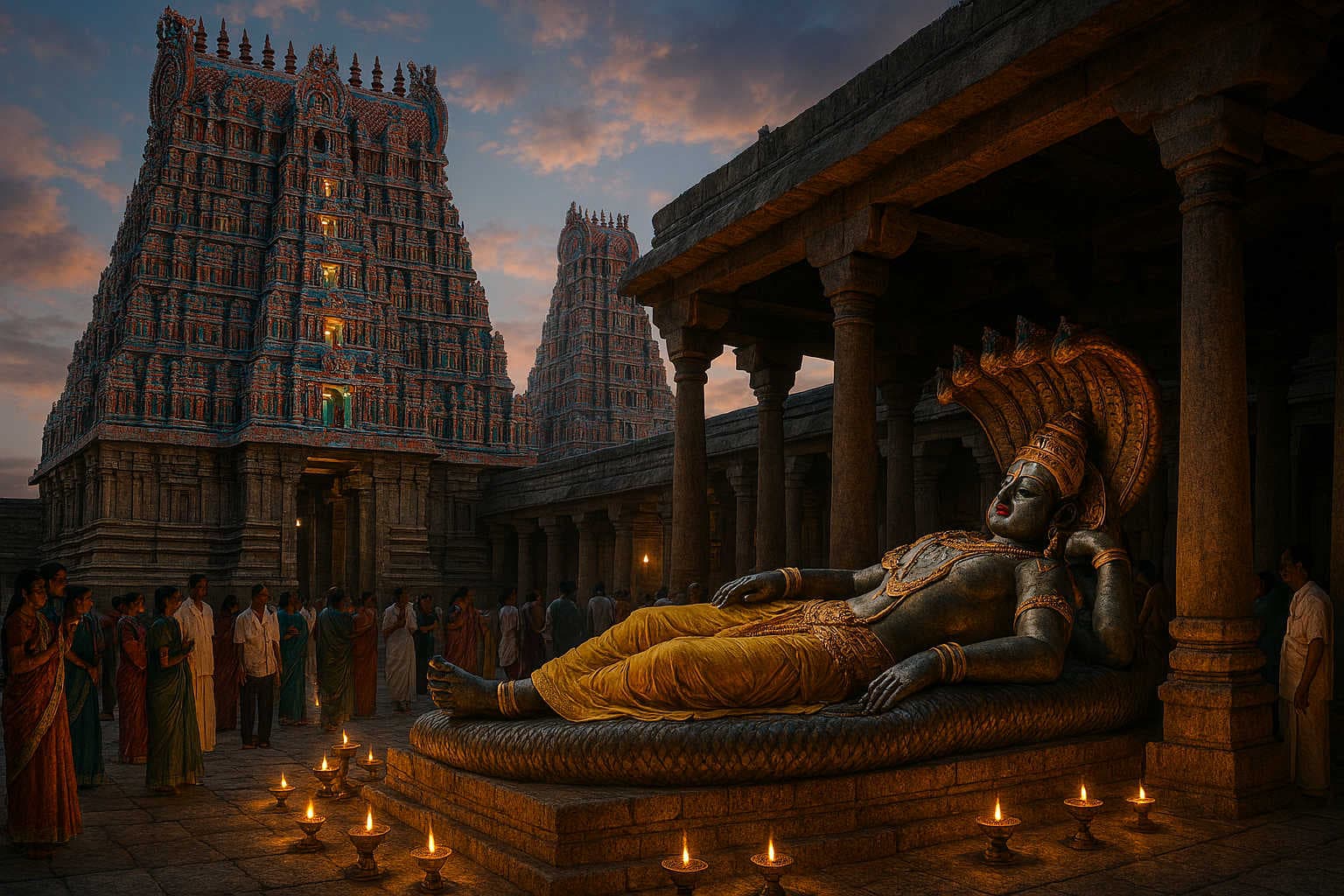
Ranganathaswamy – The Sleeping Lord in Srirangam
In the heart of Tamil Nadu, on a river island formed by the Kaveri and Kollidam, stands the magnificent Ranganathaswamy Temple of Srirangam. Dedicated to Lord Vishnu in his reclining form as Ranganatha, the temple is not just a religious monument but a thriving cultural and spiritual center. It is the largest functioning Hindu temple in the world, a sacred seat of Vaishnavism, and one of the most important of the 108 Divya Desams glorified in Tamil Alvar hymns.
The Legend of Ranganatha
According to tradition, the idol of Lord Ranganatha was originally worshipped by Brahma, the creator, and later gifted to Ikshvaku, ancestor of Lord Rama. Generations later, when Lord Rama defeated Ravana, he gave the idol to Vibhishana, Ravana’s righteous brother, as a token of friendship and blessing.
However, when Vibhishana was carrying the idol southward, he placed it on the banks of the Kaveri at Srirangam. The idol became immovable, establishing Srirangam as the eternal abode of Lord Ranganatha. This myth ties the temple not only to Ramayana lore but also to the eternal love of Vishnu for his devotees.
The Reclining Lord
The presiding deity, Ranganathaswamy, is depicted reclining on the serpent Adishesha, with his consort Ranganayaki (Lakshmi Devi) at his side. His posture symbolizes the divine state of yoga nidra, a cosmic sleep in which he sustains the universe. The peaceful expression of the Lord reflects eternal compassion and protection for devotees.
Darshan of the Lord is considered highly auspicious, as Srirangam is regarded as “Bhooloka Vaikuntha” – the earthly abode of Vishnu.
Architecture of the Temple
The Srirangam temple is an architectural marvel, spreading over 156 acres with seven concentric enclosures and 21 massive gopurams (gateway towers).
-
Rajagopuram – The temple’s tallest tower rises to 236 feet, making it one of the tallest in Asia.
-
Thousand-Pillared Hall – An exquisite structure filled with carved pillars, used for festivals and cultural performances.
-
Golden Vimana – The sanctum is crowned with a golden tower, marking the holiest part of the temple.
-
Prakaras – The seven enclosures symbolize the seven layers of the universe, with the deity at the cosmic center.
Walking through the vast temple complex is like traversing a living city, complete with markets, residences for priests, and bustling activity.
Spiritual Importance
Srirangam is revered as the foremost among the 108 Divya Desams, sacred Vishnu shrines celebrated in the Tamil hymns of the Alvars. Saints like Periyalvar, Andal, Tiruppan Alvar, and Thirumangai Alvar sang passionately of Lord Ranganatha, enriching Tamil devotional literature.
The temple is also one of the five sacred shrines known as the Pancharanga Kshetrams, all dedicated to Lord Ranganatha along the Kaveri River. Among these, Srirangam is considered the most significant.
Temple Life and Festivals
The temple is not only a place of worship but a vibrant hub of rituals and festivities.
-
Daily Worship – Intricate pujas are performed six times a day, accompanied by Vedic chants, music, and flower offerings.
-
Vaikunta Ekadashi – The grandest festival at Srirangam, celebrated in December–January. On this day, the Paramapada Vasal (gateway to heaven) is opened, allowing devotees to pass through, symbolizing entry into Vaikuntha.
-
Panguni Brahmotsavam – A 21-day festival in March–April with elaborate processions and celebrations.
-
Andal Festival – Dedicated to the poet-saint Andal, whose devotion to Ranganatha is immortalized in the Tamil classic Tiruppavai.
During these festivals, the temple becomes a sea of devotion, drawing lakhs of pilgrims from across the world.
The Temple’s History
The temple has seen centuries of patronage, invasions, and revival:
-
Early Cholas, Pandyas, and Hoysalas contributed to its expansion.
-
In the 14th century, the temple was attacked during the Delhi Sultanate invasions, but the priests protected the idol, hiding it in Tirupati for years before reinstating it.
-
The Vijayanagara rulers and Nayaks further enriched the temple, building mandapas, towers, and halls.
Today, the temple stands as a testament to resilience, faith, and artistic excellence.
Srirangam as Bhakti’s Heartland
For Vaishnavas, Srirangam is more than a temple; it is the spiritual capital. Philosophers like Ramanujacharya, the great teacher of Sri Vaishnavism, made Srirangam his home. His shrine within the temple continues to inspire followers.
Bhakti here is not limited to rituals – it permeates music, poetry, and community life. The air is filled with recitations of the Divya Prabandham and melodies of devotion that connect hearts directly to Ranganatha.
Pilgrimage and Experience
A visit to Srirangam is a journey through devotion, history, and architecture:
-
Devotees first bathe in the Kaveri before entering the temple.
-
The darshan of Lord Ranganatha, lying in serene majesty, leaves pilgrims humbled and comforted.
-
Walking around the seven enclosures offers both physical and spiritual cleansing.
The town of Srirangam itself is wrapped in temple life, with traditions carried on for centuries.
Conclusion
The Ranganathaswamy Temple of Srirangam is not just a temple but a living universe of faith. It combines myth, history, art, and spirituality in a seamless whole. To see Lord Vishnu reclining on Adishesha, resting in eternal compassion, is to experience a glimpse of Vaikuntha on Earth.
For the millions who flock here every year, Srirangam is more than a pilgrimage—it is the assurance that the Lord sleeps not in forgetfulness but in watchful grace, ever protecting and blessing his devotees.