Jagannath Puri – The Rath Yatra Mystery
The holy town of Puri in Odisha is one of the most sacred pilgrimage destinations for Hindus, renowned as one of the Char Dham shrines. At the heart of its spiritual aura lies the Jagannath Temple, dedicated to Lord Jagannath, a form of Lord Vishnu or Krishna. While devotees flock here throughout the year, the most awe-inspiring and mysterious event is the Rath Yatra, or the Chariot Festival, which has been celebrated for centuries with grandeur, devotion, and mystique.
The Legend of Lord Jagannath
Lord Jagannath is regarded as a manifestation of Lord Vishnu, specifically associated with his Krishna avatar. Unlike traditional deities, the idols of Jagannath, Balabhadra, and Subhadra are made of wood and are distinctly unique with large round eyes, incomplete arms, and a simplistic form.
The legend says that King Indradyumna of Malwa had a vision of Lord Vishnu, who instructed him to carve the deities. Vishwakarma, the celestial architect, agreed to carve them under the condition of being undisturbed. However, the queen impatiently opened the door midway, leaving the idols unfinished. Thus, the incomplete yet divinely powerful idols came to be worshipped in Puri.
The Rath Yatra – A Festival of Chariots
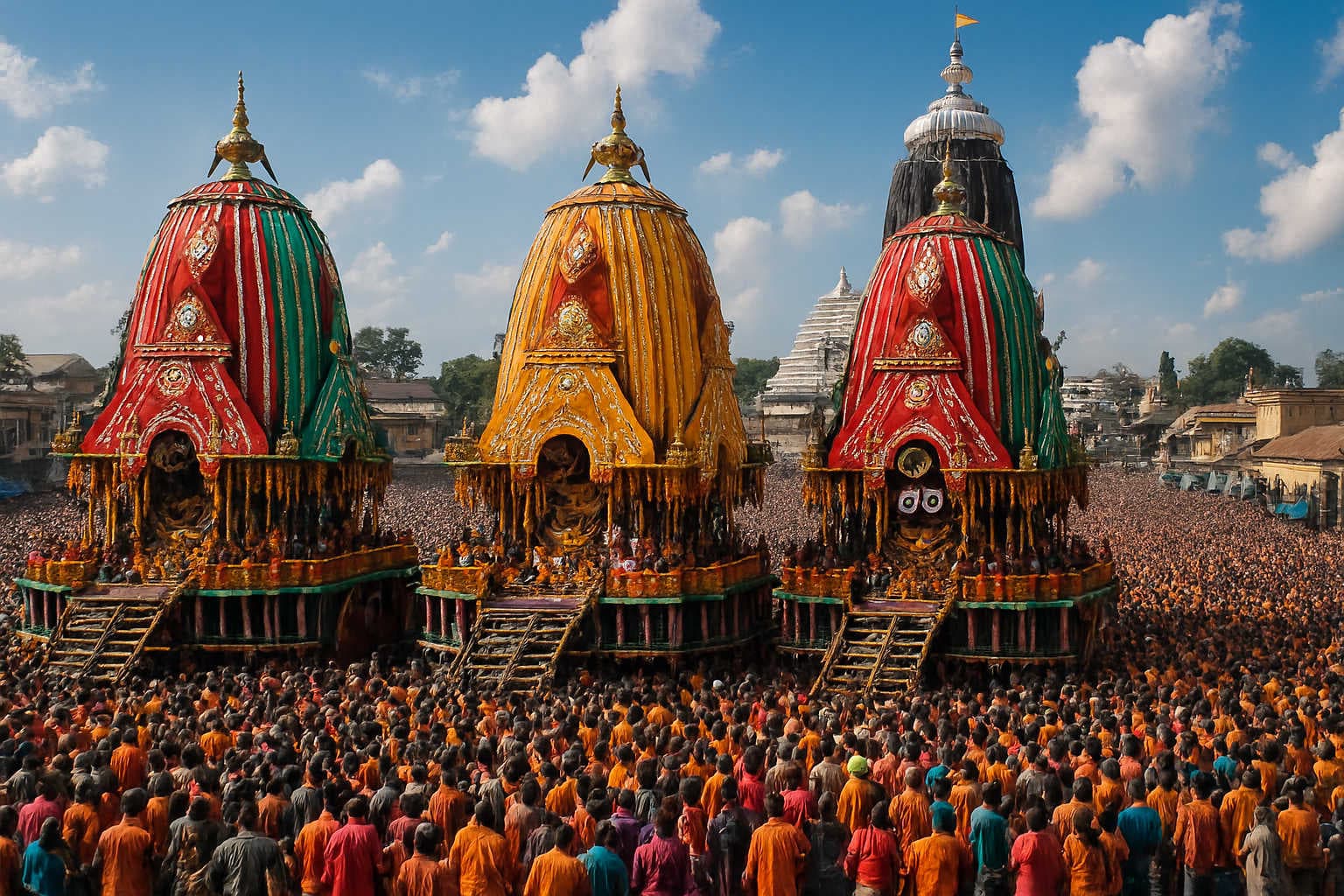
The Rath Yatra is the grandest festival of Puri, held annually in June or July. It symbolizes Lord Jagannath’s journey from his temple to his aunt Gundicha’s temple, where he resides for nine days before returning. The three colossal wooden chariots, newly built each year, are pulled through the streets by thousands of devotees.
-
Nandighosa – Lord Jagannath’s chariot, 45 feet high with 16 wheels.
-
Taladhwaja – Lord Balabhadra’s chariot, 44 feet high with 14 wheels.
-
Darpadalana – Devi Subhadra’s chariot, 43 feet high with 12 wheels.
Each chariot is decorated with colorful fabrics, carvings, and motifs, making them moving temples on wheels.
Mysteries of the Rath Yatra
The Rath Yatra is not just a festival; it is surrounded by several mysteries and unexplained phenomena that fascinate both devotees and researchers.
-
The Flag of the Temple – The flag atop the Jagannath Temple always flaps in the opposite direction of the wind, a phenomenon unexplained by science.
-
The Chariots’ Movement – Despite their massive size and weight, the chariots move only when devotees pull them, as if guided by divine will. Sometimes, even thousands cannot move them until the right moment, believed to be chosen by Lord Jagannath himself.
-
The Temple’s Shadow – The main temple structure casts no shadow at any time of the day.
-
The Wooden Idols – Every 12 to 19 years, a ritual called Nabakalebara replaces the old wooden idols with new ones. The old idols are buried within the temple complex, but the process of transferring the divine energy remains a secret performed only by selected priests at midnight.
These mysteries elevate the aura of Jagannath Puri and make Rath Yatra a phenomenon beyond mere celebration.
Participation of Devotees
The Rath Yatra is one of the few festivals where all barriers of caste, creed, and social status dissolve. Thousands of devotees, irrespective of background, gather to pull the ropes of the massive chariots. It is believed that pulling the chariot brings immense spiritual merit and washes away sins.
The air resonates with chants of “Jai Jagannath”, conch shells, drums, and devotional songs, creating an atmosphere that is both electrifying and spiritual.
The Gundicha Temple Journey
After the chariots reach the Gundicha Temple, considered the aunt’s house of Lord Jagannath, the deities rest there for nine days. This journey symbolizes the Lord visiting his devotees outside the sanctum of the temple, reminding them that divinity resides not only in temples but also in their homes and hearts.
On the tenth day, the return journey known as Bahuda Yatra takes place, where the deities return to the Jagannath Temple. During this time, Lord Jagannath is offered a unique sweet dish called Poda Pitha, symbolizing homecoming.
The Kitchen and Mahaprasad
Another marvel of Jagannath Puri is its temple kitchen, said to be the largest in the world. Over 56 varieties of food (Chappan Bhog) are prepared daily in earthen pots and offered to the deity before being distributed as Mahaprasad. Strangely, no matter how many devotees arrive, the Mahaprasad never falls short, further deepening the mysteries of Puri.
Significance of Jagannath Puri
Jagannath Puri holds an esteemed position as one of the Char Dham pilgrimage sites, along with Badrinath, Rameswaram, and Dwarka. For Vaishnavites, Lord Jagannath is the Lord of the Universe, and visiting Puri is considered equivalent to attaining liberation.
The Rath Yatra, in particular, symbolizes the removal of obstacles and the universal accessibility of God, as Lord Jagannath steps out of the temple to be among his devotees.
Conclusion
The Jagannath Puri Rath Yatra is not just a religious festival but a spiritual phenomenon that embodies devotion, inclusivity, and divine mysteries. From the massive chariots and the unique deities to the unexplained phenomena surrounding the temple, every aspect of Puri leaves devotees in awe.
Standing amidst the sea of pilgrims, pulling the ropes of the divine chariots, one cannot help but feel the presence of something beyond human comprehension. The Rath Yatra of Jagannath Puri is truly a reminder that in faith and devotion, mysteries transform into miracles, and the divine becomes a living reality.