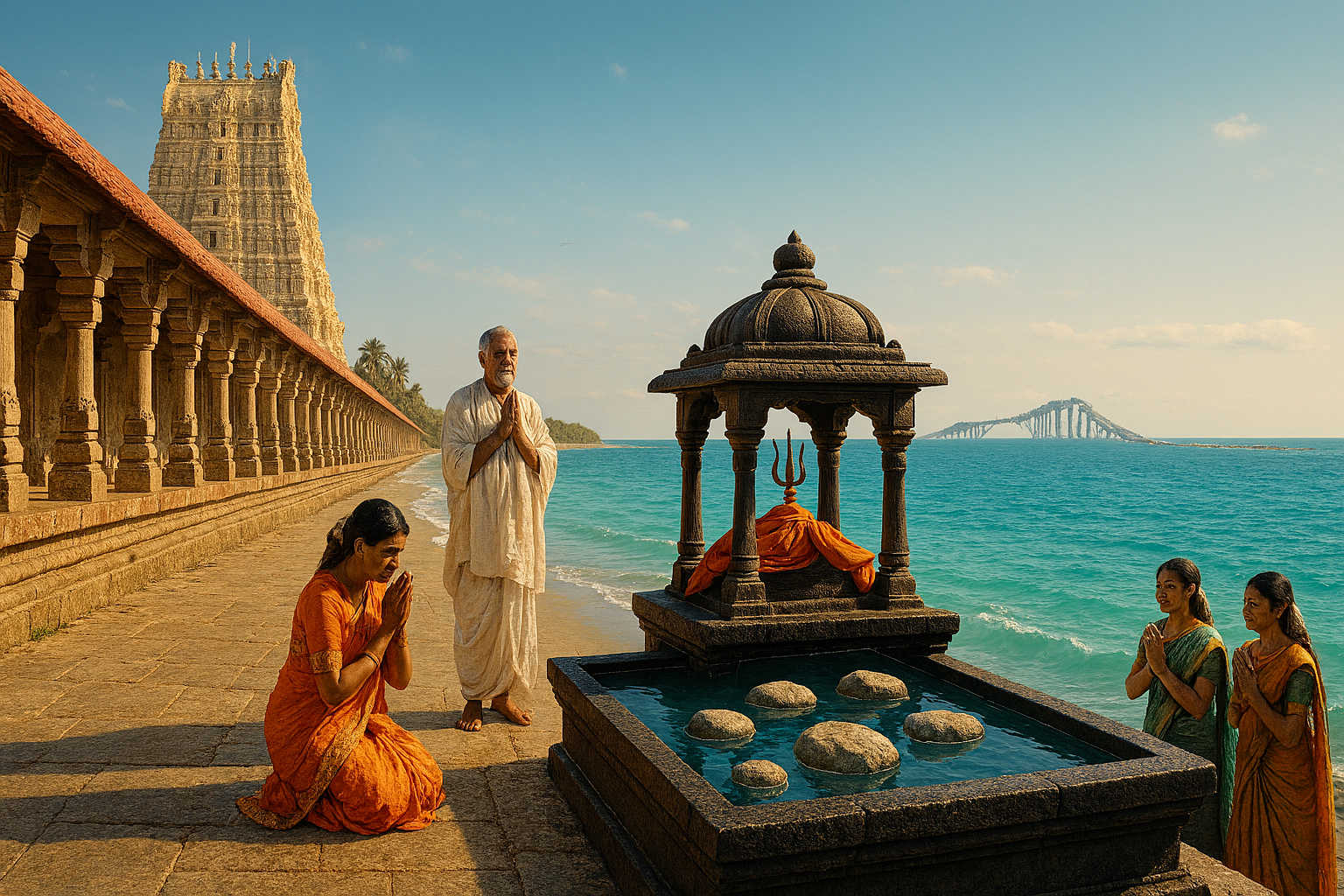
Rameswaram – Dhanushkodi and Floating Stones
Rameswaram, a serene island town in Tamil Nadu, holds a unique place in India’s spiritual and cultural map. It is one of the Char Dham pilgrimage sites and home to the Ramanathaswamy Temple, one of the 12 Jyotirlingas of Lord Shiva. But Rameswaram is more than just a temple town—it is also the site of Dhanushkodi, the mystical “ghost town” at the tip of India, and the legendary floating stones of Ram Setu that connect it with Sri Lanka.
Blending mythology, devotion, and natural beauty, Rameswaram stands as a living testimony to India’s spiritual heritage.
Rameswaram in the Ramayana
Rameswaram is intricately connected to the epic Ramayana. According to legend, Lord Rama, along with Lakshmana, Hanuman, and the Vanara Sena, reached Rameswaram while on their journey to rescue Goddess Sita from Ravana’s captivity in Lanka.
It was here that Rama worshipped Lord Shiva to seek blessings before the great war. After vanquishing Ravana, he returned to perform rituals of atonement at this very place. Thus, Rameswaram is both a Shaivite and Vaishnavite holy town, uniting devotees of Shiva and Vishnu.
Ramanathaswamy Temple – The Jyotirlinga of the South
The most important spiritual landmark of Rameswaram is the Ramanathaswamy Temple, which houses one of the twelve Jyotirlingas of Shiva. The temple is renowned for its majestic corridors with over 1,200 intricately carved pillars, making it one of the largest temple corridors in the world.
The temple’s sanctum holds the lingam installed by Lord Rama himself. According to legend, Rama ordered Hanuman to bring a Shiva lingam from the Himalayas. Since Hanuman delayed, Sita fashioned a lingam from sand, which Rama consecrated. Both lingams—Ramalingam and Vishwalingam—are worshipped today.
Pilgrims also undertake the ritual of bathing in the 22 sacred wells (Theerthams) inside the temple premises, believed to purify sins and grant liberation.
Dhanushkodi – The Ghost Town
Just 20 km from Rameswaram lies Dhanushkodi, a small strip of land stretching into the sea. Mythologically, this is the spot where Rama marked the point for building the bridge to Lanka—hence the name Dhanushkodi (end of Rama’s bow).
In recent history, Dhanushkodi was devastated by a cyclone in 1964, which submerged the town and left it uninhabited. Today, it is a hauntingly beautiful destination often referred to as a “ghost town.” Visitors can see remnants of old churches, railway stations, and schools, all standing as silent witnesses of nature’s fury.
The confluence of the Bay of Bengal and Indian Ocean, called Arichal Munai, is located here, offering breathtaking views of two seas merging.
Ram Setu and the Floating Stones
One of the greatest mysteries of Rameswaram lies in the story of Ram Setu (Adam’s Bridge)—a chain of limestone shoals stretching from Rameswaram to Sri Lanka. According to the Ramayana, this bridge was built by the Vanara Sena using special stones that floated on water, thanks to Lord Rama’s blessings.
Even today, temples in Rameswaram and surrounding areas preserve floating stones as sacred relics. Devotees are awestruck when they see heavy stones that miraculously float in water, reinforcing their faith in the legend. Scientists attribute this phenomenon to porous volcanic stones, but for devotees, they remain divine reminders of Rama’s victory.
Other Sacred Sites in Rameswaram
-
Agni Theertham – A holy beach where pilgrims take a dip before entering Ramanathaswamy Temple.
-
Kothandaramaswamy Temple – Associated with the spot where Vibhishana, Ravana’s brother, surrendered to Rama.
-
Gandhamadhana Parvatham – A sacred hillock offering panoramic views and housing Rama’s footprints.
-
Pamban Bridge – The iconic railway bridge connecting Rameswaram to mainland India, itself an engineering marvel.
Festivals and Rituals
Rameswaram comes alive during Mahashivratri and Rama Navami, when thousands of devotees gather to worship. Daily rituals at the temple, especially the Spatika Lingam aarti at dawn, are deeply spiritual experiences.
Pilgrims often combine their Rameswaram visit with a trip to Dhanushkodi and perform rituals for their ancestors at the seashore, as the site is considered sacred for Pitru Tarpan.
Travel Tips
-
Best Time to Visit: October to April, when the weather is pleasant. Summers can be very hot.
-
How to Reach:
-
By Air: Nearest airport is Madurai (174 km).
-
By Train: Rameswaram is well connected by rail to major cities.
-
By Road: Connected by highways to Chennai, Madurai, and Trichy.
-
-
Local Transport: Autos, cycle-rickshaws, and rental jeeps are popular for temple and Dhanushkodi visits.
Conclusion
Rameswaram is not just a pilgrimage—it is an experience of faith, history, and nature. From the spiritual aura of Ramanathaswamy Temple to the haunting charm of Dhanushkodi and the eternal mystery of the floating stones of Ram Setu, the town captures the very essence of India’s living mythology.
For pilgrims, Rameswaram is liberation. For travelers, it is wonder. For everyone, it is a journey into timeless faith and legend.