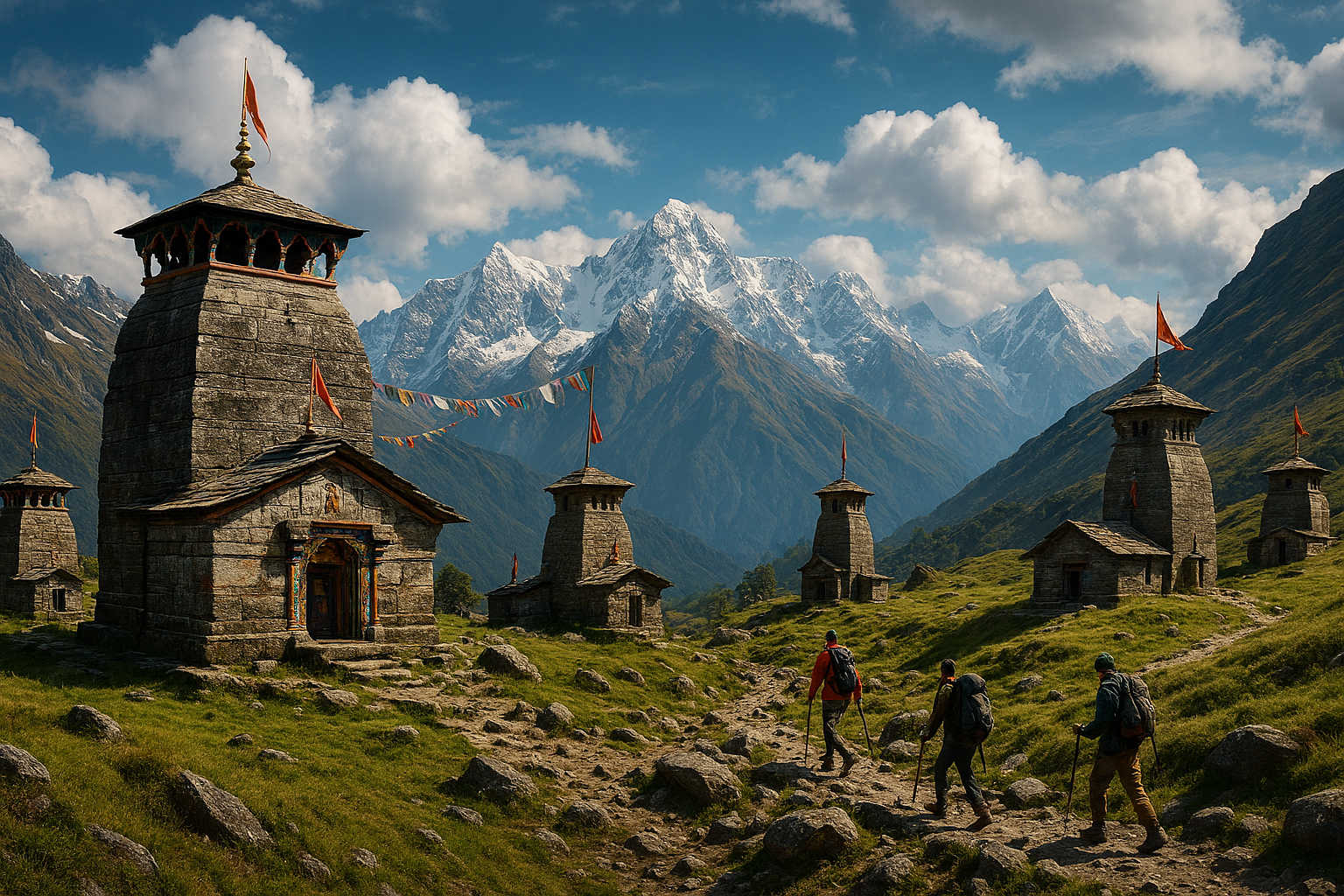
Panch Kedar Temples – The Hidden Shrines of Shiva
High in the majestic Garhwal Himalayas of Uttarakhand, amidst snow-clad peaks and alpine meadows, lie the five sacred shrines of Lord Shiva, collectively known as the Panch Kedar. These temples—Kedarnath, Tungnath, Rudranath, Madhyamaheshwar, and Kalpeshwar—are revered by millions of devotees and trekkers alike. Each temple has its unique location, mythological importance, and spiritual aura, making the Panch Kedar Yatra one of the most fulfilling journeys in Hinduism.
What is Panch Kedar?
The term Panch Kedar translates to “Five Kedars” and refers to the five holy Shiva temples situated in remote and high-altitude regions of Uttarakhand. They are:
-
Kedarnath – The most famous and one of the twelve Jyotirlingas of Lord Shiva.
-
Tungnath – The highest Shiva temple in the world, located at an altitude of 3,680 meters.
-
Rudranath – Known for its natural rock formation resembling Shiva’s face.
-
Madhyamaheshwar – Dedicated to Shiva’s navel and stomach portion.
-
Kalpeshwar – The only temple among the five that remains open throughout the year.
Mythological Background – The Legend of the Pandavas
According to Hindu mythology, the story of Panch Kedar is closely linked to the Mahabharata and the Pandavas. After the Kurukshetra war, the Pandavas were burdened with the sin of killing their own relatives and Brahmins. To seek atonement and forgiveness, they wanted to meet Lord Shiva and seek his blessings.
However, Lord Shiva was displeased with the Pandavas for the destruction caused by the war. To avoid meeting them, Shiva took the form of a bull (Nandi) and disappeared into the Garhwal Himalayas. When the Pandavas pursued him, Shiva dived into the ground, and his body emerged in five different locations, each becoming one of the Panch Kedar shrines:
-
Hump – Kedarnath
-
Arms – Tungnath
-
Face – Rudranath
-
Navel & stomach – Madhyamaheshwar
-
Hair – Kalpeshwar
The Pandavas built temples at these five spots, and thus began the tradition of worshiping Lord Shiva in his Panch Kedar form.
Significance of the Panch Kedar Yatra
The Panch Kedar Yatra is considered extremely sacred and spiritually rewarding for devotees of Lord Shiva. It is believed that:
-
Visiting these five temples helps in absolving sins and attaining moksha (liberation).
-
The journey symbolizes faith, endurance, and devotion, as the temples are located in remote and rugged terrain.
-
It is a perfect combination of spiritual quest and adventure, attracting not just pilgrims but also trekkers and nature lovers.
The Five Temples of Panch Kedar
1. Kedarnath
-
Altitude: 3,583 meters
-
Specialty: One of the 12 Jyotirlingas and the most famous among Panch Kedar.
-
Highlight: The temple is surrounded by snow-clad mountains, including the Kedarnath peak.
-
Access: Requires a trek of about 16 km from Gaurikund.
2. Tungnath
-
Altitude: 3,680 meters
-
Specialty: The highest Shiva temple in the world.
-
Legend: Represents Shiva’s arms.
-
Trek: A short but steep 4 km trek from Chopta, known as the Mini Switzerland of India.
3. Rudranath
-
Altitude: 2,286 meters
-
Specialty: Natural rock formation resembling Shiva’s face.
-
Highlight: The temple is set in the midst of lush alpine meadows and thick forests.
-
Trek: One of the toughest among Panch Kedar treks, requiring 18–20 km of trekking.
4. Madhyamaheshwar
-
Altitude: 3,289 meters
-
Specialty: Represents Shiva’s navel and stomach.
-
Highlight: Surrounded by the beautiful Chaukhamba and Kedarnath peaks.
-
Trek: Around 16 km from Ransi village.
5. Kalpeshwar
-
Altitude: 2,200 meters
-
Specialty: Represents Shiva’s hair (jata).
-
Unique Feature: It is the only temple that remains open throughout the year.
-
Access: A relatively easy trek of about 2 km from Urgam village.
Route and Travel Tips
Traditionally, the Panch Kedar Yatra starts from Kedarnath and ends at Kalpeshwar. The journey requires good physical fitness as it involves long treks through steep mountain paths, forests, and river valleys.
-
Best Time to Visit: May to June and September to October.
-
Avoid: Monsoon months (July-August) due to heavy rainfall and landslides.
-
Nearest Railway Station: Haridwar / Rishikesh.
-
Nearest Airport: Jolly Grant Airport, Dehradun.
Why is Panch Kedar Special?
Unlike other pilgrimages, the Panch Kedar temples are located in secluded and serene locations, far away from the hustle of cities. They offer:
-
Tranquility and peace amidst nature.
-
Adventurous treks through scenic Himalayan landscapes.
-
A chance to experience the true essence of devotion and surrender.
Conclusion
The Panch Kedar Yatra is not just a pilgrimage—it is a spiritual expedition that tests your endurance, purifies your soul, and brings you closer to the divine presence of Lord Shiva. Whether you are a devout pilgrim or an adventure seeker, this journey will remain etched in your memory forever.