Lord Shiva and the Dance of Destruction – Tandava
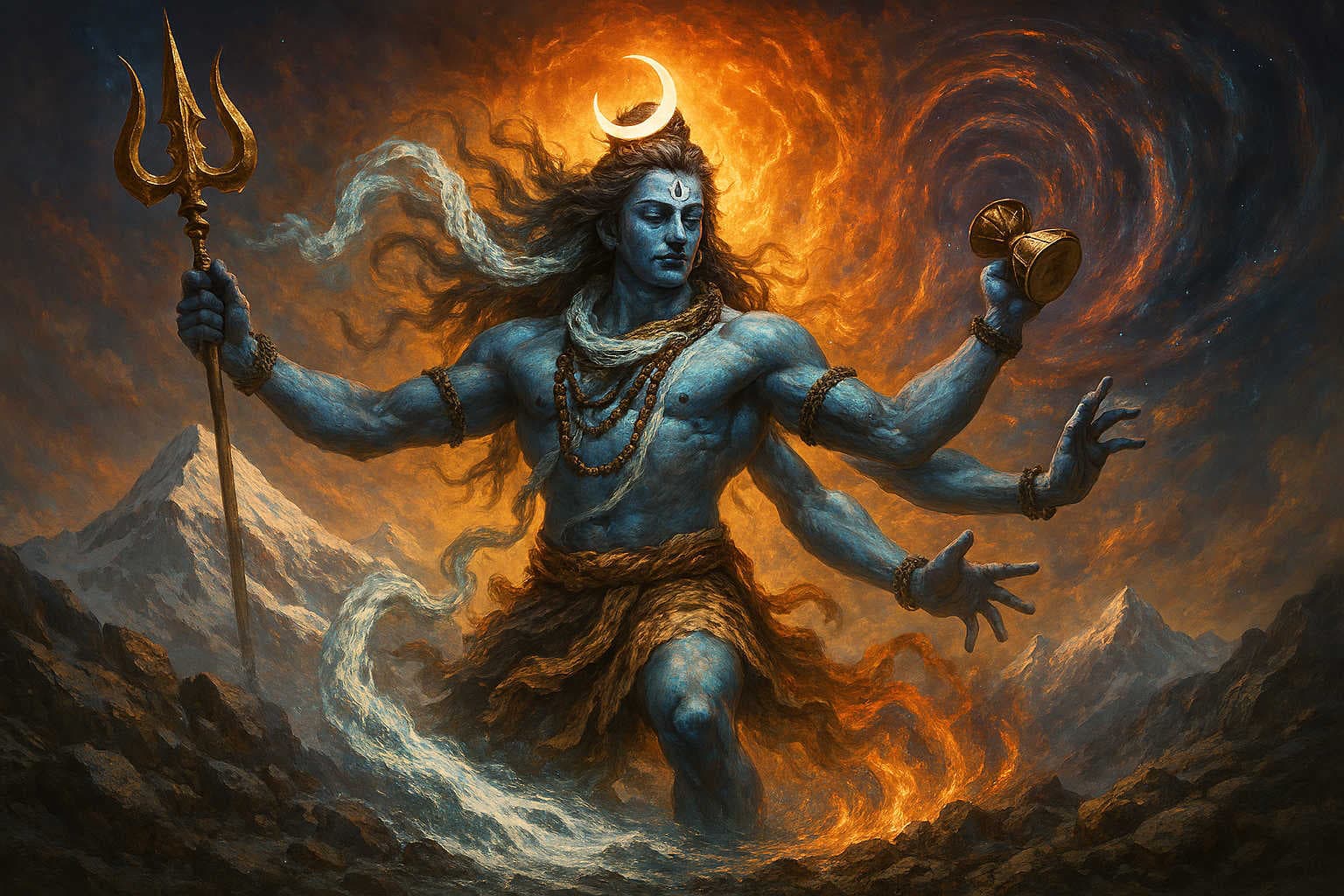
Lord Shiva, the supreme deity in Sanatan Dharma, is known for his many forms—benevolent, meditative, fierce, and cosmic. Among his most profound manifestations is the Tandava, a celestial dance that represents the rhythm of the universe. This dance is not just an art form; it is a symbol of cosmic cycles—creation, preservation, and destruction.
In this post, we explore the story behind Tandava, its types, and its spiritual significance in Hindu philosophy.
What is Tandava?
The word Tandava comes from the Sanskrit root “Tandul”, meaning vigorous dance. According to the Agamas and Puranas, Tandava is the powerful and divine dance performed by Lord Shiva. It signifies both destruction of ignorance and awakening of knowledge.
Shiva’s dance is often depicted in the form of Nataraja, the cosmic dancer who holds the universe in motion. Every gesture, every movement of this dance holds deep meaning—the eternal cycle of birth, death, and rebirth.
The Origin of Tandava
The concept of Tandava is described in Shiva Purana, Linga Purana, and many other scriptures. There are multiple legends associated with its origin:
1. After Sati’s Death
One of the most famous stories is linked to Daksha Yagna. When Sati, Shiva’s beloved consort, sacrificed herself due to her father Daksha’s insult, Shiva was overcome with rage and grief. In his fury, he performed the Rudra Tandava, a dance so fierce that it shook the heavens and threatened to destroy the universe. This dance symbolized cosmic dissolution, preparing the universe for renewal.
2. The Cosmic Play
Another version says that Shiva performs Tandava at the end of each cosmic cycle, marking the dissolution of the old and the creation of the new. It is not merely destruction—it is transformation, a cleansing process to allow new life to emerge.
Forms of Tandava
Shiva’s Tandava is not a single dance. Scriptures mention several variations, each representing a different aspect of existence:
-
Ananda Tandava – The Dance of Bliss, representing joy and creation.
-
Rudra Tandava – The Dance of Anger, symbolizing destruction.
-
Sandhya Tandava – Performed during twilight, balancing creation and dissolution.
-
Tripura Tandava – Signifying Shiva’s victory over the demon Tripurasura.
-
Gauri Tandava – Performed in harmony with Goddess Parvati.
Each of these forms shows how the same cosmic energy manifests in different ways, from nurturing to annihilating.
Symbolism of Nataraja and the Tandava
One of the most iconic representations of Tandava is Nataraja, the Lord of Dance. In this form, Shiva dances within a ring of flames, symbolizing the universe’s endless cycle. His posture and attributes convey profound truths:
-
Upper Right Hand (Damaru) – The drum of creation, representing sound as the source of life.
-
Upper Left Hand (Agni) – Fire, the force of destruction and transformation.
-
Lower Right Hand (Abhaya Mudra) – Fearlessness, granting protection.
-
Lower Left Hand – Points to the raised foot, symbolizing liberation.
-
Raised Foot – The path to moksha (liberation).
-
Apasmara (Demon under foot) – Ignorance crushed by divine knowledge.
-
Ring of Flames – The cosmic cycle of birth and death.
The Tandava thus reflects the truth that creation and destruction are inseparable—one cannot exist without the other.
The Spiritual Meaning of Tandava
Beyond its dramatic imagery, Tandava carries deep spiritual lessons:
-
Impermanence of Life – Everything in existence is temporary; destruction is as natural as creation.
-
Balance of Opposites – Joy and sorrow, birth and death, are part of the same cycle.
-
Dance as Devotion – Tandava is also seen as the ultimate expression of bhakti (devotion), where the devotee becomes one with the rhythm of the divine.
In yoga and spiritual practice, Tandava represents dynamic energy (Shakti) working with consciousness (Shiva) to sustain the cosmos.
Tandava in Art and Culture
The concept of Tandava has deeply influenced Indian classical dance, especially Bharatanatyam and Kathak, where sequences are inspired by Nataraja’s posture. The Chidambaram Temple in Tamil Nadu is dedicated to Lord Nataraja, where his cosmic dance is eternally celebrated.
Why is Tandava Called the Dance of Destruction?
Many people associate Tandava only with destruction, but this is a limited view. In reality, it is the dance of renewal. Destruction in Hindu philosophy is not negative; it is essential for the continuation of life. Just as old leaves fall for new ones to grow, the universe must dissolve to recreate itself.
Famous References of Tandava
-
Shiva Tandava Stotra – A powerful hymn composed by Ravana, praising the grandeur of Shiva’s cosmic dance.
-
Chidambaram Rahasya – The mystery of the empty space in the Chidambaram temple, symbolizing Shiva’s dance as the essence of the universe.
Lessons from Shiva’s Tandava
-
Change is Inevitable – Accept the cycles of life with grace.
-
Power with Balance – Energy must be controlled, not chaotic.
-
Destruction is Transformation – Every ending leads to a new beginning.
Conclusion
Lord Shiva’s Tandava is not just a divine performance—it is the very pulse of existence. It reminds us that life is a continuous dance of creation and dissolution. To witness Tandava in its essence is to understand the rhythm of the cosmos, where Shiva’s steps echo the eternal truth: everything changes, yet the Self remains unchanged.
So, the next time you see the image of Nataraja, remember—it is the symbol of life’s eternal dance, where destruction paves the way for creation, and chaos leads to cosmic order.