The Curse of Rishi Bhrigu on Lord Vishnu
Hindu scriptures are filled with fascinating stories that illustrate the profound relationship between gods, sages, and cosmic order. Among these, the story of Rishi Bhrigu’s curse on Lord Vishnu stands out as a tale of anger, ego, and devotion. This episode, deeply rooted in the Puranas, explains why the Supreme Lord Vishnu, who is beyond birth and death, willingly accepts incarnations in the mortal world.
Who Was Rishi Bhrigu?
Rishi Bhrigu was one of the Saptarishis (seven great sages) and the mind-born son of Lord Brahma. Revered for his wisdom and penance, Bhrigu played a key role in many ancient texts, including the creation of Bhrigu Samhita, a compilation of astrological predictions. His name is synonymous with knowledge, tapas (austerity), and sometimes, fiery temper.
The Background – A Divine Test
The story of Bhrigu’s curse is connected to a time when the rishis performed a great yajna (sacrifice). During the yajna, a question arose among the sages:
“Who among the Trinity – Brahma, Vishnu, or Shiva – is the supreme?”
Unable to arrive at a conclusion, they decided to send Rishi Bhrigu to test each deity and determine who deserved the highest honor.
Bhrigu Visits Lord Brahma
First, Bhrigu visited Lord Brahma, his own father. But when he did not bow to Brahma as a mark of respect, the creator god grew angry and was about to curse him. However, Brahma controlled his anger because of their father-son relationship. Bhrigu noted Brahma’s reaction and moved on.
Bhrigu Tests Lord Shiva
Next, the sage went to Lord Shiva, who greeted him with joy and tried to embrace him. But Bhrigu refused the embrace and spoke harshly, accusing Shiva of being impure due to his association with cremation grounds. Offended, Shiva’s temper flared, and he was about to strike Bhrigu down. But Goddess Parvati intervened, calming him. Again, Bhrigu took note of Shiva’s reaction and left.
Bhrigu’s Encounter with Lord Vishnu
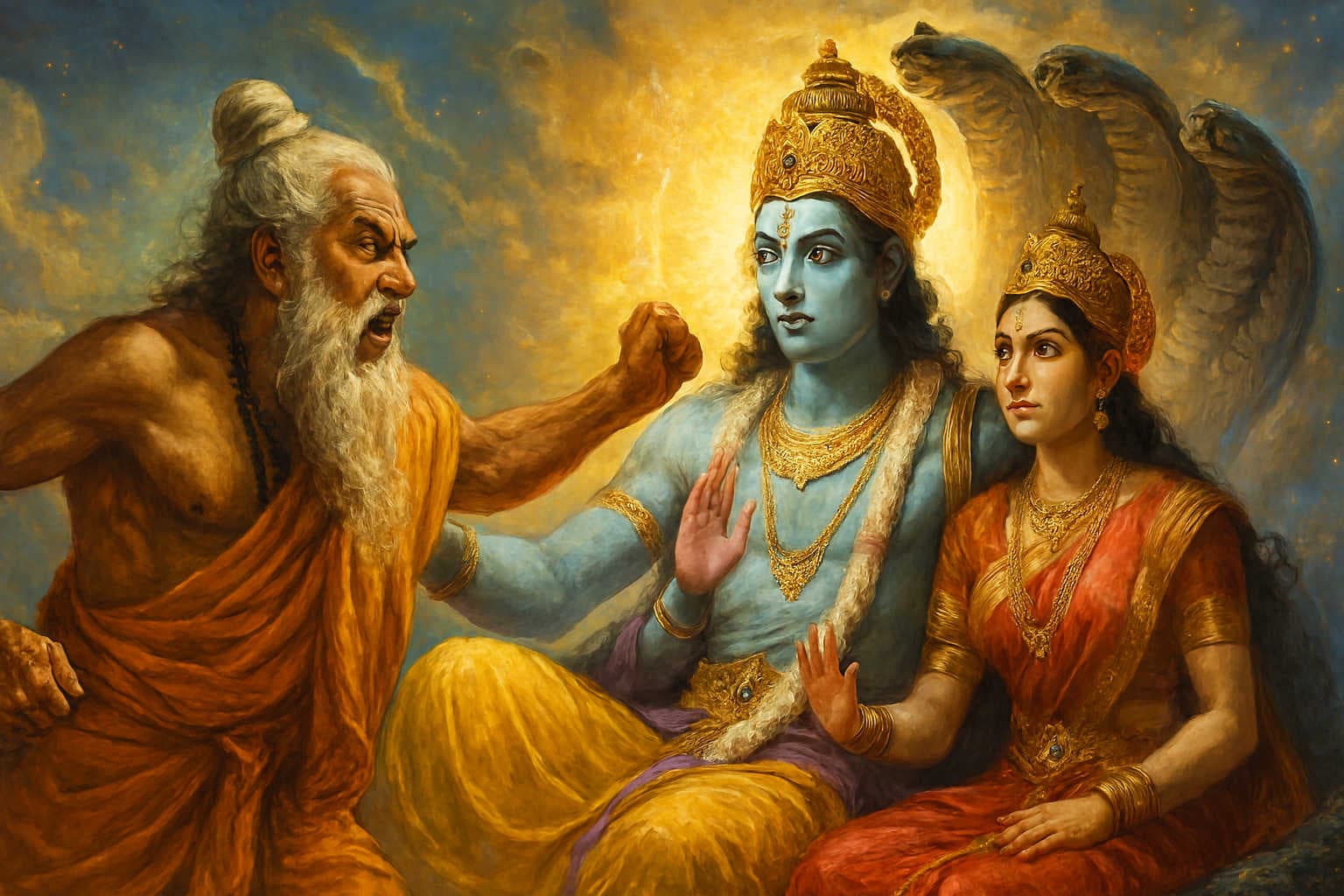
Finally, Bhrigu traveled to Vaikuntha, the divine abode of Lord Vishnu. Vishnu was resting on the serpent Ananta Shesha, with Goddess Lakshmi seated beside him, gently massaging his feet. The sage entered unannounced and, seeing Vishnu apparently ignoring him, became furious.
In a shocking act, Bhrigu kicked Lord Vishnu on the chest to draw his attention.
Lord Vishnu’s Response – The Embodiment of Calmness
Instead of reacting with anger, Lord Vishnu rose from his bed and folded his hands in humility. He addressed Bhrigu with utmost respect:
"O revered sage, I am sorry if I have offended you by not welcoming you properly. Your foot might have hurt by striking my chest. Let me massage it and ease your pain."
Saying this, Vishnu gently pressed the sage’s foot and removed all discomfort. This act of supreme tolerance and humility stunned Bhrigu. He realized that among the Trinity, Vishnu alone exhibited the virtue of forgiveness and calmness.
The Curse of Goddess Lakshmi
While Bhrigu was satisfied and left, this incident deeply hurt Goddess Lakshmi, who resided in Vishnu’s chest (known as Shrivatsa, the mark of Lakshmi). She felt insulted that a sage had kicked her divine abode. Angered, she cursed:
"Because of this insult, I cannot stay with you in Vaikuntha permanently. You will have to incarnate on Earth repeatedly, and I will also take birth as your consort in each life."
Thus began the cycle of Lord Vishnu’s avatars, including Rama and Krishna, and Goddess Lakshmi’s incarnations as Sita and Rukmini.
Why Did Bhrigu Curse Vishnu?
Some versions suggest that before leaving, Bhrigu cursed Lord Vishnu as well. The curse was that Vishnu, for allowing the sage to insult him without punishment, would be born on Earth and suffer human hardships. This too tied into the concept of Vishnu’s divine incarnations (Dashavatara).
The underlying message here is profound:
-
Even the Supreme Lord accepts karma and consequences to maintain cosmic balance.
-
True greatness lies in forgiveness and humility, not power or anger.
Philosophical Significance of the Story
This story teaches us several spiritual lessons:
-
Anger vs. Forgiveness – Brahma and Shiva reacted with anger, but Vishnu’s calmness made him supreme.
-
Ego in Spirituality – Even sages can fall prey to pride, reminding us to remain humble.
-
Power of Words and Actions – A curse, once spoken, cannot be taken back; hence, restraint is crucial.
-
Divine Purpose of Incarnations – The curse became a cosmic plan for Vishnu to descend as avatars to protect dharma.
Impact on Hindu Beliefs
The mark of Shrivatsa on Vishnu’s chest is a symbolic reminder of this event. Temples often depict Vishnu with this divine emblem. Devotees also believe that Lakshmi’s curse and Bhrigu’s act indirectly led to the great epics Ramayana and Mahabharata, shaping Sanatan Dharma’s foundation.
Conclusion
The story of Rishi Bhrigu and Lord Vishnu is not just a tale of anger and humility; it reflects universal truths about ego, patience, and forgiveness. Vishnu’s reaction shows that true divinity is expressed through compassion and tolerance, even in the face of insult. It also reminds us that every action has consequences, and sometimes what appears as a curse is part of a greater divine plan.