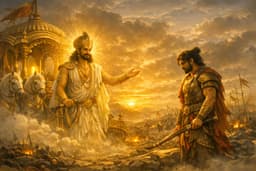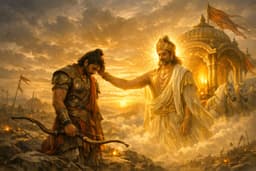
The Story of Parshuram – Warrior Sage
Among the ten avatars of Lord Vishnu, Parshuram holds a unique place. Unlike other incarnations, Parshuram is considered a Chiranjivi—an immortal being who still walks the earth. Known as the warrior sage, he is revered for his strength, austerity, and uncompromising commitment to dharma (righteousness). His name itself means “Rama with the axe,” signifying his divine weapon, the Parshu (axe), gifted by Lord Shiva.
Parshuram’s story is one of power, penance, and purpose—a tale that bridges the worlds of warriors and sages, and marks the transition from Treta Yuga to Dvapara Yuga.
Birth and Divine Mission
Parshuram was born to Sage Jamadagni and Mata Renuka, a deeply spiritual couple belonging to the Bhrigu lineage. His birth was no ordinary event. The earth was plagued by arrogant and oppressive Kshatriya rulers who misused their power, straying from the principles of dharma. The gods appealed to Lord Vishnu, who decided to incarnate as Parshuram to restore balance.
Blessed with exceptional strength and intellect, Parshuram grew up mastering scriptures, martial arts, and spiritual practices. He was deeply devoted to his parents and known for his fierce sense of justice.
The Axe from Lord Shiva
One of the most defining episodes of Parshuram’s life was his penance to please Lord Shiva, the god of destruction and supreme warrior. After intense austerities, Parshuram was blessed by Shiva and gifted a mighty axe (Parshu) along with unmatched skills in warfare. This divine weapon became his signature, earning him the title Parshuram.
Shiva also imparted the knowledge of astras (celestial weapons) and martial techniques, making Parshuram invincible in battle. This prepared him for his divine mission—to curb the tyranny of corrupt Kshatriya rulers.
The Tale of Vengeance and Justice
One of the most famous incidents in Parshuram’s life involves the killing of Kartavirya Arjuna, a powerful and arrogant king who misused his strength. Kartavirya, blessed with a thousand arms, once visited Sage Jamadagni’s ashram and was treated with great respect. However, intoxicated by power, the king seized the sage’s divine cow, Kamadhenu, by force.
When Parshuram learned of this, he was enraged. In a fierce battle, he killed Kartavirya Arjuna and retrieved the cow. This act, though just, sparked a cycle of revenge. The king’s sons later killed Jamadagni in his hermitage. Overcome with grief and fury, Parshuram vowed to annihilate the Kshatriya class.
Twenty-One Campaigns Against Kshatriyas
In his righteous rage, Parshuram waged twenty-one battles against oppressive Kshatriyas, purging the earth of their arrogance. After fulfilling his vow, he performed penance to atone for the violence and donated all his conquered lands to the Brahmins. This act of renunciation demonstrated that his actions were driven by dharma, not personal ambition.
Role as a Guru and Chiranjivi
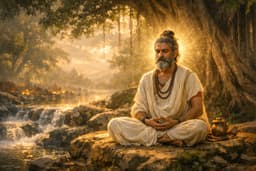
Despite his warrior nature, Parshuram embraced the life of a sage after his mission. He continued to guide and teach great warriors, including:
-
Bhishma, the grandsire of the Mahabharata.
-
Karna, one of the greatest archers.
-
Drona, the revered teacher of the Kauravas and Pandavas.
His presence spans multiple yugas, making him one of the seven immortals (Chiranjivis). It is believed that Parshuram will reappear during the end times to teach and guide Kalki, the final avatar of Vishnu.
Philosophical Significance
Parshuram’s story is more than a tale of battles; it conveys deep spiritual lessons:
-
Balance of Power and Wisdom: True strength lies in righteousness, not in domination.
-
Detachment After Duty: Despite immense power, Parshuram renounced material gains, showing the ideal of nishkama karma (selfless action).
-
Justice Over Ego: His actions were never for personal revenge but for restoring dharma.
He represents the union of kshatra (valor) and brahma (wisdom), teaching that a warrior must also be a sage at heart.
Parshuram in Hindu Traditions
Parshuram is worshipped widely, especially in Maharashtra, Karnataka, Goa, and Kerala. The famous Parshuram Jayanti is celebrated on the Akshaya Tritiya, considered an auspicious day for new beginnings.
In Kerala’s tradition, Parshuram is credited with creating the land itself. According to legend, he threw his axe into the sea, and the water receded, forming the region of Kerala.
Legacy and Relevance Today
In today’s world, Parshuram’s teachings inspire us to:
-
Stand against injustice fearlessly.
-
Use power responsibly and ethically.
-
Balance material pursuits with spiritual wisdom.
-
Act without attachment to results.
His life reminds us that true heroism lies in humility, not arrogance, and that righteousness should always guide strength.
Conclusion
The story of Parshuram is timeless—a saga of divine purpose, discipline, and justice. As the immortal warrior sage, he continues to be a guiding light for seekers, warriors, and devotees alike. His unwavering commitment to dharma makes him one of the most fascinating avatars of Vishnu, embodying the perfect harmony of strength and spirituality.