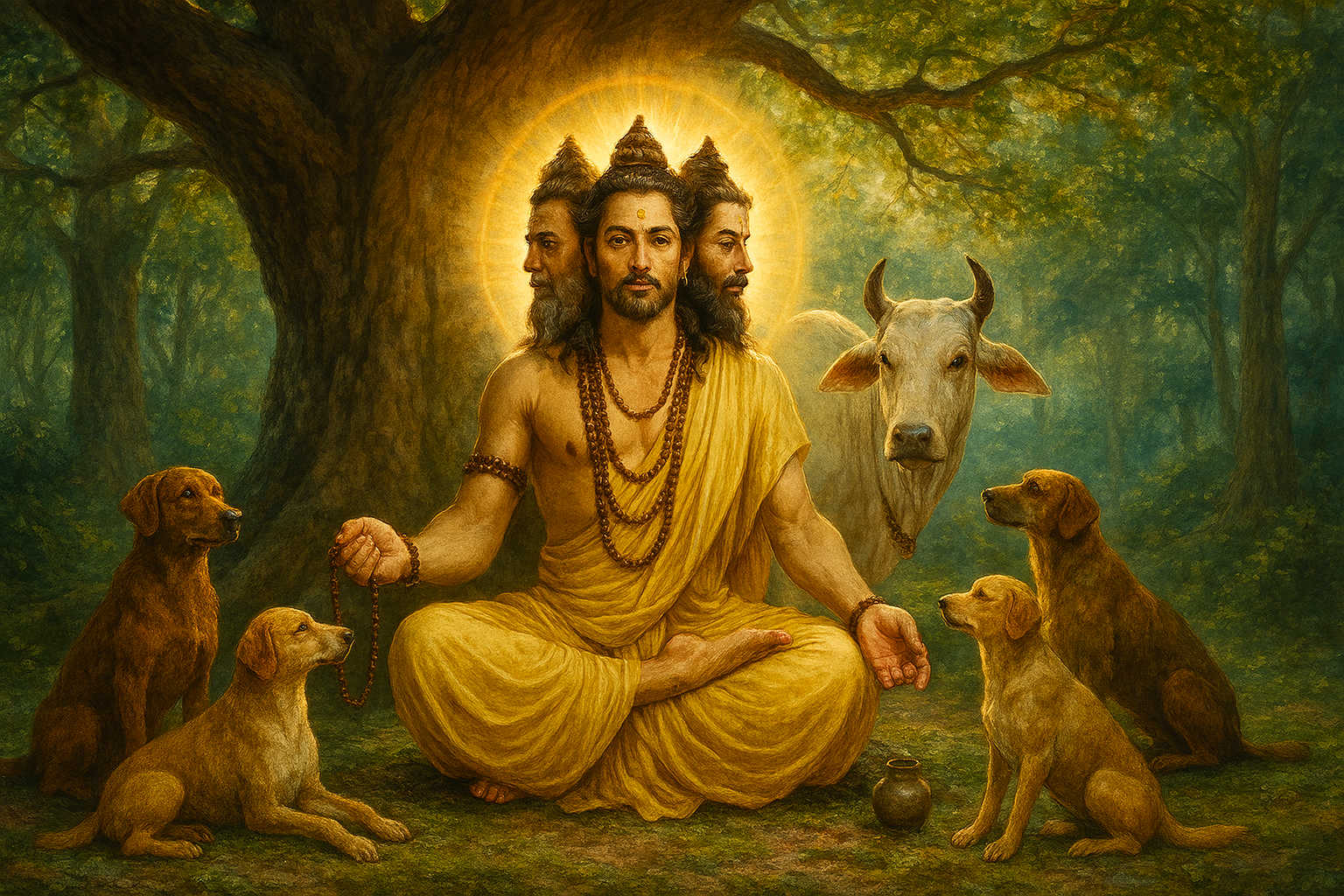
Lord Dattatreya – The Trimurti Avatar
In the vast and intricate tapestry of Sanatan Dharma, Lord Dattatreya stands out as a unique and fascinating figure. Unlike other deities who are manifestations of a single divine aspect, Dattatreya is considered the combined incarnation of the Hindu Trinity – Brahma (the Creator), Vishnu (the Preserver), and Shiva (the Destroyer). This makes him an embodiment of creation, sustenance, and dissolution, representing the complete cycle of existence.
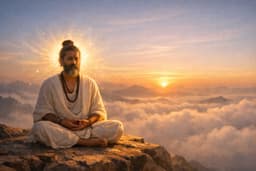
He is revered as the Adi Guru (the first spiritual teacher) and the patron of wisdom, renunciation, and the ultimate truth. His life and teachings form a deep spiritual foundation for seekers of liberation.
The Birth of Lord Dattatreya
The story of Dattatreya begins with Atri Rishi and his wife Anasuya, both renowned for their spiritual greatness. Anasuya was celebrated for her unparalleled devotion and chastity, so much so that the Trinity – Brahma, Vishnu, and Mahesh – decided to test her virtue.
According to legend, the three gods appeared before Anasuya disguised as mendicants and asked her to serve them food in a peculiar condition – she must do so without wearing any clothes. Bound by the principle of Atithi Devo Bhava (the guest is divine), and without compromising her chastity, Anasuya used her spiritual power to transform the three gods into infants. She then fed them with maternal love and fulfilled their wish without breaking her virtue.
Pleased with her wisdom and purity, the Trinity blessed her with a son who would embody all three of them. Thus, Dattatreya was born – Datta meaning “given” and Atreya referring to his lineage (son of Atri).
Iconography of Lord Dattatreya
Lord Dattatreya is often depicted as:
-
Three Faces: Representing Brahma, Vishnu, and Shiva.
-
Four Dogs: Symbolizing the four Vedas – Rigveda, Yajurveda, Samaveda, and Atharvaveda.
-
A Cow: Representing Mother Earth, the giver of sustenance.
-
Sacred Tree: Signifying eternal knowledge and rootedness in dharma.
-
Wanderer with Kamandalu and Veena: Emphasizing renunciation and divine music.
This imagery reveals his role as the ultimate Guru who draws wisdom from nature and teaches selfless living.
The Teachings of Dattatreya
Lord Dattatreya is regarded as the founder of the Avadhuta Tradition, a path of total detachment and realization of the Self. His key teachings can be found in texts like Avadhuta Gita and Guru Gita. Some core principles include:
-
Renunciation (Vairagya): True happiness lies beyond material possessions and ego.
-
Unity of All Beings: Everything is an expression of the same universal consciousness.
-
Self-Knowledge: Liberation (Moksha) is attained through self-realization, not rituals.
-
Guru Tattva: The importance of a spiritual guide and surrender to the divine.
Dattatreya and His 24 Gurus
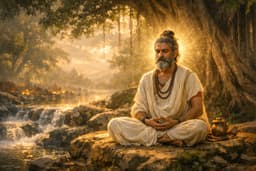
One of the most remarkable aspects of Dattatreya’s philosophy is his acknowledgment of 24 gurus from nature. He learned lessons from rivers, mountains, animals, and even insects. For example:
-
From Earth, he learned patience and forbearance.
-
From Water, he learned purity.
-
From a Spider, he learned about creation and dissolution.
This perspective teaches that wisdom is everywhere for those who seek with humility.
Role in Spiritual Traditions
Lord Dattatreya is a central figure in several spiritual traditions, particularly:
-
Nath Sampradaya: The lineage of yogis, including great saints like Matsyendranath and Gorakshanath.
-
Avadhuta Tradition: A philosophy of absolute non-duality and freedom.
-
Bhakti Paths: He is revered in Maharashtra, Gujarat, Karnataka, and Andhra Pradesh as a compassionate deity.
His presence transcends ritualistic religion, guiding seekers toward ultimate truth.
Sacred Places of Dattatreya Worship
There are numerous temples dedicated to Dattatreya, especially in Western and Southern India. Notable pilgrimage sites include:
-
Ganagapur (Karnataka)
-
Audumbar (Maharashtra)
-
Girnar (Gujarat)
-
Pithapuram (Andhra Pradesh)
These places are associated with his miracles and teachings, attracting thousands of devotees who seek spiritual upliftment.
The Spiritual Significance of Dattatreya
The concept of Lord Dattatreya teaches us an essential truth: the divine is not separate from us. By integrating the principles of creation (Brahma), preservation (Vishnu), and dissolution (Shiva) within ourselves, we can live harmoniously and progress toward liberation.
His life also breaks rigid notions of spirituality. Unlike ascetics who shun society, Dattatreya wandered among people, teaching through simplicity and universal love. His philosophy embraces both renunciation and inner joy.
Relevance in Modern Life
In today’s world of stress and materialism, Dattatreya’s message is a beacon of light:
-
Live simply and consciously.
-
Learn from nature.
-
Practice humility and gratitude.
-
Understand that true wealth lies in inner peace, not possessions.
Conclusion
Lord Dattatreya is not just a deity but an eternal principle that combines knowledge, devotion, and renunciation. His story inspires seekers to rise above dualities and realize the oneness of existence. By chanting his name and following his teachings, one can overcome ignorance and experience the bliss of self-realization.