King Harishchandra – The Ultimate Truth
Among the countless legends of truth and righteousness in Indian mythology, the story of King Harishchandra stands at the pinnacle. Known as Satyavadi Harishchandra, he was a king who valued truth above all else, even more than his kingdom, family, and personal comfort. His unwavering commitment to honesty and dharma makes this tale timeless and deeply inspirational.
The Noble King of Ayodhya
Harishchandra was the illustrious ruler of Ayodhya, celebrated for his fairness, compassion, and adherence to righteousness. Under his rule, the kingdom flourished, and the people lived in peace and prosperity. His reputation for truthfulness spread far and wide. It was said that Harishchandra never uttered a lie—even unintentionally.
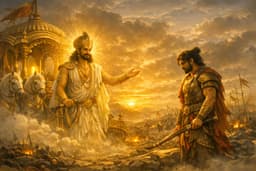
This steadfastness attracted the attention of the gods, who decided to test him. Vishwamitra, the great sage, played a central role in this divine test of character.
The Sage’s Demand
One day, Sage Vishwamitra approached King Harishchandra during a yajna (sacred ritual). The king welcomed him with respect and asked how he could serve the sage. Vishwamitra, wishing to test the king’s devotion to truth, asked for a dakshina (gift).
Harishchandra agreed without hesitation, saying, “O revered sage, I shall give you whatever you desire.” Smiling, Vishwamitra demanded the entire kingdom as his gift. True to his word, Harishchandra immediately gave away his empire, leaving himself with nothing.
But the sage wasn’t done. He declared that the king must also pay dakshina for the donation itself—a traditional practice. Harishchandra, with no wealth left, promised to arrange the payment. Vishwamitra gave him a short deadline to fulfill the promise.
Exile and Hardship
To keep his word, Harishchandra left Ayodhya with his wife Taramati and their little son Rohitashva. They wandered across forests, enduring hunger and fatigue. Finally, they reached Kashi (Varanasi), where Harishchandra hoped to find work.
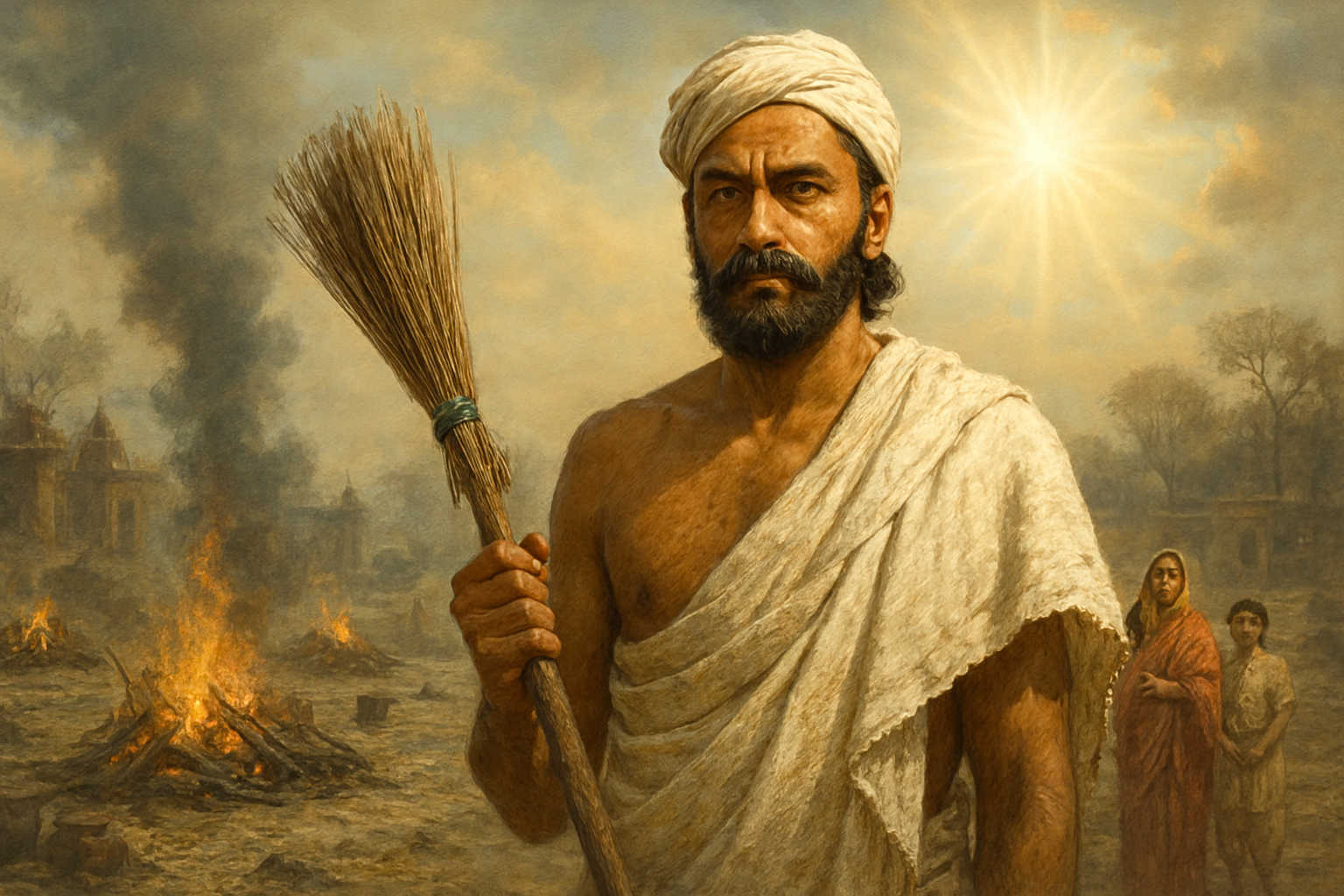
In Kashi, he approached Vishwamitra again, but the sage demanded the promised fee immediately. Unable to pay, Harishchandra agreed to sell himself as a servant. A man engaged him as a worker at the cremation ground, where his duty was to collect fees from those bringing dead bodies for cremation.
Taramati, too, sold herself to a Brahmin family to survive, while Rohitashva helped his mother in her chores.
The Supreme Test
One day, tragedy struck. Rohitashva was bitten by a snake and died. Grief-stricken, Taramati carried her son’s body to the cremation ground where Harishchandra worked. The scene was heart-wrenching: a mother bringing her dead child, a father duty-bound to demand the cremation fee.
Even in this moment of unbearable sorrow, Harishchandra did not abandon his principles. He told Taramati, “I cannot perform the rites without the fee, for it is my duty.” But she had nothing to give except her sari. Harishchandra, torn between his role as a father and his duty as a servant, stood firm on truth.
The Divine Revelation
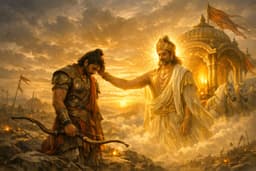
As Taramati prepared to tear her last piece of cloth to pay the fee, the heavens resounded with divine voices. Lord Vishnu, Indra, and the gods appeared with Vishwamitra, revealing that all this was a test of Harishchandra’s integrity.
The gods praised his steadfastness, declaring, “You are the embodiment of truth.” Rohitashva was restored to life, Harishchandra’s kingdom was returned, and he and his family were honored in heaven for their unparalleled virtue.
Significance of the Story
The story of Harishchandra teaches eternal values that transcend time:
-
Truth Above All: Harishchandra valued truth even in the face of unimaginable suffering.
-
Unwavering Dharma: He fulfilled his duties as a king, husband, father, and servant without compromising righteousness.
-
Sacrifice for Principles: True integrity often demands great personal sacrifice.
Cultural Legacy
This tale has been immortalized in literature, theater, and cinema. The legendary filmmaker Dadasaheb Phalke made Raja Harishchandra in 1913, which became the first full-length Indian feature film. Even today, Harishchandra’s name is synonymous with honesty and moral strength.
Modern Relevance
In a world filled with moral compromises, the story of Harishchandra reminds us that truth may be difficult, but it is never futile. Standing by one’s principles, even in adversity, builds character and leaves a lasting legacy.
Conclusion
King Harishchandra’s life is a beacon of truth and righteousness, inspiring generations to walk the path of virtue. His story is not just a myth; it is a moral compass, urging us to uphold honesty, come what may.