Savitri and Satyavan – Defeating Death
Among the many tales of love, courage, and determination in Hindu mythology, the story of Savitri and Satyavan stands as a shining example of unwavering devotion and wisdom. This tale, narrated in the Mahabharata, portrays how a devoted wife, through her intelligence and steadfastness, defeats Yama, the god of death, and brings her husband back to life. It is celebrated as a symbol of marital loyalty and moral strength, making it one of the most revered legends in Indian tradition.
The Birth of Savitri
Savitri was born to King Ashwapati, the ruler of Madra. The king, despite being virtuous, had no children for a long time. He performed intense penance to please the goddess Savitri, who blessed him with a daughter. The child was named Savitri in honor of the goddess.
From a young age, Savitri grew into an extraordinarily beautiful and intelligent woman. Her radiance was so dazzling that men felt hesitant to approach her for marriage. Realizing this, King Ashwapati allowed Savitri to choose her own husband, sending her on a journey of Swayamvara.
Meeting Satyavan
During her quest, Savitri traveled to the forest, where she met Satyavan, the son of the exiled king Dyumatsena. Satyavan lived a humble life in the forest, devoted to his parents and performing his duties with grace and strength. His noble character and simplicity captured Savitri’s heart instantly.
However, when Savitri informed her father and the royal sages about her choice, the wise Narada intervened. He revealed a grave truth: Satyavan was destined to die within a year from the day of their marriage. The prophecy was certain and unchangeable.
King Ashwapati pleaded with his daughter to reconsider, but Savitri stood firm. She declared, “Once I have chosen, I will not choose again.” Her decision was final.
Marriage and the Fateful Day
Savitri married Satyavan and left the palace life behind to live in the forest. She adapted gracefully to the austere lifestyle, serving her in-laws with devotion and supporting Satyavan in all his duties.
As the predicted day approached, Savitri observed severe penance and fasting for three days, praying silently for her husband’s well-being. On the fateful day, she accompanied Satyavan into the forest, staying by his side as he chopped wood. Suddenly, Satyavan felt dizzy and lay down with his head on Savitri’s lap. As his life ebbed away, Savitri knew the prophecy was coming true.
The Arrival of Yama
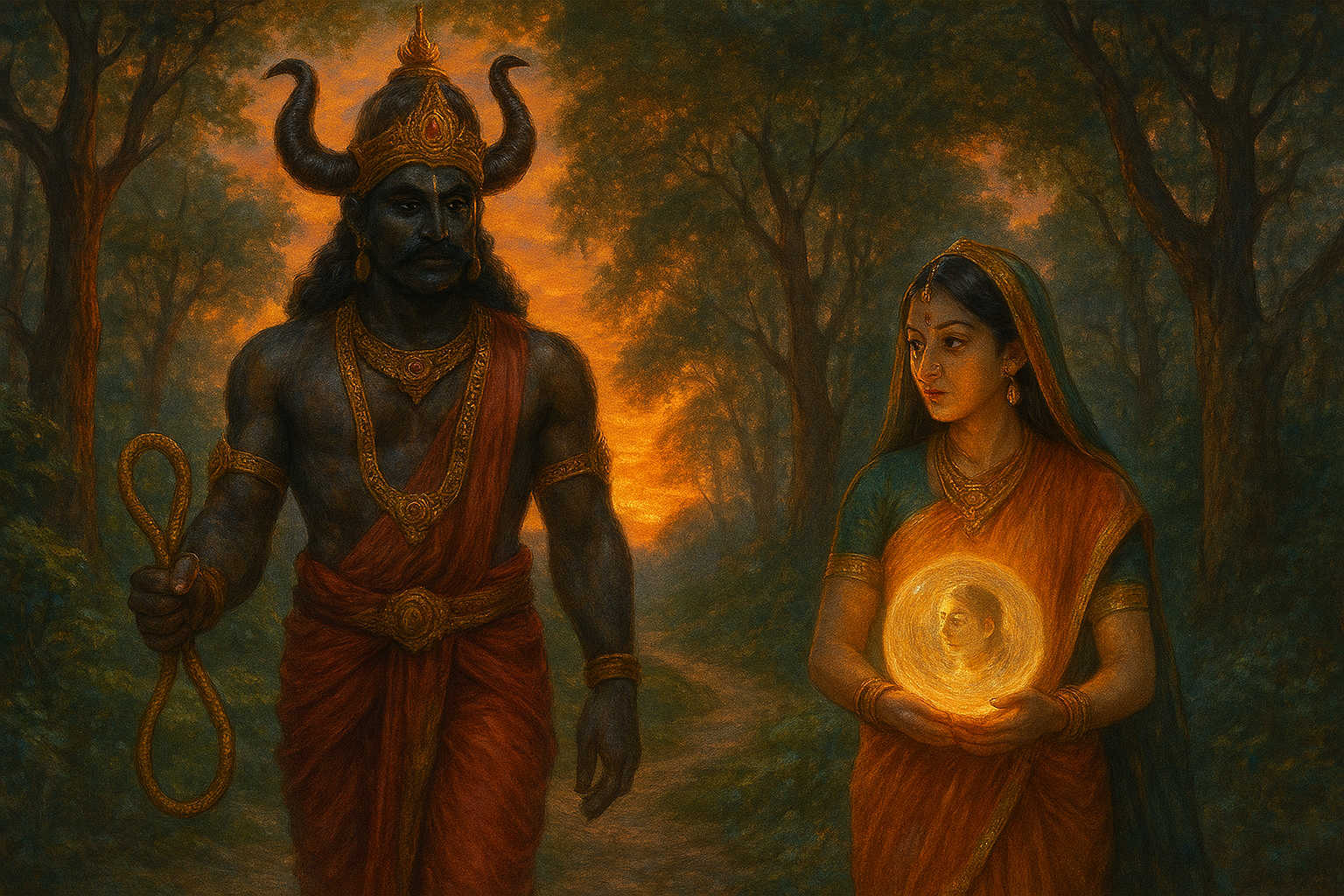
At that moment, Yama, the god of death, appeared in his majestic form, carrying a golden noose. Calmly, he drew out Satyavan’s soul and began to depart toward the realm of the dead. But Savitri, undaunted by fear, rose and followed him.
Yama turned and said, “O princess, return now. Your duty is over. Your husband’s life on earth has ended.”
But Savitri replied with humility and resolve, “Where my husband goes, there I shall go. It is my dharma as a wife to follow him.”
Impressed by her loyalty, Yama granted her a boon—anything except Satyavan’s life. Savitri asked for her father-in-law’s eyesight to be restored. Yama agreed and continued his journey. Savitri still followed.
The Dialogue of Wisdom
As they walked, Savitri engaged Yama in a profound conversation about dharma, virtue, and the duties of life. Her wisdom and composure amazed the god of death. He granted her another boon. Savitri asked for her father-in-law’s kingdom to be restored. Yama granted it.
Yet Savitri did not stop. She walked behind Yama, speaking gently and wisely, praising righteousness and the path of truth. Again, Yama, pleased with her devotion, offered a third boon. Savitri asked for a hundred sons for her father. Yama agreed.
But Savitri continued to follow. Yama granted a fourth boon. This time, Savitri asked for a hundred sons for herself and Satyavan. Yama granted it—before realizing what this meant. To fulfill this boon, Satyavan had to live.
Finally, smiling, Yama said, “Wise and devoted lady, I cannot defeat you in this game of virtue and cleverness. Take back your husband’s life.” He blessed her and disappeared.
The Return to Life
Savitri hurried back and found Satyavan awakening as if from a deep sleep. Together, they returned to the hermitage, where news came that Dyumatsena had regained his sight and soon reclaimed his lost kingdom. Every word of the boons had come true.
Significance of the Tale
The story of Savitri and Satyavan is celebrated as a victory of devotion, intelligence, and determination over destiny. It teaches several timeless lessons:
-
The Power of Dharma: True virtue and adherence to righteousness can influence even divine forces.
-
Strength of a Woman’s Will: Savitri’s courage and wisdom show the strength inherent in devotion and love.
-
Patience and Intelligence: Her calm reasoning and strategic requests changed the course of fate.
In Indian tradition, this tale is commemorated as Vat Savitri Vrat, where married women pray for the long life of their husbands, following Savitri’s example.
Modern Relevance
Even today, Savitri’s story inspires millions as an example of faith coupled with wisdom. It teaches that while fate may seem inevitable, determination, virtue, and intelligence can create miracles.
Conclusion
Savitri and Satyavan’s tale is not just a love story—it is a testament to moral courage and unwavering devotion. It reminds us that true strength lies not in defying death through power, but in upholding virtue and love with unwavering resolve.