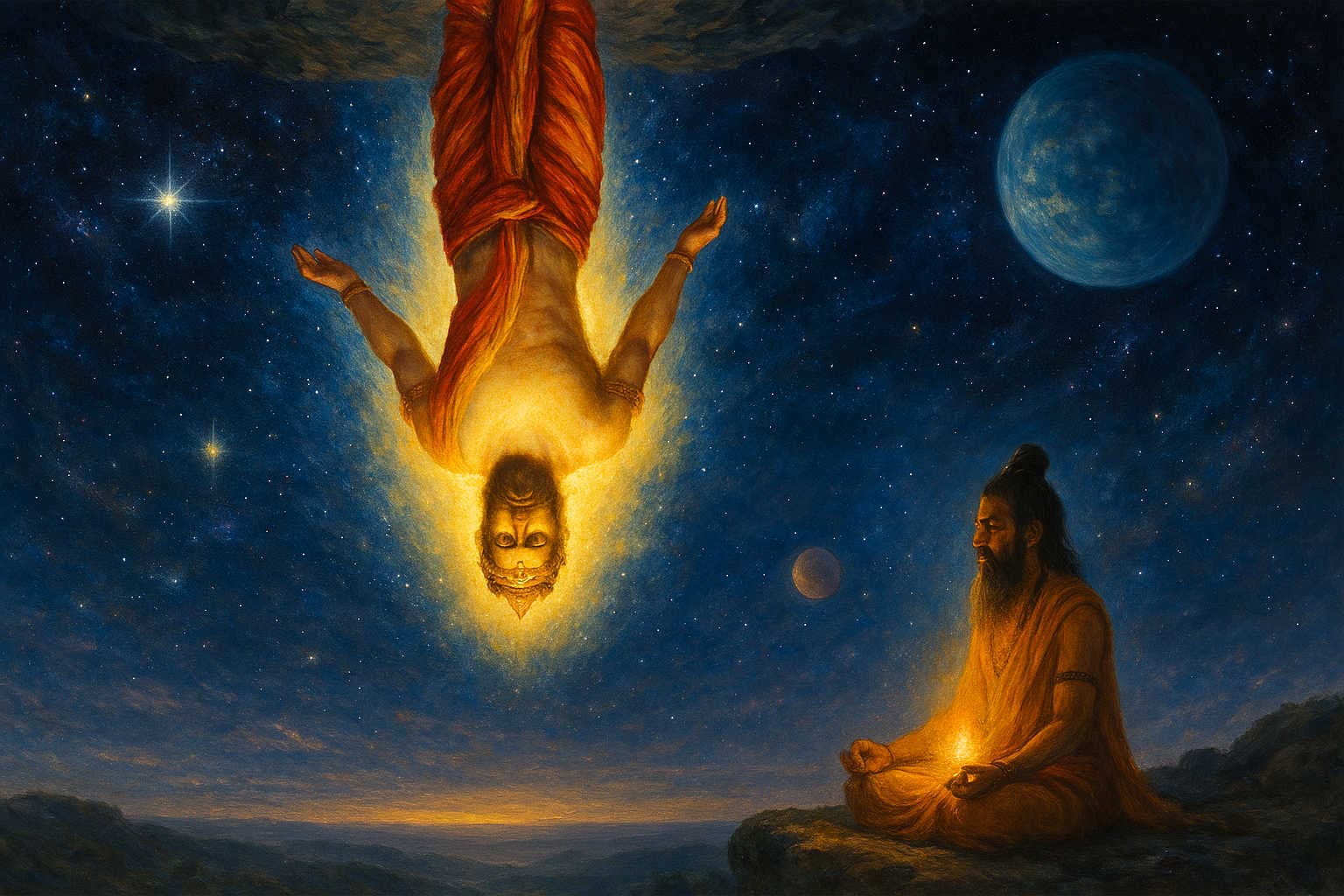
Trishanku Swarga – The Suspended Heaven
Hindu mythology is filled with tales of ambition, power, and the consequences of desire. One such captivating story is that of Trishanku Swarga, the “suspended heaven,” where a mortal king’s yearning to ascend to heaven in his physical body led to an extraordinary cosmic event. This tale beautifully illustrates the conflict between human ambition and divine law, as well as the immense power of sages in ancient times.
Who Was Trishanku?
Trishanku was a king from the Solar Dynasty (Suryavansha), known for his bravery and valor. Despite being a virtuous ruler, he harbored an unusual and audacious desire—he wished to ascend to Swarga Loka (Heaven) in his physical body, not just his soul after death. Traditionally, only the soul enters heaven after performing righteous deeds and attaining liberation. This rule was considered inviolable by the gods.
Trishanku, however, wanted to defy this law. His desire for glory and immortality in heaven sparked one of the most famous confrontations between the devas (gods) and human willpower, aided by a determined sage.
The King’s Ambition and Vashistha’s Refusal
To fulfill his wish, Trishanku approached his family priest and the revered sage Vashistha, one of the Saptarishis (seven great sages). He requested the sage to perform a yajna (sacrificial ritual) that would send him to heaven with his body intact. Vashistha, however, refused firmly. He explained that the laws of nature and dharma cannot be altered to satisfy personal desires. Heaven was not meant for mortal bodies.
Humiliated and rejected, Trishanku’s ambition turned into desperation. He then sought the sons of Vashistha, hoping they would assist him, but they too refused, considering his wish unnatural. Enraged, Trishanku insulted them, which led the sons to curse him, turning him into a Chandala (outcast). Trishanku’s downfall was swift and severe—he lost his royal status and became an untouchable.
The Meeting with Vishwamitra
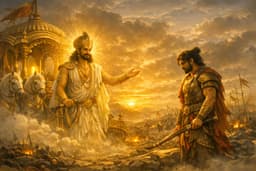
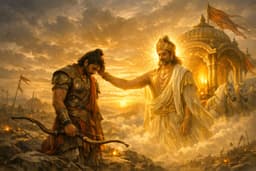
Cast out of society, Trishanku wandered in despair until he met Sage Vishwamitra, a powerful rishi known for his fiery temperament and determination. Unlike Vashistha, Vishwamitra had once been a king himself, so he understood Trishanku’s pride and humiliation. Moved by his plight and eager to assert his own supremacy over Vashistha, Vishwamitra promised to help Trishanku achieve his dream.
This was not just an act of compassion; it was also a test of Vishwamitra’s spiritual might. He declared boldly:
"I shall create a new heaven for you if necessary!"
The Great Yajna and Cosmic Dispute
Vishwamitra began a powerful yajna to send Trishanku to heaven in his physical form. His tapas (austerity) and chanting shook the three worlds. Through sheer force of will and mantra power, Vishwamitra propelled Trishanku’s body upward toward Swarga. The king soared through the skies, his heart swelling with triumph.
However, the devas, led by Indra—the king of gods—were alarmed. They saw this as a violation of cosmic law. Before Trishanku could enter heaven, Indra blocked his path and hurled him down, declaring:
"No mortal shall enter heaven in the body!"
The Suspended State – Trishanku Swarga
As Trishanku fell helplessly from the sky, he cried out to Vishwamitra for help. Enraged, the sage commanded:
"Stop there, Trishanku! Remain where you are!"
Through his immense yogic power, Vishwamitra halted Trishanku mid-air, suspended between heaven and earth. Then, in a display of supreme creative energy, Vishwamitra began creating a new heaven in the space where Trishanku was hanging. He summoned new stars, planets, and celestial realms, declaring that this new heaven would belong to Trishanku forever.
Alarmed by Vishwamitra’s audacity, the devas intervened. They feared that if the sage completed this new cosmos, the balance of the universe would collapse. After intense negotiation, the gods reached a compromise: Trishanku would remain suspended upside down in the sky for eternity, visible as a constellation, but he would not enter heaven.
Thus, Trishanku Swarga—the suspended heaven—came into being, symbolizing both human ambition and the unyielding laws of the cosmos.
The Deeper Meaning of Trishanku’s Tale
The story of Trishanku is layered with profound lessons:
-
Ambition vs. Dharma: Trishanku’s desire to defy natural law shows how unchecked ambition leads to suffering.
-
Power of Tapas: Vishwamitra’s ability to challenge the gods illustrates the immense spiritual power of austerity and will.
-
Compromise and Balance: The ultimate resolution highlights the importance of balance in the universe.
-
Symbolism of the Stars: Some traditions associate Trishanku with a constellation, reminding us of his eternal suspended state.
Spiritual Interpretation
On a spiritual level, Trishanku represents the ego that refuses to accept limitations. His desire for physical immortality mirrors humanity’s struggle to conquer death. Vishwamitra’s role shows that even great sages can be driven by pride and rivalry, while the devas represent the immutable laws of existence.
Legacy of Trishanku Swarga
Today, the phrase “Trishanku Swarga” is commonly used in Indian languages to describe a situation where someone is caught between two states—neither here nor there. It is a metaphor for being suspended in uncertainty, just like King Trishanku who hung between heaven and earth for eternity.
Conclusion
The story of Trishanku Swarga is not just a myth—it’s a timeless reflection on the limits of desire, the power of penance, and the balance of cosmic order. It teaches us that while human willpower can achieve the impossible, there are boundaries set by nature that even the greatest cannot fully overcome.