Tulsi and Vishnu – A Story of Devotion
The story of Tulsi (Vrinda) and Lord Vishnu is one of the most revered tales in Hindu mythology. It is a narrative that intertwines devotion, love, sacrifice, and divine grace, explaining why the Tulsi plant (Holy Basil) is considered sacred and why it holds a central place in Hindu households and rituals.
Who Was Tulsi (Vrinda)?
Tulsi, also known as Vrinda, was an incarnation of Goddess Lakshmi, born on earth to fulfill a divine purpose. She was renowned for her unparalleled beauty, purity, and unwavering devotion to Lord Vishnu. Her name itself signifies virtue and sanctity.
Vrinda was married to Jalandhar, a powerful demon who had gained immense strength through her chastity and devotion. His invincibility made him a serious threat to the gods. Protected by Vrinda’s virtue, Jalandhar became arrogant and waged war against the devas, causing havoc across the three worlds.
The Problem for the Gods
The gods were helpless because Jalandhar’s strength was directly tied to Vrinda’s fidelity and her deep devotion. As long as her chastity remained unbroken, Jalandhar was invincible. The devas prayed to Lord Vishnu for help.
Vishnu assured them that dharma must be restored and devised a plan, though it would come with great sorrow for Vrinda.
The Deception by Lord Vishnu
While Jalandhar fought a fierce battle with the devas, Vrinda was at home performing penance for her husband’s safety. Her mind and heart were completely absorbed in his well-being.
To break Jalandhar’s protection, Lord Vishnu disguised himself as Jalandhar and appeared before Vrinda. Seeing who she thought was her husband, Vrinda welcomed him with love and devotion. However, the moment she touched Vishnu in disguise, her chastity was considered broken.
At that very instant, Jalandhar lost his divine protection on the battlefield and was slain by Lord Shiva.
Vrinda’s Heartbreak and Curse
When Vrinda realized the truth—that it was not her husband but Lord Vishnu in disguise—she was devastated. Her faith shattered, and her grief turned into anger. She cursed Vishnu, saying:
“Just as you deceived me, you shall also suffer the pain of separation from your wife.”
This curse manifested in the future as Lord Rama’s separation from Sita during his incarnation in the Ramayana.
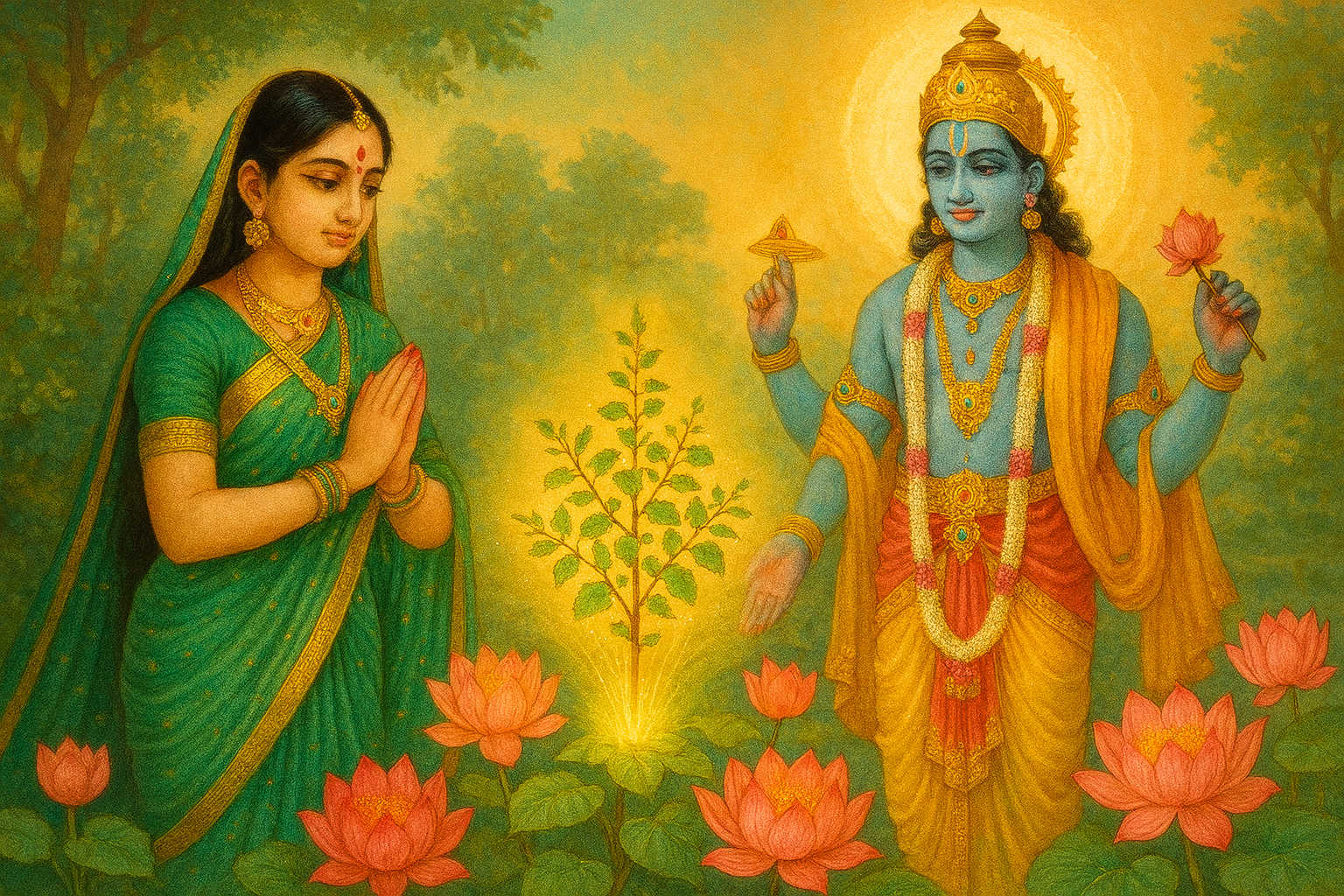
After uttering the curse, Vrinda immolated herself in the fire of grief and devotion. Her spirit returned to the divine realm, but her love and sanctity transformed into a sacred plant—the Tulsi plant.
The Transformation of Tulsi
To honor her devotion, Lord Vishnu declared that Vrinda would be worshipped forever in the form of the Tulsi plant. He blessed her, saying:
“No worship of mine shall be complete without the offering of Tulsi leaves.”
Thus, Tulsi became an inseparable part of Vishnu worship and is considered the queen of herbs in Hindu tradition.
The Divine Marriage of Tulsi and Vishnu
The story does not end with Vrinda’s transformation. On Tulsi Vivah, a sacred festival celebrated in the month of Kartik (October–November), devotees commemorate the symbolic marriage of Tulsi (as the plant) and Lord Vishnu (in the form of the Shaligram stone or Krishna idol). This marks the beginning of the Hindu wedding season.
The festival signifies that Tulsi, who once cursed Vishnu in grief, was ultimately united with him in divine harmony.
Symbolism of the Story
The story of Tulsi and Vishnu carries profound spiritual meaning:
-
Devotion and Purity – Vrinda’s chastity was so powerful that it granted divine protection.
-
Sacrifice for Dharma – Vrinda’s personal tragedy restored cosmic balance.
-
Sanctity of Tulsi – The plant is a symbol of purity, protection, and prosperity in Hindu homes.
-
Power of Karma – Even Lord Vishnu accepted Vrinda’s curse as a part of divine play.
Tulsi in Hindu Rituals
-
Tulsi leaves are offered to Vishnu and Krishna during worship.
-
They are essential for Tulsi Vivah, marking the union of Tulsi and Vishnu.
-
Consuming Tulsi is considered auspicious and spiritually cleansing.
-
The plant is often grown in courtyards, signifying prosperity and protection.
Lessons from the Tale
-
True Devotion Has Power – Vrinda’s devotion made Jalandhar invincible, showing the strength of faith.
-
Sacrifice Restores Dharma – Her personal loss ensured the triumph of righteousness.
-
Forgiveness and Grace – Despite her curse, Vishnu blessed Vrinda with eternal honor.
-
Life Beyond Form – Vrinda’s spirit lives on as Tulsi, revered for eternity.
Conclusion
The story of Tulsi and Lord Vishnu is a timeless reminder of devotion, sacrifice, and divine justice. It explains why Tulsi is not just a plant but a manifestation of faith and purity. Every time a devotee offers Tulsi leaves to Vishnu, they honor Vrinda’s unwavering devotion and the eternal bond between the divine and the devotee.