Shiva Drinking Poison – Neelkanth
The story of Lord Shiva drinking poison during the Samudra Manthan (Churning of the Ocean) is one of the most captivating episodes from Hindu mythology. This incident not only earned Him the name Neelkanth—“The Blue-Throated One”—but also highlights His supreme sacrifice for the welfare of the universe.
The Samudra Manthan – The Churning of the Ocean
The tale begins with the Devas (gods) and Asuras (demons) deciding to churn the Kshira Sagara (Ocean of Milk) to obtain Amrit (nectar of immortality). They sought guidance from Lord Vishnu, who advised them to use Mount Mandara as the churning rod and Vasuki, the serpent king, as the churning rope.
The churning began, and as they pulled Vasuki back and forth, countless divine treasures and beings emerged from the ocean—Kamadhenu, Airavata, Kalpavriksha, Lakshmi Devi, and many others. However, along with these boons came something dangerous—Halahala, a deadly poison with the power to destroy all creation.
The Emergence of Halahala
The poison was so toxic that its mere fumes threatened to annihilate the three worlds—Heaven, Earth, and the Netherworld. The Devas and Asuras were horrified. Neither could they continue churning, nor could they let the poison spread, for it would end all existence.
In their panic, they rushed to Lord Brahma and Lord Vishnu for help. Both declared that only one being in the universe had the power to contain such venom—Lord Shiva, the Mahadeva, the supreme protector of cosmic balance.
The Appeal to Lord Shiva
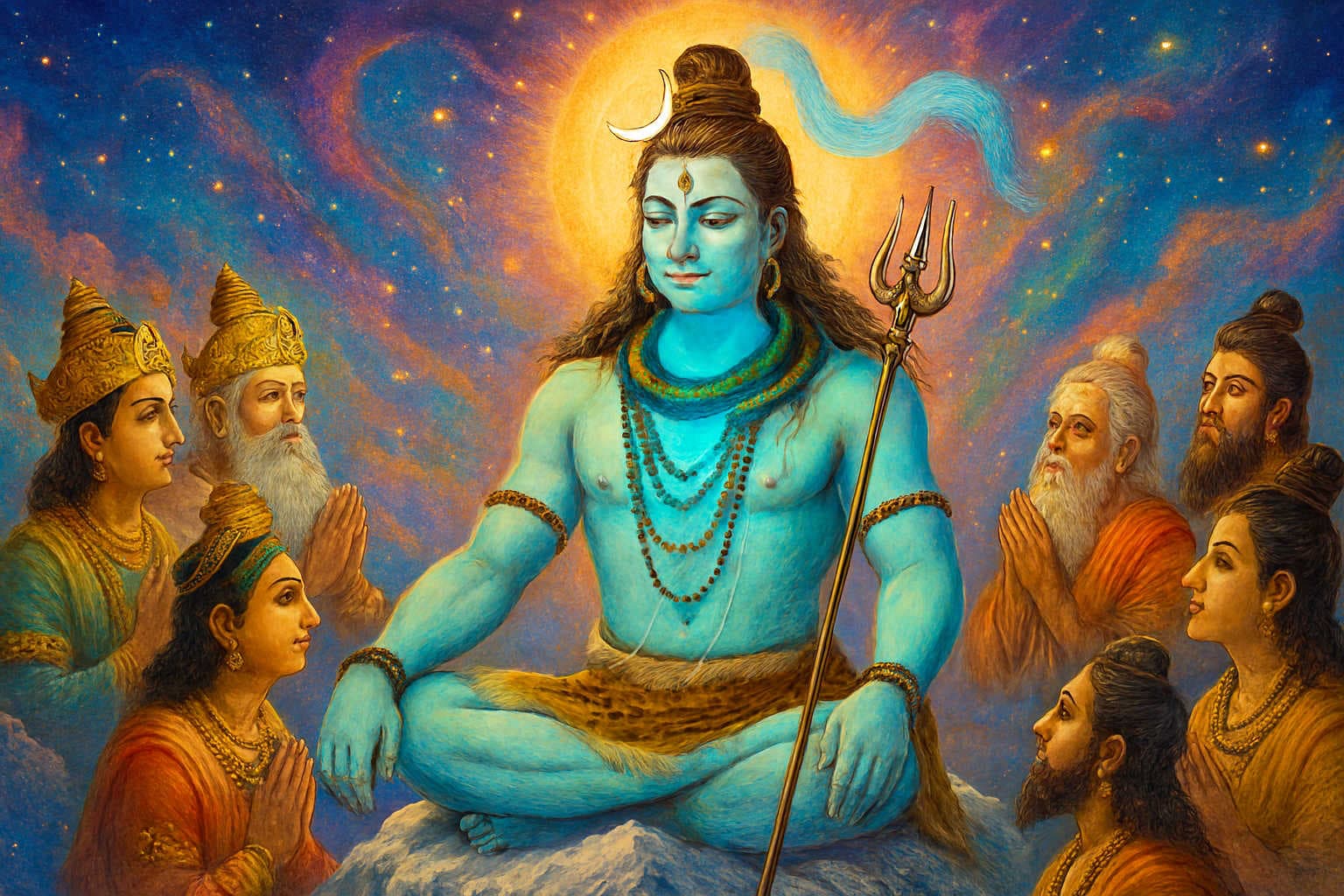
The Devas and Asuras hurried to Mount Kailash, where Lord Shiva was deep in meditation, surrounded by the serene Himalayas. They humbly bowed before Him and said:
"O Lord, the ocean has produced a deadly poison called Halahala. Its fumes are destroying the worlds. Only You can save us. Please rescue creation from this calamity."
Hearing their plea, Shiva’s heart melted with compassion. For Him, the welfare of the universe was always above His own well-being. Without a moment’s hesitation, He agreed to take the poison upon Himself.
Shiva Drinks the Deadly Poison
Lord Shiva approached the churning site and, with His immense power, gathered the Halahala poison into His palms. Every being watched in awe as He swallowed the venom to protect the universe from certain destruction.
However, as soon as He drank it, the poison began to spread within His body. To prevent it from harming Him, Goddess Parvati, His consort, pressed His throat, stopping the poison from descending into His stomach. This caused the poison to remain in His throat, turning it deep blue. From that moment, Shiva became known as Neelkanth—“The Blue-Throated One.”
The Reactions of the Universe
The entire cosmos trembled in fear when Shiva drank the poison. The gods, sages, and celestial beings began to sing hymns and prayers, praising His unmatched sacrifice and valor. The moon (Chandra) offered its coolness by adorning His matted hair, and the Ganga River flowed from His locks to soothe Him.
This act of drinking the poison elevated Shiva’s status as the supreme protector and destroyer of evil, the one who would go to any extent to preserve balance and harmony in creation.
Why Didn’t the Poison Kill Shiva?
Lord Shiva is Mahadeva, the great God, who transcends life and death. His divine nature made Him capable of containing such immense power without being destroyed. However, the poison was so potent that it left a permanent mark—His blue throat, symbolizing the magnitude of His sacrifice.
Symbolism of the Neelkanth Story
The story of Shiva as Neelkanth is rich in symbolism:
-
Poison as Negativity – Halahala represents anger, jealousy, and hatred that can destroy us if left unchecked.
-
Shiva as the Absorber of Negativity – Just as Shiva contained the poison, we too must learn to absorb negativity without letting it harm our inner self.
-
Parvati as Consciousness – She symbolizes awareness that prevents negativity from spreading deeper into our being.
-
Blue Throat as Transformation – The blue color signifies transformation, teaching us that challenges can be turned into strengths.
Spiritual Lessons
-
Sacrifice for the Greater Good – True greatness lies in putting others before oneself.
-
Detachment and Strength – Even while facing danger, Shiva remained calm, teaching us inner strength.
-
Managing Toxicity – Just as the poison was contained in the throat, we must learn to contain and neutralize negativity rather than spreading it.
Worship of Neelkanth
Devotees honor Shiva as Neelkanth, especially during Maha Shivaratri, a festival celebrating His glory and cosmic role. Pilgrimages to Neelkanth Mahadev Temple in Rishikesh and other sacred sites are popular among Shiva devotees. Many offer water, milk, and Bilva leaves to Shiva Lingams, chanting “Om Namah Shivaya” for spiritual purification.
Conclusion
The tale of Shiva drinking poison during Samudra Manthan is not just a mythological episode but a profound lesson in sacrifice, compassion, and inner strength. It teaches us that life will present challenges—symbolic poisons—but with courage, awareness, and selflessness, we can transform them into spiritual growth.
Lord Shiva as Neelkanth reminds us that greatness is not in avoiding difficulties but in facing them for the greater good of all.